
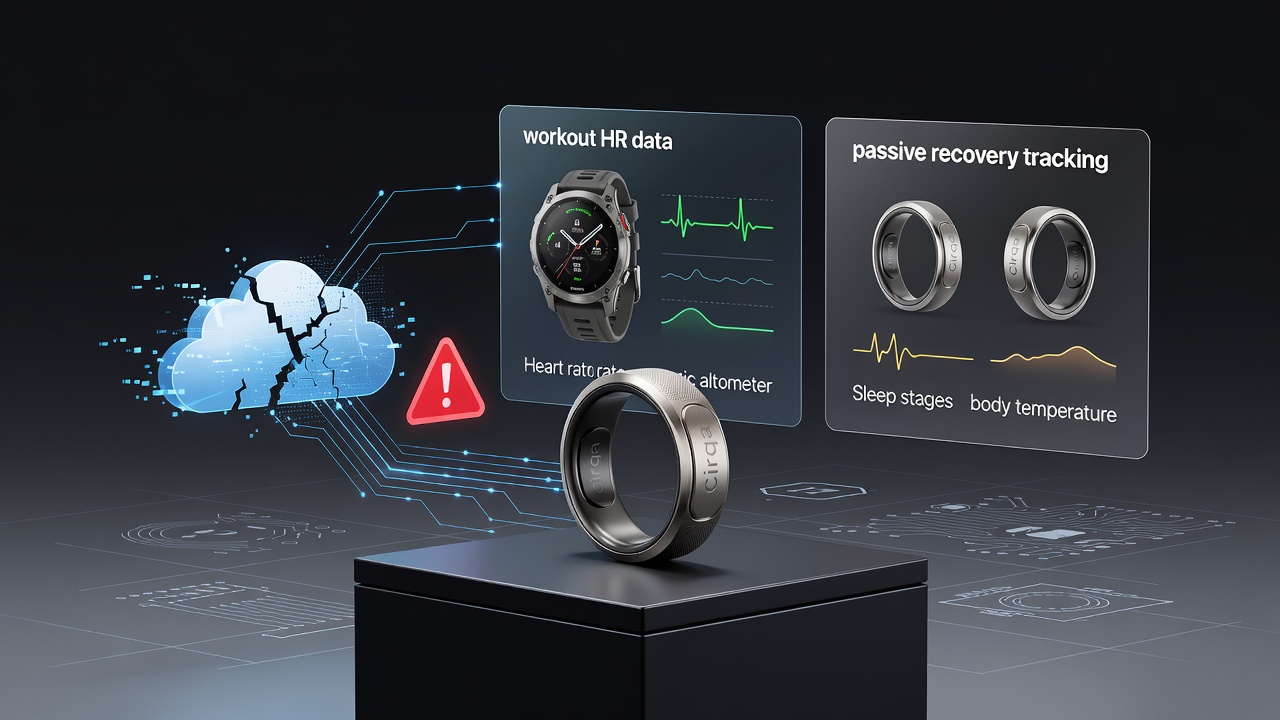
Garmin just tipped its hand. A product page for the Cirqa, a screenless wearable positioned as a direct rival to Google’s upcoming Fitbit Air, appeared briefly on the company’s own regional websites this week. The pricing data pulled straight from Garmin’s backend. No rumors. No retailer slips. Just raw numbers: $199.99 in the US, £179 in the UK, and €199 across Europe.
That’s far below the $500 tag that had been floating around earlier this year. And it lands at a moment when the wearables market has split between bulky watches that track every workout and slim rings that monitor sleep without getting in the way. But. The accompanying images raise eyebrows. They look off. Different designs between the app screenshot and the marketing render. Details don’t quite match. Some observers suspect AI generation.
Yet the pricing holds up under scrutiny.
TechRadar first spotted the slip and verified the part number 010-04675-00 by plugging it into Garmin’s pricing API. The response came directly from buy.garmin.com. Not a cache. Not a third-party listing. The data is real. (TechRadar)
This isn’t Garmin’s first recent leak. In January the company accidentally listed the CIRQA Smart Band on its US, Canada, and Brazil sites. That device targets the Whoop-style subscription-free band crowd. Now the Cirqa appears aimed at something lighter. Something you forget you’re wearing. Something that competes with the Fitbit Air’s promised minimalism.
Garmin has long resisted the smart-ring wave. Executives have argued publicly that watches deliver better data. Joe Schrick, Garmin’s VP of fitness, laid it out at the 2024 Garmin Health Summit in Prague. “The fidelity of the data on the wrist is going to be better because you have more power, you have more LEDs, you have more sensors, and you have more battery life,” he told Wareable. Scott Burgett, another Garmin technical leader, added that the wrist provides superior PPG waveform quality thanks to the extra real estate for lights and processing power. (Wareable)
Those comments came amid the rise of Oura, Ultrahuman, and Samsung’s Galaxy Ring. Garmin instead doubled down on its watch lineup. The Fenix 8, Venu 4, and Forerunner series all saw refreshes in 2025. Prices climbed. The company introduced Garmin Connect+ as a paid tier for advanced analytics. Yet it avoided finger-based devices entirely.
A December 2025 analysis spelled out why. Garmin holds zero US patents for ring-style wearables. Its Elevate heart-rate module simply doesn’t shrink well without losing accuracy during movement. Legal headaches add another barrier. Oura has pursued lawsuits against Samsung, Ultrahuman, Circular, and RingConn over intellectual property. Garmin prefers to steer clear. Instead it launched the Index Sleep Monitor, a thin band that captures full sensor data without the size constraints of a ring. (Gadgets and Wearables)
So why the Cirqa now? Market pressure, perhaps. Smart rings have carved out a niche. Oura dominates with its subscription model. A $5.99 monthly fee unlocks recovery scores, sleep staging, and long-term trends. Garmin customers expect to pay once and own the device. Wareable’s comparison laid bare the philosophical gap. Oura excels at passive health insights. Garmin watches crush active training metrics, GPS accuracy, and real-time coaching. (Wareable)
Recent tests highlight the accuracy trade-offs. Android Central ran heart-rate trials during gym sessions and runs. Garmin’s Venu 3 stayed locked on even at high intensities. Rings from Oura, Amazfit, and RingConn sometimes dipped or lagged when motion increased. The difference wasn’t catastrophic for casual users. For athletes chasing precise zones, it mattered. (Android Central)
The Verge’s 2024 roundup of six rings delivered a blunt verdict. Accuracy and polish separate winners from also-rans. The Oura Ring 3 topped the list. Samsung’s Galaxy Ring impressed on hardware but tied users to its ecosystem. Cheaper options from RingConn and Circular stumbled on syncing delays or inconsistent step counts. Battery life varied wildly. Some lasted nine days. Others needed charging every few. (The Verge)
Garmin’s entry, if the leak proves legitimate, could reset the conversation. A $200 price point undercuts most rings while dodging subscriptions. No monthly fee. Full integration with the Garmin Connect app that millions already use. Training load. Recovery time. Body battery. All the metrics serious athletes trust. And the screenless design promises comfort that even the slimmest watches can’t match.
But questions linger. Will the Cirqa include GPS? How long does the battery last? Does it track naps or only overnight sleep? The dubious images offer few clues. One version looks like a simple black band. Another shows subtle color accents. Features appear to differ. One might emphasize activity tracking. The other recovery. Until Garmin confirms, speculation fills the gap.
Timing adds intrigue. The Fitbit Air has been teased for months. Google’s hardware push in health has been uneven since the acquisition. A credible rival at half the expected cost could steal momentum. Meanwhile the broader ring category matures. Wareable’s 2026 buyer’s guide lists new models from RingConn, Ultrahuman, and Renpho. Prices range from $180 to nearly $500. Battery claims reach 15 days. Some add haptics or blood-pressure estimates. (Wareable)
Garmin brings something different to the fight. Decades of sports science. A massive user base of runners, cyclists, and multisport athletes. Reputation for reliability in harsh conditions. If the Cirqa delivers even 80 percent of a high-end watch’s metrics in a form factor you never remove, the appeal is obvious. Especially at that price.
Industry watchers note the shift. Garmin’s 2025 report card from Android Central praised its watch launches but questioned pricing strategy. The company raised MSRPs across the board. Fenix models pushed past $1,000. The Cirqa, by contrast, looks like a deliberate play for accessibility. A way to pull in new customers who find traditional watches cumbersome. (Android Central)
Of course leaks can mislead. The images’ questionable quality suggests someone may have mocked up concepts rather than final hardware. Garmin has removed the page. No official statement yet. But the pricing endpoint remains live in the system. That detail feels telling.
Competition in wearables has never been fiercer. Apple dominates casual users. Whoop owns the subscription recovery crowd. Oura sets the standard for rings. Garmin’s potential move blurs lines. A band that feels like a ring but thinks like a watch. Data quality without the wrist real estate penalty. Comfort without the subscription trap.
Analysts expect clarification soon. Garmin typically moves fast once a product surfaces in its own catalog. Spring or early summer launch windows have been common for lifestyle trackers. If the Cirqa ships at the leaked price, it forces every ring maker to reconsider positioning. Oura may highlight its clinical validation. Samsung may lean on Galaxy ecosystem perks. Budget brands will struggle to match Garmin’s software depth.
For now the leak does what leaks do best. It starts the conversation. It forces the company to address the speculation. And it hints that even the most watch-centric brand in fitness has noticed the quiet revolution happening on users’ fingers. The Cirqa may not be the first Garmin ring. It might not even be a ring at all. But its arrival would signal that the days of choosing between data power and daily comfort are numbered.
One thing is clear. At two hundred dollars, many athletes will listen.


 WebProNews is an iEntry Publication