

Key Takeaways
- In Malaysia, SEO is moving towards voice-based, AI-driven, and localised search.
- To remain credible, businesses need to focus on E-E-A-T (experience, expertise, authoritativeness, trust).
- Keyword stuffing is no longer as important as content quality, accessibility, and intent alignment.
- Search Generative Experience (SGE) will transform the way Malaysians search online.
- Single-channel strategies will not work as well as SMEs that combine SEO with social, content, and paid media.
Why The Future Of SEO In Malaysia Matters
The digital world in Malaysia is not merely evolving in 2025, but it is evolving at a rapid pace. Artificial intelligence, voice search, and hyper-local targeting are redefining the way consumers search, discover, and interact with brands. This change is a challenge and an opportunity for Malaysian business owners. Whether you manage your marketing in-house or work with an experienced SEO agency Malaysia businesses trust, understanding these shifts is crucial.
No matter how small your F&B establishment is in Johor Bahru or how large your e-commerce brand is nationwide, knowing where SEO is going will help you future-proof your marketing and grow in a sustainable manner.
This guide will dissect what SEO means to Malaysia in 2025, why it is still a factor and how you can adjust your business approach to what the search engines (and your customers) now expect.
SEO, and Why You Need It
SEO is an abbreviation that means Search Engine Optimisation, which is the act of enhancing your visibility in the organic search results. It entails technical, creative and analytical aspects that assist your content to reach the right people at the right time.
- SEO is one of the most affordable digital channels despite the emergence of paid advertisements and social commerce.
- A recent benchmark shows about 68% of online experiences begin with a search engine (Source: Ahrefs).
- This implies that unless your site is optimised to suit the current Malaysian mode of search, you are losing access to high quality customers looking to buy your product.

Alt text: A sad man looks as though he’s going to cry, as he holds a shopping bag.
The context of SEO in Malaysia has changed to be more than just a keyword-targeting approach and is now AI-based and intent-driven. Rather than the question being, “How can I rank this keyword?” the question now becomes, “How can I be the best answer to this search?” Such a change is what makes SEO in 2025.
The Relevance Of SEO To Malaysian Businesses Today
Increasing Local Search Competition.
- The ‘near me’ search boom has revolutionized the way businesses are found by Malaysians.
- Many Malaysians like to search for information like “hair salon near KSL”, or “lawyer in Kuala Lumpur” or “best nasi lemak in Penang”.
- Local SEO will decide which answers to these questions rank first on Google.
- It is now necessary to optimise for Google Maps, reviews, and regular business NAP (name, address, phone) information.
Current consumer research shows people search multiple times per day, 30% are comfortable choosing a business after researching just one result, and complete contact details/opening hours influence the majority of choices (Source: BrightLocal). This implies that local SEO Malaysia strategies are no longer merely a visibility tool, but a direct revenue generator.
When requesting reviews, ask customers for honest, detailed experiences (avoid coaching keywords or incentives) to comply with platform policies while still building trust (Source: Google).
Lower Marketing Costs
- SEO has compounding returns compared to Google Ads or Meta Ads.
- SEO-optimised blog posts or landing pages keep on attracting traffic months or even years after they are published.
- High-performing SEO can reduce reliance on paid media over time, but the actual impact varies by market, competition, and execution.
Increasing Confidence in Organic Performance
- Organic listings are more trusted by users compared to sponsored ones.
- SEO creates credibility when used in conjunction with genuine reviews, schema markup, and local expertise-reflecting content.
- Transparency and accuracy have never been as important as they are now, as search engines continue to emphasise E-E-A-T principles in their guidance (Source: Google).
Key Points On The Future Of SEO In Malaysia
AI and Search Generative Experience (SGE).
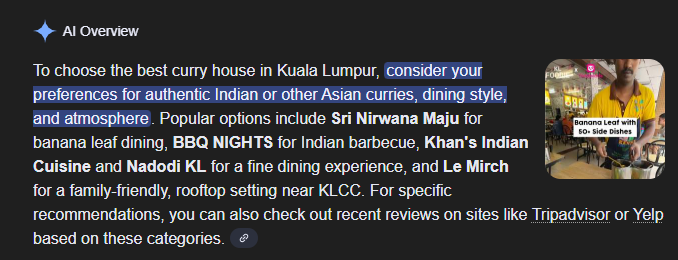
Alt text: An example of Google AI Overview, when someone Googles “choosing the best curry house in kl”
- Google is redefining its query processing due to artificial intelligence.
- Search Generative Experience (SGE) and AI Overviews have enabled Google to produce instant summaries and contextual responses.
- Although this can reduce some conventional clicks, it presents new possibilities of visibility within AI-based summaries.
To adapt, businesses should:
- Have organised content, well-defined answers, headings, and schema markup.
- Apply factual and cited information to improve signals of trust.
- Pay attention to conversational questions, which AI summarises directly.
Industry studies indicate AI Overviews now surface for a meaningful share of queries and are changing click patterns. Clear structure and schema help machines understand your pages, but there’s no guarantee that markup alone will increase impressions (Source: Semrush).
Voice and Multilingual Search
- The multilingual nature of Malaysians, who speak English, Malay and Mandarin, makes voice search a particularly significant aspect of SEO.
- Individuals can find services using Siri, Google Assistant, and even in-car systems without using their hands.
- Voice search queries are longer and in the form of questions. Users may not type in “SEO company Malaysia”, but may query, “which is the best SEO company to use in small business in Malaysia?”
Optimising for this means:
- Writing in a manner that resembles natural speech.
- Adding frequently asked questions that provide direct answers.
- Focusing on long-tail and location-specific keywords.
Around one-fifth of internet users globally report using voice search in 2024–2025, and Malaysia’s exact percentage isn’t separately published (Source: DataReportal).
Local Search and Map Optimisation
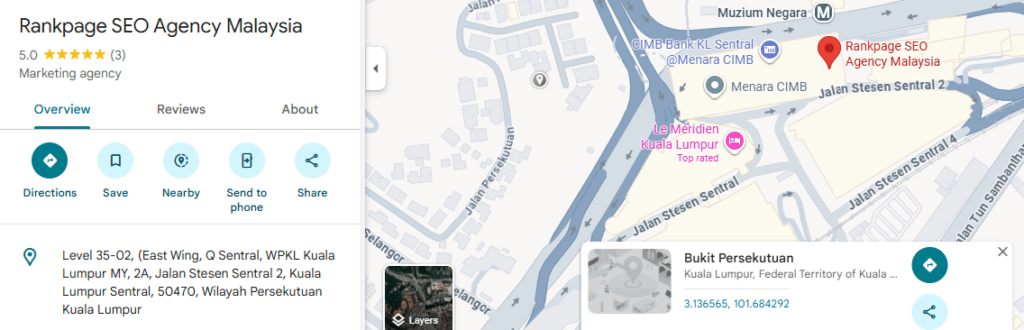
Alt text: An example of a business (in this case, Rankpage) being displayed on Malaysia Google Maps
- In the case of small businesses, being visible in Google Maps and Business Profiles can mean more than being on page one of Google.
- Malaysian SMEs updating their profiles, promoting authentic customer reviews, and employing local backlinks perform better than those that only use websites.
Ask satisfied clients to leave genuine, detailed reviews about their real experiences. This aligns with platform policies and helps prospective customers evaluate your business (Source: Google).
Mobile Experience and Core Web Vitals
- In Malaysia, overall web traffic is currently split across desktop and mobile rather than being overwhelmingly mobile; both experiences matter (Source: Statcounter).
- Slow loading sites or those that display poorly lose rankings and credibility.
- Core Web Vitals (which indicate load speed, interactivity, and visual stability) are still important for user experience and can support SEO success (Source: Google).
- Even small slowdowns can impact sales performance. Classic benchmarks from Akamai show that latency increases correlate with a drop in user conversions (Source: Akamai).
- Being responsive, fast, and secure is no longer a choice, but a prerequisite to success.
E-E-A-T and Content Authenticity
Experience, Expertise, Authoritativeness and Trust are the content qualities that search engines value. Malaysian consumers are becoming more wary of AI-generated or recycled content.
This means:
- Professionals in their fields should write or revise articles.
- References to reliable sources on the local level (LHDN, MDEC, SSM, etc.) increase authority.
- You should publish transparent About and Contact pages to increase the level of trust.
- Companies that share local experiences and human understanding have a higher chance of being ranked in top results, particularly in the service industry.
Information, Data, and Search Intention
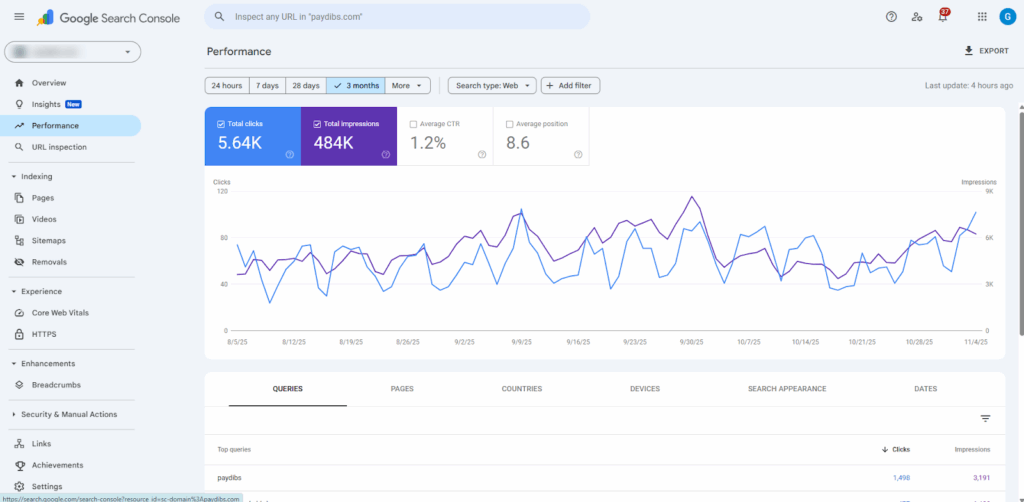
Alt text: Google Search Console example of a website.
The days of making guesses about what customers want are gone. Using tools like Google Search Console and GA4, companies can learn the purpose of each query.
Search intent has three major types:
- Informational: “What is SEO?”
- Transactional: “Hire SEO agency Malaysia.”
- Navigational: “Rankpage SEO Malaysia.”
When the content is aligned with the right intent, and also structure, visuals, and CTAs, it will perform better in both rankings and conversion rates.
Social and Paid Channel Integration
- SEO is no longer a vacuum. Search visibility is enhanced when it incorporates social proof, video marketing, and paid campaigns.
- While social likes/follows aren’t direct ranking factors, social activity can indirectly help SEO by expanding reach, earning links, and growing branded search—signals that support organic performance (Source: Google).
- As an illustration, a Malaysian apparel brand that has regular TikTok activity and optimised blog postings is indexed quicker and ranked higher locally.
- Social media creates awareness, but SEO transforms it into action. Together, they strengthen brand equity.
Myths and Misunderstandings
“AI will replace SEO.”
AI is a tool, not a threat. It assists in the analysis of intent and efficient structuring of content, yet it is incapable of replicating the depth and credibility of human-written knowledge.
“SEO is just about Google.”
Other ecosystems such as Bing Copilot, ChatGPT Search, and YouTube SEO are emerging. Malaysian companies ought to consider SEO as Search Everywhere Optimisation, as opposed to Google rankings.
“SEO gives instant results.”
Sustainable development is a process. Many businesses begin to see measurable results within 3 to 6 months, depending on competitiveness and starting authority (Source: Ahrefs).
“SEO requires huge budgets.”
Not true. SMEs can begin with simple activities, such as Google Business Profile, blogs with keywords, and simple technical optimisation, and expand with the increase in traffic.
SEO & The Future Of Your Business In Malaysia
SEO in Malaysia is changing more rapidly than ever, yet the principle has not changed: know your audience, deliver value, and be consistent. The companies that will be successful in 2025 are not the largest, but the most flexible.
Investing in quality content, technical quality, and local relevance will make sure that your brand is not only present but also trusted. By collaborating with a reputable SEO firm Malaysia, you have access to knowledge, analytics, and future-proof tools to support this change with confidence.
Search will continue to evolve, yet human connection will be its essence. Make sure you partner with the right SEO agency and solutions provider to get the benefits of high-quality SEO.
Frequently Asked Questions (FAQs)
What is the largest SEO trend in Malaysia in 2025?
The most popular trends are AI-based optimisation and voice search, closely followed by local search and E-E-A-T-based content strategies.
What is the impact of AI on SEO services in Malaysia?
AI makes data analysis, content clustering, and key word research easier, but successful strategy remains a matter of human ingenuity and ethical control.
Do I require an SEO agency when I use AI tools?
Yes. AI is able to produce insights, but agencies make sure that they are aligned with user intent, compliance, and channel-wide optimisation.
What is the time frame of SEO results in Malaysia?
Within 3 to 6 months, most businesses start to record quantifiable ranking and traffic growth, based on competition and effort.
What do I seek in an SEO company Malaysia?
Verified case studies, open reporting, domestic experience, and ethical, white-hat practices.
Will Malaysian SMEs still find SEO worthwhile in 2025?
Absolutely. The cost of advertising is increasing and the consumer behaviour is becoming more diverse, so SEO is one of the most predictable, scalable, and ROI-positive marketing channels.


 WebProNews is an iEntry Publication