
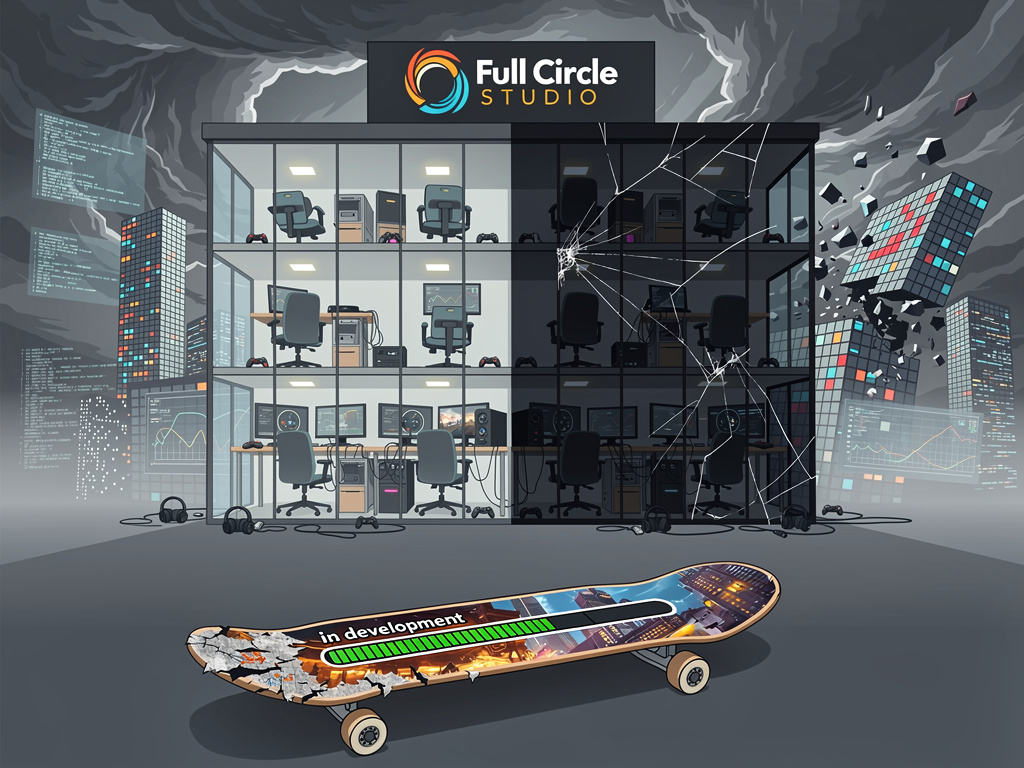
Full Circle, the Electronic Arts studio tasked with reviving the beloved Skate franchise, has confirmed significant layoffs affecting a substantial portion of its workforce. The cuts, which reportedly impact roughly half the studio’s employees, represent yet another grim chapter in a gaming industry that has shed tens of thousands of jobs over the past two years. But the Full Circle situation carries a particular sting: the studio was built from the ground up with a specific creative mission, staffed by passionate developers, and held up as a model for how a major publisher could incubate a smaller, more focused team. That experiment now appears to be in serious jeopardy.
The layoffs were first reported by Mashable, which confirmed that the Vancouver-based studio had begun notifying affected employees. Full Circle was established by EA in 2021 with the express purpose of developing a new entry in the Skate series, a franchise that had been dormant since Skate 3 launched in 2010. The announcement of the studio’s formation and the new game—tentatively known simply as skate. (stylized in lowercase with a period)—was met with enormous enthusiasm from a fanbase that had spent years petitioning EA for a sequel.
A Studio Born From Fan Demand Now Faces an Uncertain Future
The origins of Full Circle are inseparable from the grassroots campaign that brought the new Skate into existence. For nearly a decade, fans flooded EA’s social media channels, comment sections, and community forums with requests for a new installment. The hashtag #SkateForever became a rallying cry. When EA finally acknowledged the project in 2020 with a brief teaser, the reaction was euphoric. The formation of Full Circle the following year, led by studio head Dan McCulloch, signaled that EA was taking the project seriously enough to dedicate an entire team to it rather than folding it into one of its existing mega-studios like DICE or Respawn.
The studio’s approach was notably different from the typical AAA development pipeline. Full Circle leaned heavily into community involvement, launching an insider playtesting program that gave thousands of fans early access to builds of the game. The developers shared progress openly, acknowledged bugs, and invited feedback in a manner more reminiscent of an indie studio than a division of one of the world’s largest game publishers. The free-to-play model chosen for skate. was intended to lower the barrier to entry and build a large, engaged player base over time. But that model also comes with its own set of financial pressures—pressures that appear to have caught up with the studio.
The Scope of the Cuts and What They Mean for skate.
While EA has not provided a precise headcount of the layoffs, reporting from multiple outlets indicates that approximately half of Full Circle’s staff has been let go. For a studio that was already modestly sized by AAA standards—estimated at somewhere between 100 and 200 employees—losing half its workforce is a devastating blow. The cuts span multiple departments, affecting artists, designers, engineers, and support staff alike. Several affected employees took to social media to confirm their departures, with many expressing a mix of gratitude for the experience and frustration at the abruptness of the decision.
EA, for its part, has framed the layoffs as part of a broader restructuring effort aimed at aligning its resources with its strategic priorities. The publisher has undergone multiple rounds of layoffs since early 2023, part of a company-wide push to reduce costs and focus on its most profitable franchises. In February 2024, EA cut approximately 670 jobs, or about 5% of its global workforce, as reported by various industry outlets at the time. The Full Circle cuts appear to be a continuation of that same cost-discipline philosophy, though they raise pointed questions about whether EA remains fully committed to skate. as a tentpole release.
An Industry-Wide Reckoning Shows No Signs of Slowing
Full Circle’s layoffs do not exist in isolation. The gaming industry has experienced an unprecedented wave of job cuts since mid-2022, with major publishers, mid-size studios, and small independents all affected. Microsoft laid off approximately 1,900 employees from its gaming division in January 2024, following its acquisition of Activision Blizzard. Sony cut about 900 jobs from PlayStation’s global workforce the following month. Riot Games, Bungie, Epic Games, and Unity have all made significant reductions as well. By some estimates, more than 20,000 game industry workers lost their jobs in 2023 alone, and the pace in 2024 and into 2025 has remained disturbingly brisk.
The root causes are multifaceted. During the COVID-19 pandemic, gaming companies hired aggressively to meet surging demand from homebound consumers. As the world reopened and growth rates normalized, many studios found themselves overstaffed relative to revenue. Rising development costs, longer production timelines, and the increasing difficulty of launching successful live-service games have further squeezed margins. For a project like skate., which is attempting to build a free-to-play live-service model around a franchise historically sold as a premium retail product, the financial calculus is especially tricky.
The Free-to-Play Gamble and the Pressure to Monetize
When Full Circle announced that skate. would be free-to-play, the decision was met with mixed reactions. Longtime fans worried about aggressive microtransactions and pay-to-win mechanics, while industry analysts saw the move as a pragmatic response to market trends. The studio repeatedly assured players that monetization would be limited to cosmetic items and would not affect gameplay balance. But the free-to-play model demands a large and sustained player base to generate meaningful revenue, and building that base requires significant upfront investment in content, marketing, and live operations infrastructure.
With half its workforce now gone, Full Circle’s ability to deliver on those promises is an open question. Live-service games are notoriously resource-intensive; they require constant updates, seasonal content drops, bug fixes, and community management to keep players engaged. Studios that launch live-service titles with insufficient staffing often find themselves caught in a vicious cycle: thin content leads to player attrition, which leads to lower revenue, which leads to further cuts. The graveyard of failed live-service games—from Anthem to Hyenas to Rumbleverse—is a stark reminder of how unforgiving the model can be.
What Remains of the Dream
Despite the layoffs, EA has indicated that development on skate. will continue. The game remains in active playtesting, and the company has not announced a cancellation. But the reduced team size will almost certainly affect the scope and timeline of the project. Features that were planned may be scaled back. The cadence of updates post-launch may slow. And the community goodwill that Full Circle painstakingly built through years of transparent development could erode quickly if players sense that the game is being released in a diminished state.
For the affected employees, the immediate concern is more personal. The gaming industry’s job market remains saturated with talent displaced by layoffs, making re-employment a difficult prospect. Vancouver, while home to a vibrant game development scene that includes studios like EA Vancouver, Relic Entertainment, and various smaller outfits, has itself been hit by closures and reductions. Several laid-off Full Circle employees have posted their availability on LinkedIn and X, hoping to connect with studios that are still hiring.
A Test Case for Publisher-Developer Relationships
The Full Circle situation is, in many ways, a test case for how major publishers manage smaller, mission-driven studios within their corporate structures. EA created Full Circle with a clear mandate and gave it a degree of creative independence that is unusual for a publisher of its size. The studio’s community-first approach was celebrated as a refreshing departure from the opaque, marketing-driven development cycles that characterize most AAA projects. But when the financial winds shifted, that independence offered no protection. The same corporate machinery that greenlit the studio’s creation could—and did—cut it down to size without apparent regard for the unique culture and approach that made it distinctive.
Whether skate. ultimately succeeds or fails, the story of Full Circle will be studied by industry observers for years to come. It raises uncomfortable questions about the sustainability of the live-service model, the human cost of corporate restructuring, and the tension between creative ambition and financial discipline. For the fans who spent a decade asking for a new Skate game, the layoffs are a sobering reminder that even the most passionate advocacy cannot insulate a project from the cold logic of a balance sheet. And for the developers who poured their talent and energy into making that dream a reality, the loss is far more than professional—it is deeply personal.


 WebProNews is an iEntry Publication