
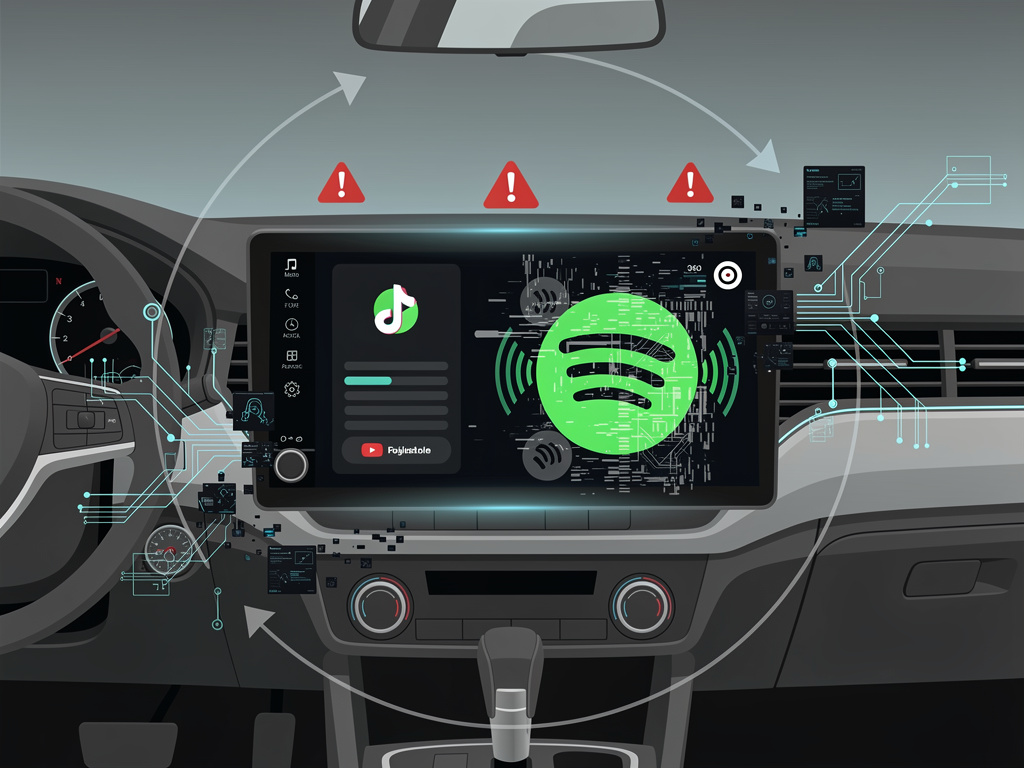
Drivers climbing into their cars expect music to flow without hassle. Yet for thousands relying on Spotify through Android Auto, that expectation falls apart. The app throws up an error demanding a newer version of Android Auto. No such update exists. The message repeats. Playback stalls. And the experience collapses into repeated annoyance.
This bug surfaced toward the end of April 2026. It quickly spread across vehicles and phones. Users report that Spotify opens briefly if a song already plays. Start fresh from the car screen, however, and the trouble begins. A looping demand for an Android Auto update appears. The interface freezes. Controls fail. Nothing works as it should.
Mark Jansen laid out the details in a report for Android Police. He noted the error reads “Spotify needs a newer version of Android Auto.” Clearing cache or data for either app brings temporary calm. Restart the car the next morning and the cycle returns. The fix evaporates. Drivers grow weary of repeating steps that deliver only fleeting success.
But this stands as only the latest chapter in a longer story. Android Auto and Spotify have clashed before. In August 2025 a redesign intended to add Jam collaboration support instead produced blank widgets on the dashboard. The now-playing tile showed “Tap to Open” even while music ran. Skip buttons refused to respond. Steering wheel controls went silent. 9to5Google captured those complaints, many tied to a Subaru Forester and echoed across Reddit threads. A washed-out, gray display plagued the entire system at the same time. Google later pushed corrections. The pattern, however, holds.
By March 2026 another Spotify headache emerged. Local music files stored on phones vanished from playlists when viewed inside Android Auto. The tracks existed. The app simply ignored them. Android Police reported the issue alongside missing network icons and stubborn connectivity drops on Pixel and Samsung devices. Google responded with a late-March update that resolved some wireless headaches. Many Galaxy owners still faced trouble. Then in April the beta of version 16.7 arrived. Testers saw no visible changes yet the company hinted it would address accumulated problems. Relief proved short-lived.
May brought version 13.5.26 of Android Auto. A Google support thread exploded with fresh frustration. One owner of a 2021 Mazda CX-9 described a spinning buffer icon that never resolved. The Spotify home screen refused to load. Song playback appeared but touch controls stayed dead. “It has been extremely frustrating as the only reason I use Android Auto is for Spotify,” the poster wrote. Similar accounts poured in from Honda, Toyota and other makes. A Reddit user traced the trigger to a Spotify phone app update delivered May 8. Before that release no version warning appeared. Afterward the demand for a nonexistent Android Auto update became constant.
Support conversations reveal deeper irritation. One driver contacted Spotify customer service and learned of a “world-wide problem” between the two platforms. The representative advised patience for a future patch but offered no timeline or workaround. Forums on GrapheneOS and Spotify’s own community fill with parallel tales. The now-playing card displays only a logo and basic play button. Progress bars, shuffle options and skip controls disappear. Steering wheel buttons skip two tracks instead of one in certain 2026 Toyota RAV4 models. The integration that once felt reliable now demands constant troubleshooting.
Google maintains awareness through its support channels. No public statement has detailed root causes or committed to a schedule. Spotify likewise stays quiet on the current error. That silence fuels speculation. Some point to shifts in the Car App Library that enabled richer media experiences yet introduced compatibility gaps. Others suspect permission changes, battery optimizations or conflicts after Android OS updates. None of these theories produce a permanent cure. Drivers continue to experiment with developer mode unlocks, full app reinstalls, or toggling Spotify visibility inside Android Auto settings. A few report that unchecking the app, reconnecting, then re-enabling it restores function for a single drive. The next trip resets the failure.
The stakes rise beyond simple inconvenience. Many motorists depend on Android Auto for safe, glanceable controls. When Spotify fails they lose access to vast libraries, curated playlists and podcast queues built for the road. They switch to FM radio, Bluetooth audio without visuals, or rival services that behave better. Some cancel subscriptions. Others vent on X, where recent posts echo the same fatigue seen in support threads. The pattern repeats every few months. A bug appears. Users document it. Temporary patches arrive. Stability returns until the next update breaks something new.
Automakers ship vehicles with Android Auto built in yet bear little control over the software layers. Google owns the platform. Spotify supplies the content. When the two diverge, owners sit in parking lots clearing caches instead of driving. The latest episode, reported today by Android Police, highlights how thin the tolerance has grown. Drivers no longer accept that clearing data counts as a solution. They demand code changes that prevent the false update prompt from appearing at all.
Until that arrives the advice remains familiar. Keep both apps current. Disable battery optimization for Android Auto and Spotify. Test wired versus wireless connections. But none of these steps guarantee success. The error returns. The buffer spins. And the music stays out of reach. For an industry that celebrates connected cars, the persistence of such basic failures raises questions about testing and accountability. How many more mornings must begin with the same broken interface before a lasting repair rolls out?


 WebProNews is an iEntry Publication