
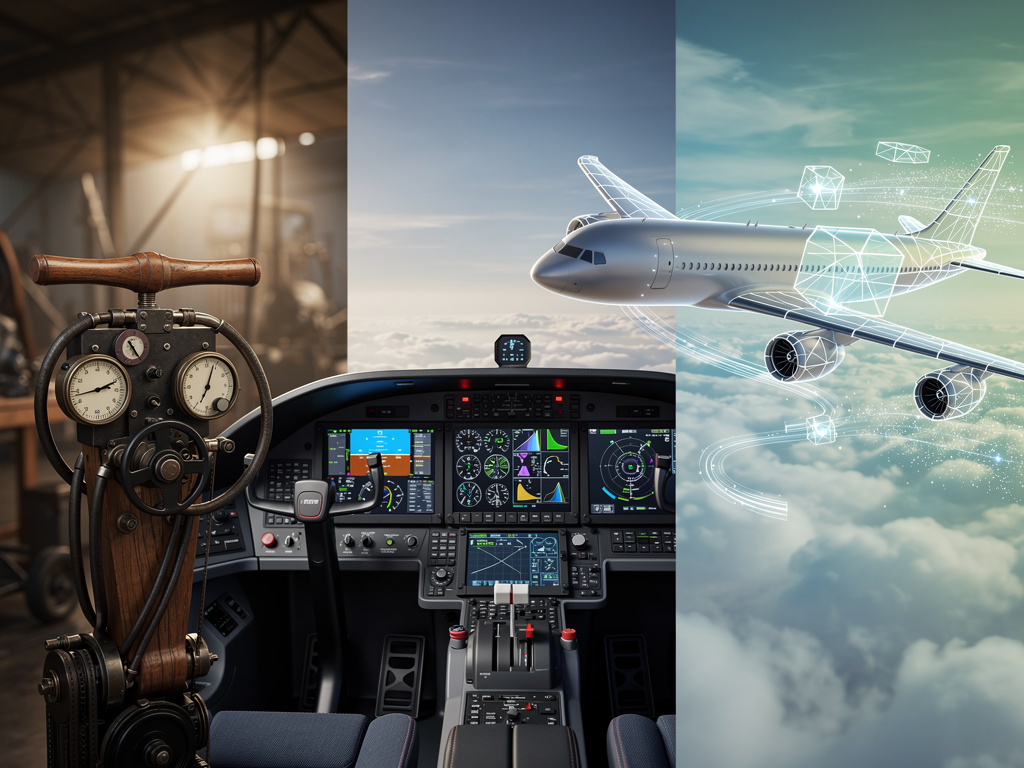
Digital Skies: The Computational Conquest of Aviation
In the early days of aviation, pilots relied on mechanical ingenuity and sheer human skill to keep aircraft aloft. The Wright brothers’ 1903 Flyer was a marvel of wood, wire and fabric, controlled by warping wings and a rudimentary elevator. Fast-forward to today, and the cockpit has transformed into a high-tech command center where computers orchestrate everything from takeoff to landing. This shift didn’t happen overnight; it was a gradual infusion of digital technology that fundamentally altered how planes fly and how the industry operates. Drawing from historical accounts and recent innovations, we explore this evolution, crediting insights from sources like the Introduction to Aerospace Flight Vehicles by Embry-Riddle Aeronautical University, which details the progression from basic flight vehicles to sophisticated systems.
Computers first entered aviation in subtle ways, often as tools for calculation rather than direct control. During World War II, analog computers helped with bomb aiming and navigation, but it was the post-war era that saw digital systems take root. By the 1950s, devices like the Bendix Central Air Data Computer used gears and synchros to compute airspeed and altitude, as noted in posts from X users discussing vintage aviation tech. These early systems laid the groundwork for more integrated roles, evolving from passive calculators to active participants in flight management.
The turning point came with the advent of fly-by-wire technology in the 1970s. Instead of mechanical linkages, electronic signals from the pilot’s controls are interpreted by computers, which then adjust flight surfaces. This innovation, pioneered in military jets like the F-16, allowed for unprecedented stability and efficiency. Commercial aviation soon followed, with Airbus introducing fly-by-wire in the A320 in 1988, a move that reduced weight and improved fuel economy.
From Cables to Code: The Rise of Fly-by-Wire Systems
Fly-by-wire systems represent a paradigm shift, where software mediates between pilot intent and aircraft response. Computers process inputs thousands of times per second, making micro-adjustments for smoother flights, as highlighted in a recent X post about modern airliners’ control surfaces. This technology not only enhances safety by preventing stalls but also enables envelope protection, where the system refuses commands that could endanger the plane.
Beyond control, computers revolutionized navigation. The inertial navigation systems of the 1960s gave way to GPS-integrated avionics in the 1990s, allowing precise positioning without ground-based aids. According to Centennial of Flight, these advancements ensured planes could reach destinations safely and on time, transforming global travel logistics.
The impact on the aviation industry extends to design and manufacturing. Computer-aided design (CAD) software has streamlined aircraft development, enabling simulations that test aerodynamics virtually before a single prototype is built. This has accelerated innovation cycles, reducing costs and time-to-market for new models.
Autopilot Evolution: From Gyroscopes to AI-Driven Guidance
Autopilots, once simple gyroscopic devices holding course, now incorporate artificial intelligence for complex tasks. Elmer Sperry’s 1914 invention evolved into systems that can manage entire flights, as described in the same Centennial of Flight resource. Modern autopilots integrate with flight management systems (FMS), optimizing routes for fuel efficiency and weather avoidance.
In recent years, AI has pushed boundaries further. A December 2025 X post recounted an incident where an autonomous system detected a pressurization issue at 23,000 feet, took control, communicated with air traffic control, and safely landed the plane. This level of autonomy hints at a future where pilots oversee rather than actively fly, raising questions about human roles in the cockpit.
The aviation sector has seen operational efficiencies soar thanks to these technologies. Airlines use big data analytics to predict maintenance needs, minimizing downtime. Spartan College outlines how such predictive maintenance has improved safety records, with fewer incidents due to mechanical failures.
Digital Twins and Simulation: Redefining Aircraft Design
One of the most profound changes is the use of digital twins—virtual replicas of physical aircraft that simulate real-world conditions. Engineers can test modifications in software environments, iterating designs rapidly. This approach, detailed in BAA Training’s blog on 2024 trends, has led to lighter, more efficient airframes, contributing to the industry’s push toward sustainability.
However, this reliance on computers isn’t without challenges. Recent IT meltdowns, like the Alaska Airlines grounding in late 2025, underscore vulnerabilities. As reported by NPR, these incidents highlight the need for robust backups and cybersecurity measures in an increasingly digital ecosystem.
On the innovation front, computers have enabled advancements in electric and hybrid propulsion. Simulations optimize battery placements and power distribution, paving the way for greener flights. The Transport & Environment analysis warns that without continued innovation, decarbonization goals could falter, emphasizing the role of computational modeling in breakthroughs.
Safety Enhancements Through Computational Intelligence
Safety has been the biggest beneficiary of computational integration. Systems like the Traffic Collision Avoidance System (TCAS) use radar and algorithms to prevent mid-air collisions, a technology that has saved countless lives since its 1990s rollout. Enhanced ground proximity warning systems (EGPWS) provide terrain awareness, further reducing accident rates.
In private aviation, emerging standards by 2030 may mandate predictive tech features, as per News Channel 3-12. These include AI-driven diagnostics that foresee failures, shifting from reactive to proactive safety protocols.
The military sector has driven many of these advancements. The U.S. Air Force’s upgrades, discussed in Simple Flying, balance legacy fleets with cutting-edge computing, incorporating AI for threat detection and autonomous operations.
Industry-Wide Transformations: Efficiency and Economics
Economically, computers have reshaped airline operations. Revenue management systems use algorithms to optimize ticket pricing, maximizing profits amid fluctuating demand. This data-driven approach, evolving since the 1980s, has made air travel more accessible while boosting carrier revenues.
Training has also been revolutionized. Flight simulators, powered by advanced graphics and physics engines, allow pilots to practice scenarios without risking lives or equipment. AOPA’s 1992 article on computers in aviation foresaw this trend, which has only intensified with virtual reality integrations.
Moreover, the push for sustainable aviation fuel (SAF) relies on computational modeling to assess viability. Innovations like those in BAA Training’s list of game-changers include computer-optimized engines that reduce emissions, aligning with global environmental mandates.
Challenges and Future Horizons in Aviation Computing
Despite triumphs, the integration of computers brings hurdles. Cybersecurity threats loom large, with potential hacks disrupting critical systems. Industry insiders note that as planes become more connected, safeguarding digital infrastructure is paramount, echoing concerns from the NPR report on system failures.
Looking ahead, quantum computing could further transform aviation by solving complex optimization problems instantaneously, from route planning to material science for lighter composites. X posts from aviation engineers highlight ongoing developments, such as variable camber wings reprogrammed in flight, a concept Airbus explored in the 1980s.
The Boeing 737 MAX saga illustrates both potential and pitfalls. The MCAS system, introduced to handle engine placement changes, relied on software to maintain stability but led to tragedies when flaws emerged. A 2025 X post from an aircraft maintenance engineer explained how this small change amplified the need for rigorous software validation.
Pioneering Autonomy: Toward Pilotless Skies
Autonomy is the next frontier. Companies like Boeing and Airbus are testing unmanned cargo flights, leveraging AI for decision-making. The Amprius Technologies piece on future safety underscores how technology ensures reliable electric aircraft operations.
In urban air mobility, eVTOL vehicles depend on computers for navigation in crowded skies. These advancements promise to decongest roads and revolutionize short-haul travel, backed by simulations that predict traffic patterns.
Yet, regulatory bodies must keep pace. The FAA and EASA are updating frameworks to certify AI systems, ensuring they meet safety thresholds without stifling innovation.
Global Impacts and Ethical Considerations
On a global scale, computational advancements have democratized aviation in developing regions. Low-cost carriers use data analytics to expand routes, connecting remote areas. However, this raises ethical questions about job displacement, as automation reduces the need for human crews.
Diversity in aviation benefits from tech, with simulators making training more inclusive. Women and underrepresented groups gain access to high-fidelity practice, fostering a broader talent pool.
As we stand on the cusp of 2030, the fusion of computers and aviation continues to evolve. From the modular designs of the 747, analogized in an X post to software architecture, to AI-piloted emergencies, the trajectory is clear: computers aren’t just tools; they’re the very fabric of modern flight.
Sustaining Momentum in Technological Flight
To sustain this momentum, investment in R&D is crucial. Governments and private firms are pouring resources into next-gen computing, like edge AI for real-time decisions without cloud reliance.
Challenges like the stall in aircraft innovation, as per the Transport & Environment study, call for renewed focus on breakthroughs. Hybrid models combining human oversight with machine precision could mitigate risks.
Ultimately, the story of computers in aviation is one of relentless progress, turning what was once daring human endeavor into a symphony of silicon and sky. With each advancement, the industry soars higher, safer and more efficiently, promising a future where the impossible becomes routine.


 WebProNews is an iEntry Publication