
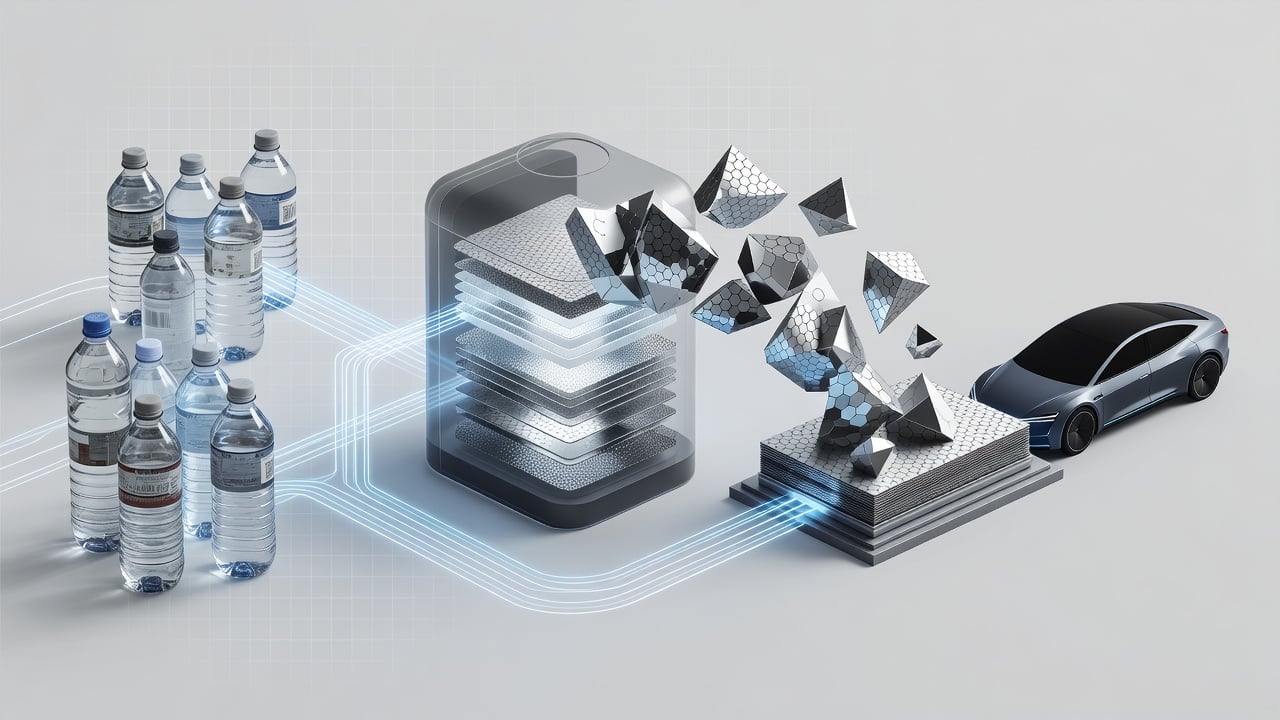
A discarded plastic water bottle, the kind tossed absentmindedly after a long drive, could soon store energy in an electric vehicle. Researchers at Penn State have found a way to turn polyethylene terephthalate, or PET, into high-quality synthetic graphite suitable for lithium-ion battery anodes. The material they produced shows better structural order than many commercial natural graphite samples. And the process avoids the metal catalysts that usually complicate manufacturing.
Graphite demand keeps climbing. Electric vehicles, smartphones, grid storage. All need it. The U.S. Department of Energy lists graphite as a critical mineral. At the same time, PET waste piles up. Many bottles get recycled. Many more end up in landfills or downcycled into lesser products. This work tackles both problems at once.
“Most people think of a plastic bottle as waste once they’re done using it,” said Shakshi Sekar, lead author of the study and a doctoral student in Penn State’s John and Willie Leone Family Department of Energy and Mineral Engineering. “Our work shows that the same material can become a valuable resource for producing graphite, which is essential for modern battery technologies.” (Penn State University, June 26, 2026)
The method starts simple. Shred the PET. Mix in a small amount of graphene oxide. Apply controlled heat. The graphene oxide acts as a template. Oxygen-containing groups on its edges guide carbon atoms from the melted plastic into stacked, well-ordered graphite crystals. Just 2.5% graphene oxide by weight delivered the best results. The crystallites formed proved larger and more organized than those in benchmark natural graphite.
Traditional ways of making synthetic graphite often rely on iron, nickel or cobalt catalysts. Those metals leave impurities. Extra purification steps follow. Chemical waste grows. The Penn State approach skips the metals entirely. Cleaner output. Fewer steps. Lower environmental cost. “By avoiding metal catalysts, we can produce cleaner graphite while reducing chemical use and waste generation,” Sekar added. (Penn State University)
The Technical Edge
Performance matters. Battery anodes need consistent, highly ordered graphite to move lithium ions efficiently and hold up over thousands of cycles. The PET-derived material delivered large, well-aligned crystallites. That ordering signals strong potential for high-capacity, stable anodes. Early data suggests it could match or exceed commercial options without the mining footprint of natural graphite or the energy intensity of conventional synthetic routes.
Randy Vander Wal, professor of energy and mineral engineering at Penn State and faculty member in the Institute of Energy and the Environment, has explored related upcycling concepts before. Earlier Penn State research examined how different plastics, including PET and low-density polyethylene, mix with graphene oxide during thermal processing. The newer results build directly on that foundation, sharpening the focus on battery-grade output. (Penn State University, May 11, 2022)
Yet hurdles remain. The laboratory success must scale. Industrial furnaces, consistent feedstock quality, cost competitiveness. All need proving. Long-term battery testing lies ahead. Cycle life under real EV conditions. Rate capability. Safety. No one claims this technology will appear in next year’s models. Still, the pathway looks promising. It turns a ubiquitous waste stream into a strategic material.
Other researchers have pursued plastic in batteries too. A team at Singapore’s Agency for Science, Technology and Research once converted PET into polymer electrolytes for safer lithium-ion cells. That work targeted a different battery component. (ASME, June 1, 2023) Separate groups have examined pyrolysis of spent cathodes mixed with PET to recover metals more efficiently. These efforts show growing interest in linking plastic waste management with battery material cycles. (Nature Communications Engineering, 2024)
The timing feels urgent. Global EV sales continue their rise. Battery production strains supply chains for both lithium and graphite. China dominates much of the graphite refining. Western governments push for domestic or allied sources. A process that pulls graphite from domestic plastic waste offers a partial answer. It reduces reliance on mining. It cuts landfill volume. It lowers the carbon footprint of anode production.
But economics will decide adoption. Battery-grade graphite sells for thousands of dollars per ton. The Penn State method must compete on price as well as performance. Graphene oxide itself carries cost, though only small quantities are needed. Future optimizations could replace it with even cheaper templates or recycled graphene sources. Process energy requirements also matter. Graphitization typically demands high temperatures. The team’s controlled thermal approach aims to keep those demands reasonable.
Sekar sees a larger shift. “If waste plastic can become a feedstock for advanced energy materials, it changes how we think about recycling. Instead of viewing plastic as a disposal problem, we can see it as a resource that helps support clean energy technologies.” (Penn State University)
That perspective aligns with broader industry moves. Carmakers and battery makers increasingly commit to recycled content targets. Regulations in Europe and proposed rules in the U.S. push for higher recovery rates of battery materials. Graphite often receives less attention than the metals in cathodes. This work reminds the sector that anodes matter too.
Practical challenges persist. PET collection rates vary by region. Contamination in recycling streams can affect quality. The graphene oxide addition, while small, must be sourced sustainably. And full life-cycle analysis will be needed to confirm net environmental gains. Still, the core idea holds appeal. Take a product that pollutes landfills and oceans. Transform it into something that powers zero-emission driving.
The research, supported by the National Science Foundation, appeared in a peer-reviewed journal and has drawn attention for its elegance. No exotic reagents. No complex chemical baths. Just plastic, a carbon template, and heat. Results that outperform commercial benchmarks in structural order.
Industry insiders watch closely. Graphite supply tightness could worsen as EV adoption accelerates toward 2030 and beyond. Any new domestic production route gains interest. Companies already invest in synthetic graphite plants. If this PET route scales, it could feed those facilities with a recycled feedstock that also addresses plastic waste.
One bottle won’t power a car. Millions could. The math is straightforward. Billions of PET bottles produced yearly. A fraction redirected to battery production would ease pressure on both waste systems and critical material markets. The Penn State team has shown one technically sound way to make that redirection possible.
Further development will test whether the laboratory advantage survives scale-up. Battery makers will demand consistency across batches. Automakers will insist on proven durability. Yet the early data offers reason for optimism. Ordered crystals. Reduced impurities. Dual environmental benefit. Sometimes the best innovations repurpose what society already discards.
So the next time you finish a bottle of water, consider its possible second life. Not as another bottle. Not as carpet fiber. But as the quiet heart of an electric motor, quietly storing and releasing energy mile after mile.


 WebProNews is an iEntry Publication