
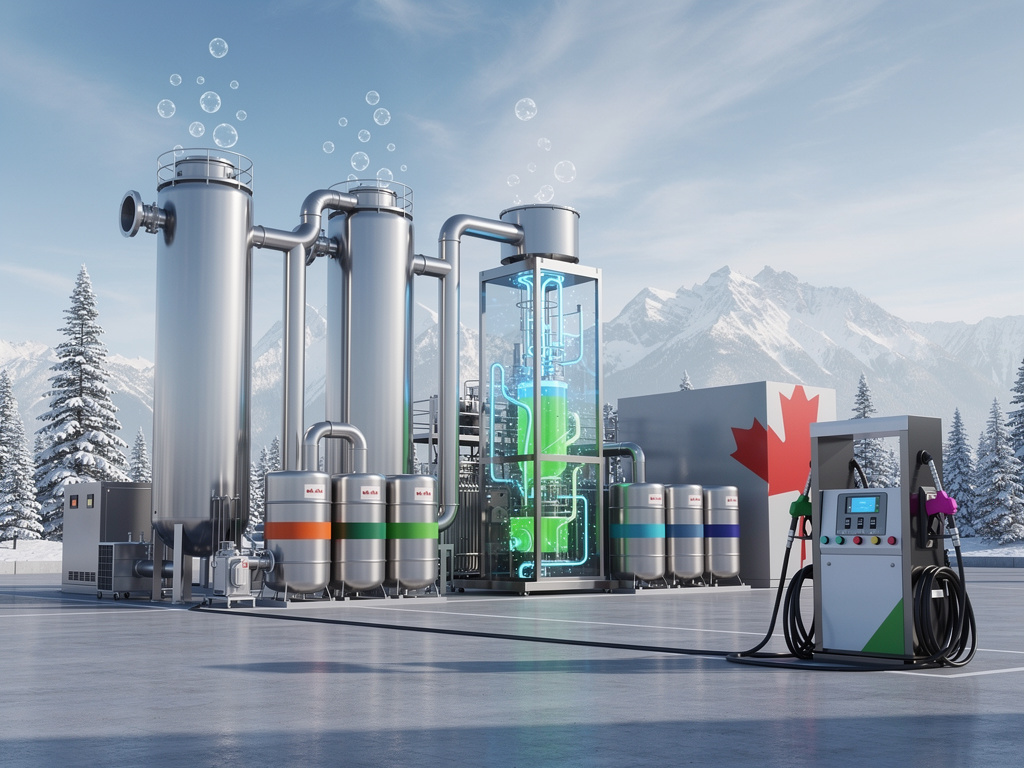
The automobile industry stands at the precipice of a potentially revolutionary shift, one that could fundamentally alter how we think about fuel production and carbon emissions. A Canadian startup has developed technology that extracts carbon dioxide directly from the atmosphere and converts it into gasoline, diesel, and jet fuel—a process that sounds like science fiction but is already producing commercial-grade fuel at a pilot facility in British Columbia.
Carbon Engineering, the company behind this breakthrough, has been quietly perfecting its direct air capture (DAC) technology for over a decade. According to Futurism, the facility can pull CO2 from ambient air and synthesize it into liquid fuels that are chemically identical to their petroleum-based counterparts. This isn’t a laboratory curiosity—the company has already demonstrated the technology at scale, producing approximately one barrel of fuel per day at its demonstration plant.
The Economics of Atmospheric Carbon Extraction
The critical question facing this technology isn’t whether it works, but whether it can compete economically with conventional fossil fuels. Carbon Engineering estimates that its process can produce fuel for between $94 and $232 per barrel, depending on the energy source and scale of production. While this price point currently exceeds the cost of traditional petroleum extraction in many markets, it becomes increasingly competitive when carbon pricing mechanisms and environmental regulations are factored into the equation.
The company’s approach involves two primary steps: first, capturing CO2 from the air using large fans and chemical absorption systems; second, combining that carbon with hydrogen derived from water electrolysis to synthesize hydrocarbon fuels. The process requires substantial energy input, which means the environmental benefits depend heavily on using renewable electricity sources. When powered by solar, wind, or hydroelectric energy, the resulting fuels can be nearly carbon-neutral over their lifecycle, as the CO2 released during combustion is equivalent to what was captured from the atmosphere during production.
Industry Backing and Strategic Partnerships
The technology has attracted significant attention from major players in the energy and automotive sectors. Chevron, one of the world’s largest oil companies, has invested in Carbon Engineering, signaling that even traditional fossil fuel producers recognize the potential of synthetic fuel production. Similarly, Occidental Petroleum has committed to building the world’s largest direct air capture facility, capable of removing one million tons of CO2 annually, with plans to use captured carbon for both fuel production and enhanced oil recovery.
Bill Gates, through his investment firm Breakthrough Energy Ventures, has also backed Carbon Engineering, lending credibility to the technology’s commercial viability. The involvement of such high-profile investors suggests that air-to-fuel conversion is transitioning from experimental technology to a potentially scalable industrial process. These partnerships provide not only capital but also the operational expertise and distribution networks necessary to bring synthetic fuels to market at meaningful volumes.
Technical Challenges and Engineering Realities
Despite the promise, significant technical hurdles remain. The energy intensity of the process is considerable—it takes approximately 8.81 gigajoules of energy to produce one gigajoule of liquid fuel, according to Carbon Engineering’s published research. This energy penalty means that the process is only environmentally beneficial when powered by zero-carbon electricity sources, and even then, questions arise about whether that renewable energy might be better utilized elsewhere, such as directly powering electric vehicles.
The chemical engineering involved is complex but well-understood. The air capture system uses a potassium hydroxide solution to absorb CO2, which is then isolated through a series of chemical reactions and heating processes. The purified CO2 is combined with hydrogen in a Fischer-Tropsch-type synthesis process to create long-chain hydrocarbons that can be refined into gasoline, diesel, or jet fuel. Each step must be optimized for efficiency, as even small improvements in energy consumption can dramatically affect the economic viability of the final product.
Regulatory Environment and Policy Implications
Government policy will likely play a decisive role in determining whether air-derived fuels can compete in the marketplace. California’s Low Carbon Fuel Standard, for instance, provides credits for fuels with lower carbon intensities, potentially making synthetic fuels economically attractive even at higher production costs. Similar regulatory frameworks in Europe and other jurisdictions could create market opportunities for Carbon Engineering and its competitors.
The technology also intersects with broader climate policy discussions about carbon removal and offsetting. If air-captured fuels are burned in engines, they don’t remove carbon from the atmosphere on a net basis—they simply create a closed loop. However, the same capture technology can be used for permanent carbon sequestration, storing CO2 underground rather than converting it to fuel. This dual-use potential gives the technology flexibility to serve multiple roles in a decarbonizing economy, depending on policy priorities and economic incentives.
Competition from Electric Vehicles and Alternative Technologies
The rise of electric vehicles presents both a challenge and an opportunity for synthetic fuel technology. As battery costs decline and charging infrastructure expands, personal vehicles are increasingly shifting away from liquid fuels entirely. However, certain transportation sectors—particularly aviation, long-haul trucking, and maritime shipping—face significant barriers to electrification due to energy density requirements and operational constraints.
This is where air-derived fuels may find their most compelling application. Aircraft, for example, require energy-dense liquid fuels that can be stored compactly and burned efficiently at high altitudes. Battery technology is unlikely to serve this need in the foreseeable future, making synthetic jet fuel a potentially crucial tool for decarbonizing aviation. The International Air Transport Association has identified sustainable aviation fuels as a key component of the industry’s net-zero emissions strategy, creating a clear market opportunity for technologies like Carbon Engineering’s.
Manufacturing Scale and Infrastructure Requirements
Scaling up production from demonstration facilities to industrial-scale plants presents formidable logistical and financial challenges. A commercial facility capable of producing 200,000 barrels per day—roughly equivalent to a medium-sized conventional refinery—would require billions of dollars in capital investment and vast amounts of renewable electricity. The plant would also need access to water for hydrogen production and suitable geology for potential carbon storage operations.
However, synthetic fuel production offers some advantages over conventional petroleum refining. The plants can be located anywhere with access to renewable energy and don’t require proximity to oil fields or pipelines. This geographic flexibility could enable fuel production closer to consumption centers, potentially reducing transportation costs and supply chain vulnerabilities. Additionally, the modular nature of the technology means that plants can be built incrementally, starting smaller and expanding as demand and economics justify.
Market Timing and Investment Outlook
The next five to ten years will be critical in determining whether air-to-fuel technology can achieve commercial success. Current production costs remain above conventional fuel prices in most markets, but several factors could shift the economics favorably. Rising carbon prices, whether through taxes or cap-and-trade systems, would narrow the cost gap. Improvements in renewable electricity costs, which have fallen dramatically over the past decade, would reduce the largest input expense for synthetic fuel production.
Investment in the sector continues to accelerate, with multiple companies beyond Carbon Engineering pursuing similar technologies. Climeworks, a Swiss company, focuses primarily on carbon capture for storage or industrial use, while other startups are developing alternative synthesis pathways that might prove more efficient or cost-effective. This competitive environment should drive innovation and cost reduction, though it also creates uncertainty about which approaches will ultimately prevail in the marketplace.
Environmental Accounting and Lifecycle Analysis
The environmental benefits of synthetic fuels depend critically on how the energy is sourced and how the carbon accounting is performed. A fuel produced using coal-fired electricity would have a far larger carbon footprint than the petroleum it replaces, while fuel made with surplus renewable energy during periods of low demand could be genuinely carbon-neutral or even carbon-negative if some of the captured CO2 is permanently sequestered.
Lifecycle analysis must also account for the existing infrastructure that synthetic fuels can utilize. Unlike electric vehicles, which require new charging networks and grid upgrades, air-derived gasoline and diesel can flow through existing pipelines, be stored in current tanks, and power conventional engines without modification. This compatibility with legacy infrastructure could accelerate adoption in certain applications, though it also raises questions about whether the technology might slow the transition to more fundamental changes in transportation systems.
The Path Forward for Carbon-Neutral Combustion
As the technology matures, the most likely scenario involves synthetic fuels serving niche applications where electrification proves impractical, rather than completely replacing petroleum across all transportation sectors. Aviation represents the most obvious target market, followed by maritime shipping and potentially long-distance trucking. Personal vehicles will probably continue their shift toward electrification, except perhaps in regions with limited charging infrastructure or specific use cases requiring extended range.
The success of air-to-fuel technology ultimately depends on a confluence of factors: continued cost reductions through scale and innovation, supportive policy frameworks that value carbon reduction, and sustained commitment from investors willing to fund the transition from pilot projects to commercial operations. Carbon Engineering and its competitors have demonstrated that the chemistry works; the remaining question is whether the economics and market conditions will align to make atmospheric fuel production a significant part of the global energy system. The answer will shape not just the future of transportation, but the broader trajectory of climate change mitigation efforts worldwide.


 WebProNews is an iEntry Publication