
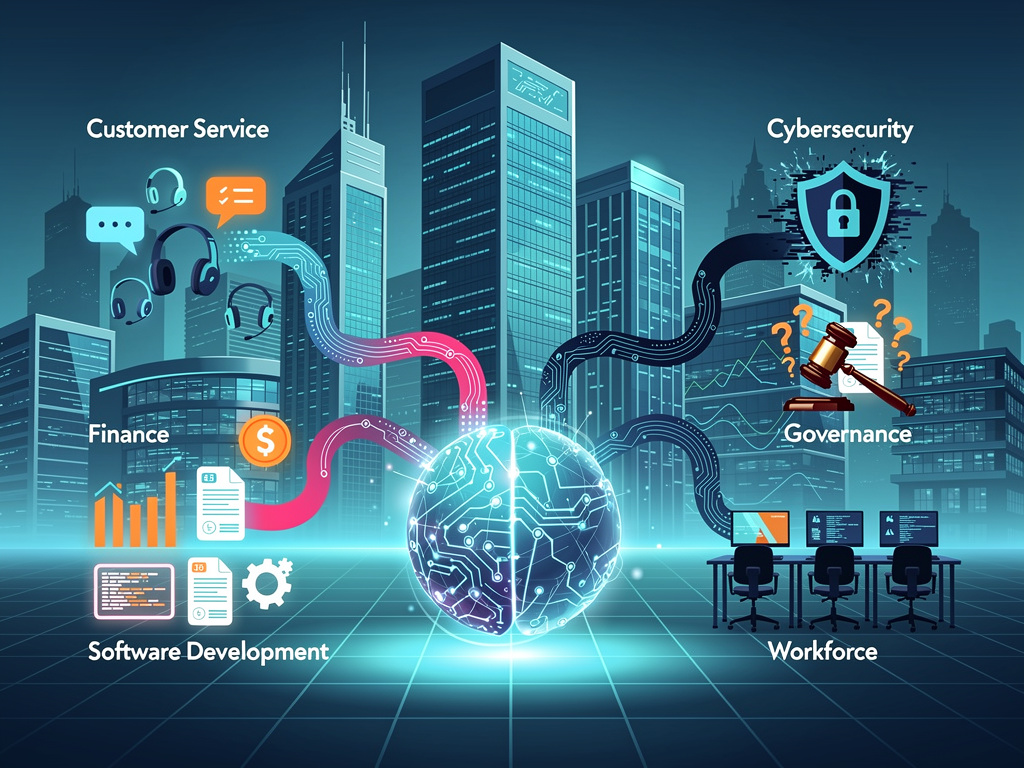
Twelve months ago, the nation’s most powerful technology executives gathered in Silicon Valley and delivered a lukewarm verdict on AI agents: promising in theory, largely absent in practice. This year, the same cohort returned with a starkly different message. AI agents are no longer experimental curiosities or pilot-project novelties. They are embedded in the daily operations of some of America’s oldest and most consequential companies, reshaping everything from customer service to financial bookkeeping to software development itself.
The transformation, detailed by attendees at The Wall Street Journal’s Technology Council Summit, represents one of the fastest enterprise technology adoption cycles in recent memory. But it also carries a thicket of unresolved challenges—cybersecurity vulnerabilities, governance gaps, employee anxiety, and the looming question of what happens when autonomous software agents begin making consequential decisions on behalf of trillion-dollar institutions.
The Year Everything Changed for Enterprise AI
The shift in sentiment among chief information officers and chief technology officers has been nothing short of seismic. Kathy Kay, CIO and executive vice president of Principal Financial Group, told The Wall Street Journal that the state of AI among enterprises has changed dramatically in the past year. “You can’t do anything hardly anymore without your employees using AI,” Kay said during an interview on the sidelines of the summit. “To really get the pace and scale and things that you need, you have to use AI to get there.”
That statement, coming from the technology leader of a 146-year-old financial services firm headquartered in Des Moines, Iowa, underscores how deeply AI agents have penetrated beyond the tech industry’s coastal enclaves. Principal Financial Group, which manages hundreds of billions of dollars in assets and serves millions of customers, is not a startup experimenting with bleeding-edge tools. It is a legacy institution that has concluded AI agents are no longer optional—they are operational infrastructure.
From Dealerships to Wall Street: Agents Go Mainstream
The breadth of industries now deploying AI agents is remarkable. Stephen Carvelli, chief technology officer of Sonic Automotive, one of the largest publicly traded automotive dealership chains in the United States, told the summit that the Charlotte, N.C.-based company has had “pretty good success” with AI agents designed to improve the customer experience. “You can, with agents, be there 24/7,” Carvelli said during a panel discussion, as reported by The Wall Street Journal. For a business built on high-touch sales interactions—test drives, trade-in negotiations, financing discussions—the idea that an AI agent can maintain a continuous, competent presence with prospective buyers represents a fundamental rethinking of the customer relationship.
Perhaps even more striking is the deployment at Bank of New York Mellon, the nation’s oldest bank, founded in 1784 by Alexander Hamilton. BNY CIO Leigh-Ann Russell revealed during the summit that the company now has 130 AI-powered “digital employees” that have human managers. The framing is deliberate and significant: these are not mere chatbots or automated scripts. They are treated as members of the workforce, with reporting structures, performance expectations, and presumably accountability chains that mirror those of their human counterparts. The implications for workforce planning, organizational design, and corporate governance are profound.
Software Development Enters a New Paradigm
While customer-facing and financial applications of AI agents have drawn considerable attention, the most disruptive near-term impact may be in software development itself. Alex Balazs, chief technology officer of Intuit, told summit attendees that the Mountain View, Calif.-based software giant has found success with AI agents that can close books on its behalf—a core function for a company whose products include QuickBooks and TurboTax. But Balazs went further, describing a tectonic shift in how code is written. “The days of AI assisting you with coding have become you are assisting the AI with coding,” he said, according to The Wall Street Journal.
That inversion—from AI as assistant to AI as primary author—carries enormous consequences for the software industry. If AI agents can write the vast majority of production code, with human engineers serving primarily as reviewers and quality controllers, the economics of software development change radically. Fewer engineers may be needed for the same output, or the same number of engineers may produce dramatically more software. Either way, the competitive dynamics of the technology sector are being rewritten in real time.
OpenAI’s Chairman Sees Coders Becoming Reviewers
Bret Taylor, co-founder and CEO of the agentic AI startup Sierra and chairman of OpenAI, reinforced this point during a summit panel. Taylor noted that some people on his team “have not written a line of code, but have just been reviewing and tuning the output of these [coding] agents,” as reported by The Wall Street Journal. Taylor occupies a unique vantage point in the AI ecosystem: as chairman of OpenAI, he oversees the organization behind GPT-4 and its successors, while Sierra builds AI agents specifically designed for enterprise customer interactions. His observation suggests that even within the companies building AI, the technology is already displacing traditional workflows.
The pressure on incumbent software companies is palpable. As AI-based platforms grow more capable, investors have begun questioning whether legacy software vendors can maintain their market positions. Though Wall Street’s top brass have sought to soothe investor jitters over AI’s threat to software, many attendees at the summit said they are more focused on deploying AI agents within their own operations than on replacing existing software vendors wholesale. That nuance matters: the near-term disruption may be less about AI replacing enterprise software and more about AI agents becoming a new layer of intelligence that sits on top of—and eventually subsumes—existing platforms.
Cybersecurity and Governance: The Unfinished Business of Agentic AI
For all the enthusiasm, the summit’s technology leaders were candid about the significant challenges that remain. Cybersecurity emerged as a recurring concern. AI agents, by their nature, require access to sensitive systems, data, and decision-making authority. Granting that access creates new attack surfaces that traditional security architectures were not designed to protect. Carvelli of Sonic Automotive highlighted this directly: “There are issues with allowing agents to be able to do their work properly, even authentication,” he said during a panel. “The tools need to be a certain level of security, a certain level of capability.”
The authentication challenge is particularly thorny. When a human employee accesses a financial system, their identity is verified through established protocols—multi-factor authentication, role-based access controls, audit trails. But when an AI agent needs to access the same system, the traditional identity framework breaks down. Who is the agent? What permissions should it have? How do you audit its actions? How do you revoke access if the agent is compromised? These are not theoretical questions; they are operational realities that every company deploying AI agents must confront. Industry groups and cybersecurity vendors are racing to develop standards and tools for agentic identity management, but the frameworks remain immature relative to the pace of deployment.
The Human Factor: Employee Resistance and Workforce Anxiety
Beyond the technical challenges, companies are grappling with a deeply human problem: employee resistance. Workers across industries fear that AI agents will eliminate their jobs, and that fear is not entirely unfounded. When BNY Mellon describes 130 “digital employees” with human managers, the implicit question is whether those digital employees are supplementing human workers or replacing them. When Intuit’s CTO describes a world where engineers assist AI rather than the other way around, the implicit question is how many engineers the company will need in five years.
Technology leaders at the summit acknowledged this tension but largely framed AI agents as augmentation tools rather than replacement mechanisms. The argument is familiar: AI handles routine, repetitive tasks, freeing humans to focus on higher-value, more creative work. But the history of automation suggests that the transition is rarely so clean. Some roles will be eliminated. Others will be transformed beyond recognition. And the pace of change—from “nowhere” to “everywhere” in a single year—gives workers and organizations precious little time to adapt. Companies that fail to invest in reskilling, transparent communication, and thoughtful change management risk not only employee backlash but also the operational failures that come from deploying powerful technology without adequate human oversight.
Wall Street Watches as the Agent Economy Takes Shape
The financial markets are paying close attention. The rapid adoption of AI agents has created both winners and losers among publicly traded technology companies. Firms that provide the infrastructure for AI—cloud computing platforms, semiconductor manufacturers, data center operators—have seen their valuations soar. Meanwhile, traditional software companies face mounting pressure to demonstrate that their products can coexist with, or incorporate, agentic AI capabilities. The concern is not that AI will replace enterprise software overnight, but that it will gradually erode the pricing power and competitive moats that have made software one of the most profitable sectors in the economy.
Recent reporting from multiple outlets has tracked this dynamic closely. The broader narrative across Wall Street is that AI spending by enterprises is accelerating, but the returns on that spending remain uneven. Some companies are seeing measurable productivity gains from AI agents; others are still in the early stages of deployment and struggling to quantify the return on investment. The gap between AI hype and AI reality remains significant, even as the technology improves at a breathtaking pace.
What Comes Next: Autonomy, Accountability, and the Road Ahead
The next frontier for AI agents is greater autonomy. Today’s agents largely operate within tightly defined parameters, executing specific tasks under human supervision. But the trajectory is clear: agents will increasingly be entrusted with more complex, multi-step workflows that require judgment, prioritization, and even negotiation. An AI agent that can close books for Intuit today may be able to conduct full financial audits tomorrow. An agent that handles customer inquiries for Sonic Automotive today may be negotiating financing terms with lenders next year.
That trajectory raises profound questions about accountability. When an AI agent makes a mistake—miscloses a financial quarter, provides incorrect information to a customer, or exposes sensitive data through a security lapse—who is responsible? The agent’s human manager? The company that deployed it? The vendor that built the underlying model? Existing legal and regulatory frameworks are not equipped to answer these questions, and the pace of adoption is outstripping the pace of governance. Regulators in the United States and Europe are beginning to grapple with these issues, but comprehensive frameworks remain years away.
What is clear from the summit and from the broader trajectory of enterprise technology is that AI agents have crossed a critical threshold. They are no longer a question of “if” but of “how”—how to deploy them securely, how to govern them responsibly, how to integrate them into workforces that are anxious about the future, and how to capture their enormous potential without creating equally enormous risks. The companies that answer those questions effectively will define the next era of corporate technology. Those that don’t may find themselves managed by the very agents they failed to manage.


 WebProNews is an iEntry Publication