
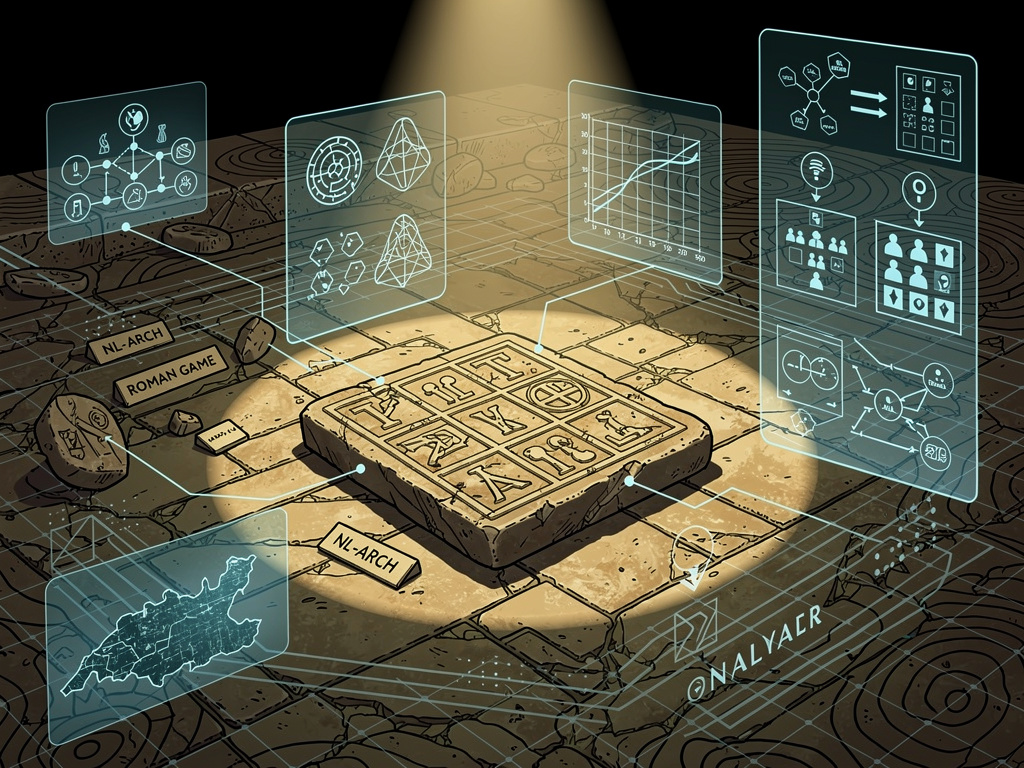
For decades, a smooth white stone unearthed in the Netherlands sat in quiet obscurity, its purpose debated by archaeologists who suspected it was a piece of an ancient board game but could never prove it. Now, in a remarkable convergence of artificial intelligence and classical archaeology, researchers say they have used machine learning to decode the rules of a mysterious Roman-era board game — one that may have entertained legionnaires and civilians alike across the vast expanse of the Roman Empire.
The breakthrough, published by a team of scientists, represents one of the most novel applications of AI in the humanities to date. Rather than simply cataloging artifacts or translating texts, the researchers deployed a sophisticated AI system to reverse-engineer the playable rules of a game that has been lost to history for roughly 1,700 years. The finding has electrified both the archaeological and gaming communities, offering a rare window into the leisure pursuits of ancient peoples.
A Stone That Stumped Scholars for Generations
The story begins with a seemingly unremarkable artifact: a polished, white gaming stone recovered from a Roman-period archaeological site in the Netherlands. As CBS News reported, the stone had long baffled researchers who recognized it as a probable game piece but lacked the contextual evidence to determine what game it belonged to or how that game was played. Ancient board games are notoriously difficult to reconstruct because while physical components — boards, stones, dice — sometimes survive the centuries, the rules were typically transmitted orally or written on perishable materials that have long since disintegrated.
The Roman world was rich with board games. Ludus latrunculorum, a strategy game sometimes compared to chess, and tabula, an ancestor of backgammon, are among the better-documented examples. But archaeological sites across Europe have yielded numerous game boards and pieces that do not neatly correspond to any known game, suggesting that the Romans and their contemporaries played a far wider variety of games than the historical record explicitly describes. The Dutch stone appeared to belong to one of these orphaned games — a pastime popular enough to produce physical artifacts but obscure enough to leave no surviving rulebook.
Teaching Machines to Play Games That No Living Person Remembers
The research team turned to an AI system built on the Ludii General Game System, a digital platform developed as part of the European Research Council–funded Digital Ludeme Project. Ludii is designed to model and play a vast range of board games from throughout human history, encoding them as combinations of fundamental game concepts called “ludemes” — the basic building blocks of game mechanics such as capturing, moving, stacking, and winning conditions. By assembling ludemes in different configurations, the system can generate and evaluate thousands of hypothetical games.
According to CBS News, the researchers fed the AI information about the physical evidence — the size and shape of recovered game boards, the number and type of pieces found at archaeological sites, and any fragmentary historical references. The AI then generated candidate rule sets that were consistent with this evidence, effectively proposing plausible reconstructions of how the game might have been played. Each candidate was evaluated for playability, strategic depth, and historical plausibility, with the machine learning system iterating toward solutions that a human community would have found engaging enough to play repeatedly.
Why This Matters Beyond the Game Board
The implications of this research extend well beyond recreational curiosity. Board games are cultural artifacts of the first order. They encode social values, cognitive priorities, and interpersonal dynamics in ways that pottery shards and foundation stones cannot. A civilization’s games reveal what it considered fun, fair, and intellectually stimulating. Decoding a lost Roman game is, in a meaningful sense, recovering a fragment of Roman thought.
Cameron Browne, a professor at Maastricht University and a leading figure in the Digital Ludeme Project, has been instrumental in developing the computational framework that made this analysis possible. The Ludii system, under his guidance, has cataloged over 1,000 traditional games from across world history, creating what amounts to a computational atlas of human play. The system’s ability to reason about games abstractly — breaking them into modular components and reassembling them — is what allows it to propose rules for games where only physical evidence survives.
The Growing Alliance Between AI and Archaeology
This project is part of a broader trend in which artificial intelligence is being deployed to solve longstanding puzzles in archaeology and ancient history. In recent years, AI has been used to decipher damaged ancient Greek inscriptions, reconstruct fragmented Dead Sea Scrolls, and identify previously unrecognized patterns in cave art. The application to board games, however, is distinctive because it requires the AI to reason not just about what an artifact is, but about how it was used — a fundamentally more complex inferential task.
The challenge is analogous to finding a deck of cards in a ruined building two millennia from now and trying to deduce the rules of poker. The cards themselves contain information — suits, numbers, face cards — but the leap from physical description to playable game requires understanding human psychology, social interaction, and the design principles that make games satisfying. The Ludii system addresses this by incorporating a vast database of known game mechanics, allowing it to identify which combinations of rules are most likely to produce a game that real humans would have enjoyed.
Skeptics Urge Caution on AI-Generated Reconstructions
Not everyone in the academic community is ready to declare the mystery fully solved. Some scholars caution that AI-generated rule sets, however plausible, remain hypotheses rather than established facts. Without a surviving ancient text explicitly describing the rules, there is no way to verify that the AI’s reconstruction matches what Roman-era players actually did. The system identifies the most probable rules given the available evidence, but probability is not certainty.
This caveat is important but should not diminish the achievement. In archaeology, certainty is a rare luxury. Scholars routinely work with probabilistic reconstructions of ancient languages, trade routes, and social structures. The AI-generated game rules meet the same evidentiary standard as many widely accepted archaeological conclusions — they are the best available explanation consistent with the physical evidence. Moreover, the rules can be tested experientially: modern players can try the reconstructed game and assess whether it feels like a coherent, engaging pastime or a random assemblage of mechanics.
What the Romans Might Have Played on a Quiet Evening
While the full technical details of the reconstructed rules have been shared in academic channels, early descriptions suggest a strategy game of moderate complexity — something that could be learned quickly but that rewarded repeated play and tactical thinking. This profile is consistent with what we know about Roman gaming culture, which favored games that could be played in taverns, military camps, and domestic settings with minimal equipment. The game appears to involve the movement and capture of pieces on a grid, with mechanics that bear some resemblance to known ancient games but are distinct enough to constitute a separate tradition.
The discovery also raises tantalizing questions about cultural transmission. If the game was played in the Roman-period Netherlands — a frontier province far from the Mediterranean heartland — it may represent either a game imported by Roman soldiers and administrators or a local tradition adopted or adapted by the Roman occupiers. Either scenario enriches our understanding of cultural exchange along the empire’s northern borders.
A New Chapter in Digital Humanities
The successful decoding of this ancient game’s rules marks a milestone for the Digital Ludeme Project and for the broader field of computational humanities. It demonstrates that AI can do more than process data at scale; it can engage in a form of creative reasoning, proposing solutions to problems that have resisted human analysis for generations. As the Ludii database continues to grow and the underlying algorithms become more sophisticated, researchers expect to tackle additional lost games from cultures around the world — from Mesopotamian gaming boards to enigmatic African stone games whose rules were never recorded by colonial-era ethnographers.
For now, the white stone from the Netherlands has finally found its context. After 1,700 years of silence, it is once again a game piece — and thanks to artificial intelligence, we may finally know how to play.


 WebProNews is an iEntry Publication