
When Elon Musk took the stage at the World Economic Forum in Davos, Switzerland, in late January, he made a bold proclamation that would soon be revealed as more than idle speculation. “The lowest-cost place to put AI will be space,” Musk told the audience, pausing to take a gulp of water. “That will be true within two years, maybe three.”
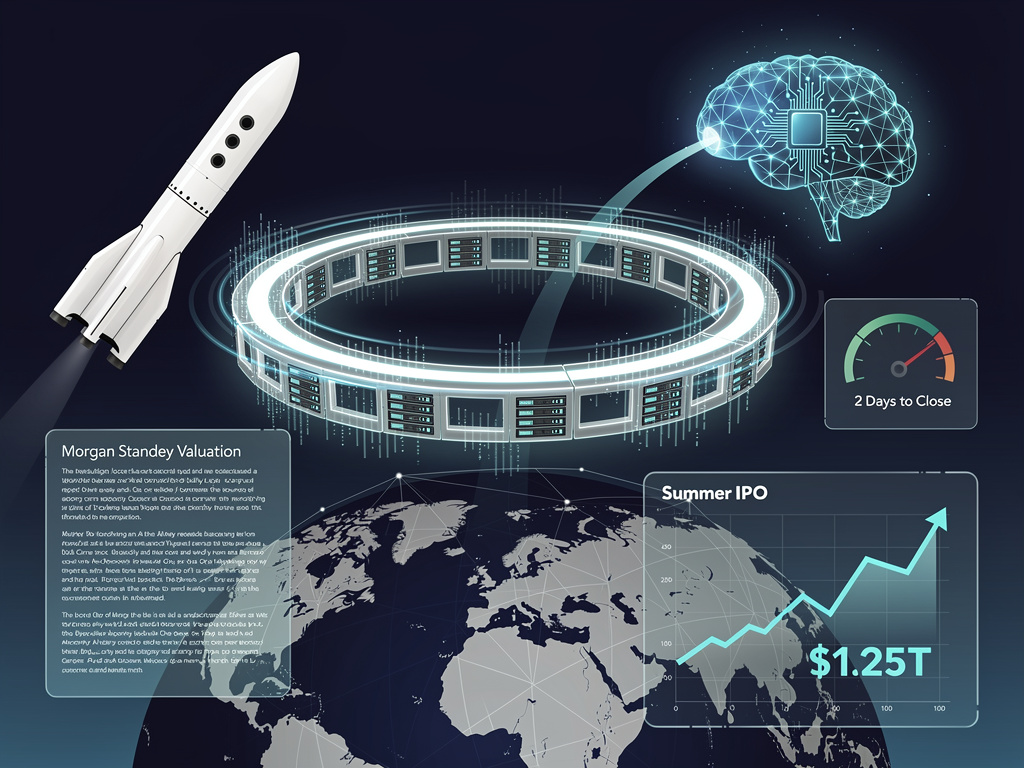
What the audience didn’t know was that behind the curtain, the machinery of one of the most extraordinary corporate transactions in American history was already whirring at full speed. Within days of that speech, SpaceX and xAI—Musk’s artificial-intelligence startup—would sign a merger agreement creating a combined entity valued at $1.25 trillion, as The Wall Street Journal reported. The deal closed just two days after signing, making it the largest corporate tie-up by value in American history and a transaction whose speed and audacity have few precedents in modern dealmaking.
A Technical Breakthrough That Changed Everything
The seeds of this megamerger were planted not in a boardroom but in the engineering labs of SpaceX, where researchers had been quietly studying the feasibility of orbital data centers—computing infrastructure deployed in space, powered by solar energy, and capable of running artificial-intelligence workloads far from the terrestrial constraints of power grids, cooling systems, and real estate. According to the Journal’s reporting, SpaceX achieved a critical technical breakthrough associated with this technology last fall, a development that fundamentally altered the strategic calculus for both companies.
That breakthrough, the details of which remain closely guarded, appears to have convinced Musk and his inner circle that the convergence of AI and space was not a distant aspiration but an imminent commercial reality. The timing was significant. Musk had just secured a key victory in November when Tesla shareholders endorsed his unprecedented $1 trillion compensation package, the largest ever awarded to a public-company executive. Emboldened by that vote of confidence, members of Musk’s inner circle turned their attention to an even more ambitious objective: merging SpaceX and xAI into a single entity capable of executing on the orbital data center vision at scale.
xAI’s Capital Hunger and SpaceX’s Financial Muscle
The merger was driven by a convergence of strategic imperatives. For xAI, the calculus was straightforward: building a world-class artificial-intelligence company requires staggering amounts of capital. Musk has envisioned making xAI’s Grok chatbot the most popular AI in the world, but achieving that goal means competing head-to-head with OpenAI, backed by Microsoft’s tens of billions, and Anthropic, supported by Amazon and Google. Being hitched to SpaceX—a company that told investors it would generate roughly $8 billion in adjusted earnings on $16 billion in revenue in 2025—gives xAI the financial muscle to wage that war.
For SpaceX, the rationale was more nuanced. The company had already been one of xAI’s earliest enterprise customers, scaling up internal use of Spok—a tailored version of Grok trained on SpaceX’s proprietary data. Last summer, SpaceX invested directly in xAI while simultaneously pressing forward with its busy launch schedule and expanding its Starlink satellite-internet service. The two companies were already deeply intertwined; the merger formalized a relationship that had been building for months. As The Economic Times reported, the transaction also carried significant tax, financial, and legal benefits for investors on both sides of the deal.
The Davos Speech and the Sprint to Close
The timeline of the deal’s execution is remarkable even by the standards of Musk, who is known for moving at velocities that make traditional corporate governance structures look glacial. On January 21—the day before Musk’s Davos appearance—SpaceX filed documents in Nevada, where xAI is incorporated, to create new entities overseen by SpaceX Chief Financial Officer Bret Johnsen. Those entities carried the name K2, an apparent homage to the Kardashev scale, the theoretical framework that measures a civilization’s technological advancement by its capacity to harness energy, including from stars. The naming choice was a not-so-subtle signal of the ambition at play.
The next day, as Musk publicly evangelized orbital data centers in Davos, the professionals tasked with structuring the deal were already deep into their work. Bankers at Morgan Stanley—long Musk’s bank of choice—were engaged to provide valuation guidance for both companies. In an arrangement that raised some eyebrows among dealmaking veterans, Morgan Stanley worked on both sides of the transaction. In a typical merger, each company retains its own financial advisers to ensure it is getting a fair deal. But in this case, Musk controls both companies, making the dual-advisory role less surprising if still unusual.
Morgan Stanley’s Valuations and the Board Decisions
Morgan Stanley’s bankers moved quickly. At the high end, the bank estimated SpaceX could be valued at as much as $1.26 trillion—far above the $800 billion valuation the company had targeted in a recent secondary stock sale. For xAI, the bank suggested a potential valuation of up to $294 billion. Both boards opted for clean, round numbers: SpaceX’s board decided as of January 30 that the company was worth $1 trillion, and xAI’s board decided it was worth $250 billion, according to investor disclosures reviewed by the Journal.
Notably, Morgan Stanley did not provide a formal “fairness opinion” on the valuations—a common feature in many mergers and acquisitions designed to assure shareholders that the terms are reasonable. While fairness opinions are less common in transactions between private companies, the absence of one in a deal of this magnitude has drawn scrutiny. Steve Kaplan, a professor of finance at the University of Chicago’s Booth School of Business, compared the transaction to deals from the dot-com era. “That’s the thing that’s very hard here,” Kaplan told the Journal. “They’ve come up with their valuations and their share exchange rates, and you don’t know how accurate those numbers are, particularly since neither one is public.”
A Blueprint Forged in the X-xAI Merger
The SpaceX-xAI merger did not emerge from a vacuum. It followed a template established by Musk’s earlier consolidation of X, the social-media platform formerly known as Twitter, with xAI. That deal, completed last year, combined the two companies into a single entity valued at an estimated $113 billion. Before the merger, X had owned a stake in xAI and the two companies conducted business with each other—a pattern of cross-pollination that Musk has increasingly employed across his corporate empire.
The X-xAI transaction served as a blueprint of sorts for the far larger SpaceX deal. In both cases, Musk leveraged existing commercial relationships between his companies to justify strategic combinations that might otherwise seem like forced marriages. The logic is consistent with Musk’s long-stated belief that his various ventures—Tesla, SpaceX, xAI, Neuralink, The Boring Company—are not separate businesses so much as different facets of a unified mission to advance human civilization. Whether investors share that vision, or whether they see it as a convenient narrative for transactions that primarily serve Musk’s interests, depends largely on whom you ask.
The Investor Calculus: Windfall and Risk
For xAI investors, the merger represents a potentially enormous windfall. The transaction hands them a roughly 20% stake in the combined company, giving them exposure to SpaceX’s proven revenue streams from Starlink and its launch business. For a startup that had been burning through capital at a prodigious rate—xAI had broken ground on a second data-center project near Memphis, Tennessee, even as several executives departed over concerns about its management and financial health—the merger provides a level of stability and credibility that would have been difficult to achieve independently.
However, some longtime SpaceX investors are less enthusiastic. They have had to make room for xAI’s shareholders in a company they invested in primarily for its space capabilities, and they now face the prospect of supporting an artificial-intelligence venture through what some believe could be a bubble reminiscent of the late 1990s. The comparison to the $180 billion AOL-Time Warner merger—widely regarded as one of the worst deals in corporate history—has been raised by skeptics, though supporters counter that the analogy is flawed because the underlying technology in this case is far more advanced and commercially viable.
The Orbital Data Center Thesis
At the heart of the merger’s rationale is Musk’s conviction that space-based computing will eventually be cheaper and more efficient than terrestrial alternatives. The thesis rests on several premises: solar energy in orbit is abundant and uninterrupted by weather or nighttime cycles; the vacuum of space provides natural cooling for heat-generating processors; and SpaceX’s Starship rocket, still under development, could deploy orbital data centers at scale in much the same way the company’s Falcon 9 rocket deployed the largest satellite fleet in history with Starlink.
The vision is undeniably compelling, but it remains largely unproven at commercial scale. Deploying, maintaining, and networking data centers in orbit presents engineering challenges that dwarf even those associated with Starlink. Latency, bandwidth, radiation hardening, and the sheer logistics of servicing hardware in space are all formidable obstacles. In a memo sent to employees on Monday, Musk said that starting launches of AI satellites is the company’s immediate focus—a signal that the orbital data center program is being treated not as a long-term research project but as a near-term operational priority.
The Road to IPO and What Comes Next
The merger also sets the stage for what could be one of the most anticipated initial public offerings in history. On a call with investors on Monday, SpaceX representatives including CFO Johnsen confirmed plans to take the combined company public this summer, according to people familiar with the discussions. An IPO would give both SpaceX and xAI investors their first opportunity to realize gains on their holdings in public markets, and it would subject the combined company’s financials and strategy to the kind of scrutiny that comes with public reporting requirements.
The IPO timing is notable. Taking the company public while enthusiasm for both AI and space technology remains at elevated levels could maximize the valuation Musk achieves. But it also means that public-market investors will be asked to buy into a company whose valuation is predicated in significant part on technology—orbital data centers—that has not yet been demonstrated at scale. The $1.25 trillion valuation already prices in a considerable amount of future success.
Musk’s Empire and the Concentration of Power
Ross Gerber, an independent investment adviser and longtime investor in Musk companies including X and Tesla, offered a characteristically blunt assessment of what it means to be a Musk investor. “You invest with Elon and that is what you get, and if you don’t like it, you leave,” Gerber told the Journal. The comment captures a fundamental truth about Musk’s corporate governance style: he moves fast, he takes enormous risks, and he expects his investors to trust his judgment even when the path forward is uncertain.
For Musk’s corporate maneuvers, the track record has often been lucrative. Banks that held underwater debts from his buyout of Twitter were ultimately repaid at around 100 cents on the dollar plus years of high-interest payments—a result that few predicted at the time of the acquisition. Whether the SpaceX-xAI merger will prove similarly rewarding depends on execution. The combined company must demonstrate that orbital data centers are commercially viable, that xAI can compete with far better-funded rivals, and that the synergies between space infrastructure and artificial intelligence are real rather than theoretical.
A Bet on the Convergence of Two Frontiers
Merging SpaceX and xAI represents a level of risk-taking and ambition that is novel even for Musk. The $1.25 trillion value assigned to the new SpaceX is simultaneously a bet on the convergence of AI and space, a wager on unproven technology deployed at vast scale, and a test of whether one entrepreneur’s vision can reshape two of the most capital-intensive industries on—and off—Earth. The deal was conceived in the wake of a technical breakthrough, executed at breakneck speed, and structured with a confidence that borders on audacity.
Whether history will record this merger as a masterstroke or a cautionary tale remains to be seen. What is already clear is that the transaction has no real precedent. No company has ever attempted to combine a leading rocket and satellite operator with a frontier AI company, and no private merger has ever approached this scale. As the combined SpaceX prepares for its summer IPO, the world will be watching to see whether Musk’s grandest vision yet—artificial intelligence powered by the stars—can survive contact with reality.


 WebProNews is an iEntry Publication