
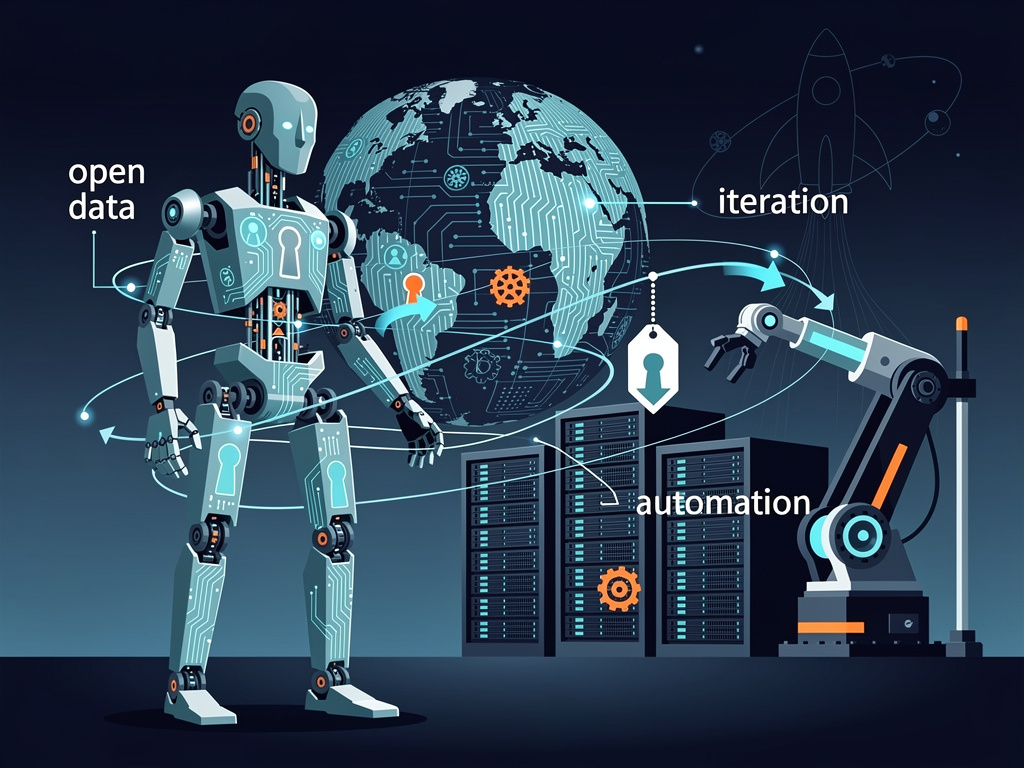
In a Palo Alto garage that feels distinctively more industrial than the polished showrooms of its competitors, a team of engineers with resumes stamped by NASA and SpaceX is attempting to dismantle the prevailing business model of the robotics sector. K-Scale Labs, a newcomer to the crowded field of embodied artificial intelligence, recently unveiled the K1, a humanoid robot developed in a timeline that defies the traditional multi-year hardware cycles of Silicon Valley. While established giants like Tesla and Boston Dynamics have spent decades refining proprietary hydraulics and actuators, this nimble startup is betting that the future of automation lies not in walled gardens, but in the chaotic, rapid iteration of open-source hardware.
The premise driving K-Scale is a direct challenge to the capital-intensive strategies of Figure AI and Agility Robotics. By utilizing off-the-shelf components and 3D-printed parts, the company aims to democratize access to humanoid platforms, effectively attempting to do for robotics what the PC did for computing in the 1980s. According to a recent report by TechCrunch via MSN, the team successfully moved from digital design to a walking prototype in under a year, a pace typically reserved for software startups rather than complex mechatronics ventures.
The Strategic Pivot from Proprietary Hardware Monoliths to Modular, Repairable Open-Source Ecosystems
The industrial logic behind the K1 is rooted in cost suppression. Traditional humanoid robots carry a bill of materials (BoM) that can easily exceed $50,000, pushing the retail price well into six figures—a prohibitive entry point for many logistics and manufacturing firms looking to automate. K-Scale’s approach mirrors the commoditization seen in the drone industry, where standardized parts drove prices down and adoption up. By releasing their hardware designs and software kernel to the public, they are inviting the global engineering community to troubleshoot, improve, and effectively subsidize their R&D efforts. This stands in stark contrast to the secretive development cycles of Tesla’s Optimus, where updates are controlled tightly by a central authority.
This methodology also addresses a critical bottleneck in the sector: data collection. For embodied AI to function effectively in unstructured environments—like a cluttered warehouse or a busy factory floor—it requires millions of hours of training data. A proprietary robot limited to a few dozen pilot programs generates data linearly. An open-source robot, built and operated by thousands of hobbyists, universities, and startups, generates data exponentially. As noted in a recent analysis by IEEE Spectrum, the race to solve general-purpose robotics is less about the dexterity of the fingers and more about the volume of edge-case data the neural networks can ingest.
Navigating the Engineering Reality Gap Between Simulation and the Unforgiving Physics of the Factory Floor
However, the transition from a controlled lab environment to the unpredictable chaos of an industrial facility remains the primary failure point for automation startups. The pedigree of K-Scale’s founders, which includes tenure at SpaceX, suggests a familiarity with high-stakes hardware reliability. Yet, the physics of a rocket launch, while extreme, are arguably more predictable than the variables of a logistics fulfillment center where human workers, dropped packages, and shifting lighting conditions create a nightmare for sensor fusion algorithms. The K1 must prove it possesses not just the mechanical durability to withstand 24/7 operation, but the cognitive resilience to handle errors without requiring constant human intervention.
Investors are watching closely to see if the “move fast and break things” ethos of software can truly apply to hardware that weighs nearly 100 pounds and operates alongside humans. A recent report from Bloomberg highlights that while venture capital continues to pour into the sector—evidenced by Physical Intelligence’s recent $400 million raise—manufacturing partners are becoming increasingly demanding regarding return on investment. The novelty of a walking robot has faded; logistics giants like GXO and Amazon now demand specific metrics on pick rates, uptime, and battery cycles before committing to fleet-wide deployments.
The Economic Implications of Sub-$15,000 Humanoids on the Global Labor Market and Supply Chain
If K-Scale meets its target of a sub-$15,000 price point, the economic calculus of automation shifts largely. At $150,000, a robot must work multiple shifts for three years to break even against human labor costs in Western markets. At $15,000, the payback period shrinks to months, making automation viable not just for automotive giants but for mid-sized machine shops and local distribution centers. This potential price collapse pressures competitors to rethink their supply chains. Figure AI and Apptronik rely on high-performance, custom actuators that offer superhuman precision. K-Scale is wagering that the market prefers “good enough” performance at a fraction of the cost, similar to how generic robotic arms eventually captured market share from high-end specialized units.
Furthermore, the open-source nature of the project creates a secondary market for modifications. Just as the Linux operating system became the backbone of the internet server infrastructure, K-Scale envisions their platform becoming the standard chassis upon which specific industrial applications are built. A third-party developer could, in theory, design a specialized gripping hand for textile manufacturing and deploy it on the K1 frame without needing permission or paying licensing fees to the parent company. This ecosystem approach could accelerate the deployment of robots into niche industries that major players like Tesla deem too small to service directly.
The Persistent Challenge of Energy Density and the Tether of Battery Technology in Mobile Robotics
Despite the optimism surrounding software and kinematics, the hard limit for all humanoid platforms remains energy storage. Assessing the MSN report on the K1, details on battery life under heavy load are scant. Industrial shifts typically last eight to twelve hours. Current battery technology generally allows for four to five hours of continuous, heavy-lifting operation before a recharge is necessary. While companies like Agility Robotics have implemented autonomous charging docks, the downtime remains a productivity leak. The open-source community may offer novel solutions here as well, experimenting with swappable battery packs or tethered power systems for stationary tasks, innovations that a rigid product roadmap might overlook.
The convergence of generative AI with robotics has provided the reasoning capabilities these machines lacked for decades. The Large Language Model (LLM) allows a robot to understand a command like “clean up that spill” by breaking it down into sub-tasks: identify spill, locate mop, execute cleaning motion. K-Scale’s integration of these models into a low-cost frame suggests a future where intelligence is cheap, but mechanical execution is the commodity. As confirmed by recent updates from Reuters regarding the sector, the differentiation is moving away from who can build the best legs to who can build the most adaptable brain.
Assessing the Long-Term Viability of Open-Source Business Models in a Hardware-Dominant Industry
Questions remain regarding the long-term monetization strategy of K-Scale. Open-source hardware companies notoriously struggle to protect margins. If the blueprints are free, Chinese manufacturers can—and likely will—clone the device and sell it for the cost of parts plus shipping. K-Scale’s defense likely lies in the cloud services and fleet management software that orchestrate these robots, a model successfully employed by enterprise open-source software companies like Red Hat. By owning the standard and the update pipeline, they can extract value even if the hardware itself becomes a race to the bottom.
The arrival of K-Scale Labs signals a maturation in the robotics sector. The era of the breathless tech demo is ending; the era of the cost-benefit analysis has begun. With ex-SpaceX engineers applying the same rigorous cost-cutting and iterative design principles to humanoids that lowered the cost of putting satellites into orbit, the industrial robot is transitioning from a futuristic curiosity to a line item on a procurement spreadsheet. Whether the K1 becomes the Model T of robotics or merely a stepping stone for a better-funded competitor remains to be seen, but the trajectory toward accessible, intelligent automation is now irreversible.


 WebProNews is an iEntry Publication