
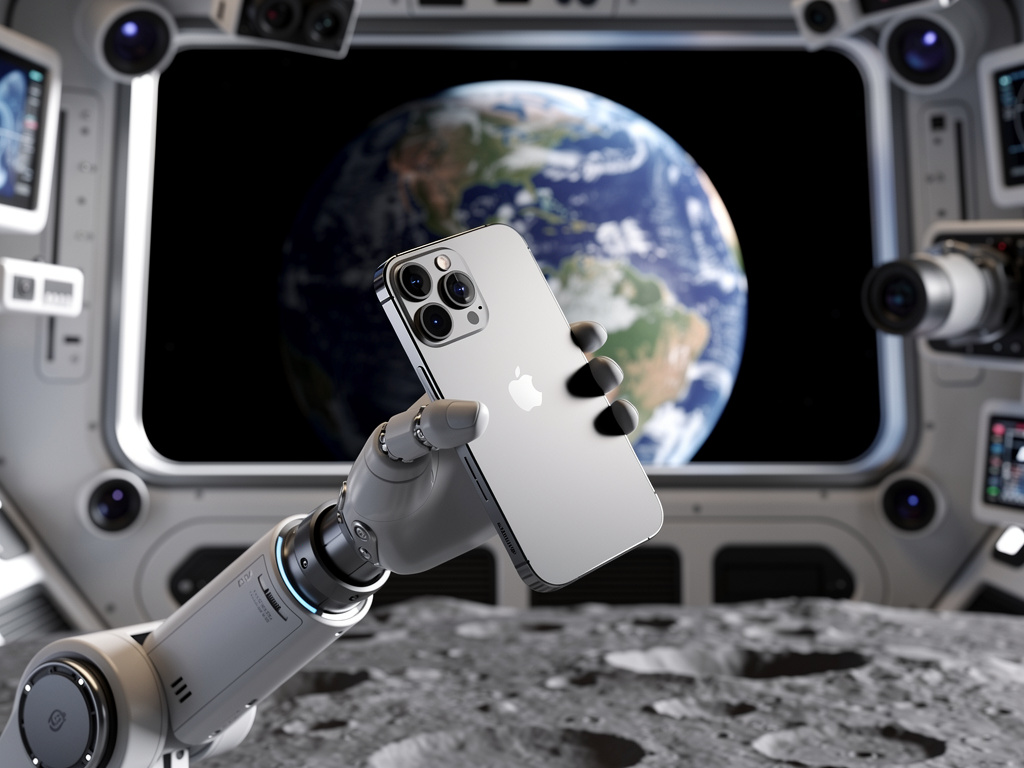
Four astronauts aboard NASA’s Artemis II spacecraft did something last week that no human had done in more than half a century. They looked back at Earth from beyond low orbit — and they captured the moment on an iPhone.
The image, already being called a successor to the iconic 1972 “Blue Marble” photograph, shows a luminous, cloud-streaked Earth suspended against the black void of space, framed by the subtle curvature of the lunar horizon. It is breathtaking. It is also, unmistakably, a product of consumer technology that fits in a pocket.
As first reported by 9to5Mac, NASA confirmed that the photograph was taken using an Apple iPhone — believed to be a modified iPhone 17 Pro — equipped with the device’s built-in camera system. The agency published the image on April 6, 2026, and within hours it had been shared millions of times across social media platforms, drawing comparisons not just to Blue Marble but to the 1968 “Earthrise” photo taken during Apollo 8.
The photo wasn’t an accident or a casual tourist snap. NASA and Apple had been working together for months ahead of the Artemis II mission, which launched in late March carrying astronauts Reid Wiseman, Victor Glover, Christina Koch, and Canadian Space Agency astronaut Jeremy Hansen on a flyby trajectory around the Moon. The collaboration involved adapting the iPhone’s computational photography capabilities — its sensor fusion, multi-frame processing, and machine learning–driven image pipeline — to perform in the harsh conditions of deep space, where radiation, temperature extremes, and the absence of atmospheric filtering present challenges no smartphone was originally designed to face.
Apple has not issued a detailed public statement about the technical modifications made to the device. But according to 9to5Mac, the phone used aboard Artemis II was fitted with additional radiation shielding and thermal protection, while the core imaging hardware — including the 48-megapixel main sensor and the tetraprism telephoto lens — remained essentially stock. The software, however, was reportedly updated with a custom firmware build tuned for the unique lighting conditions of cislunar space, where the Sun’s unfiltered light creates extreme dynamic range between illuminated surfaces and the pitch-dark background of space.
That last point matters more than it might seem.
Photographing Earth from deep space is a notoriously difficult technical problem. The planet is brilliantly lit on one side and invisible on the other. Atmospheric haze scatters light in unpredictable ways. And the spacecraft itself is moving at thousands of miles per hour, meaning even slight vibrations or timing errors can ruin a shot. During the Apollo missions, astronauts used specially modified Hasselblad cameras loaded with large-format film — equipment that was purpose-built for the task and cost, in today’s dollars, tens of thousands per unit.
The fact that a device sold at Apple Stores for around $1,199 produced an image of comparable — some would argue superior — visual quality to those Apollo-era photographs says something profound about where computational photography has arrived. Not where it’s going. Where it already is.
Apple’s “Shot on iPhone” marketing campaign has been running since 2015, featuring everything from wildlife photography to professional short films. But nothing in the campaign’s history approaches the cultural weight of an image taken from lunar orbit. The company’s marketing team surely understands this. Within hours of NASA’s release, Apple’s official social media accounts had reposted the image with the now-familiar tagline.
For Apple, the timing is almost suspiciously perfect. The company is expected to announce the iPhone 18 lineup later this year, and the Artemis II photo gives it perhaps the most dramatic proof point any consumer electronics company has ever had for its camera technology. No amount of studio testing or influencer partnerships can compete with a photograph of Earth taken from 240,000 miles away.
But this isn’t just a marketing story.
NASA’s decision to include a consumer smartphone among the imaging tools aboard a crewed deep-space mission reflects a broader shift in how the agency thinks about technology procurement and public engagement. For decades, every piece of equipment that flew on a NASA mission was custom-engineered, tested to extremes, and certified through a process that could take years. That approach isn’t disappearing — the Orion spacecraft’s primary imaging systems are still highly specialized instruments — but the agency has grown increasingly willing to incorporate commercial off-the-shelf hardware where it makes sense.
The International Space Station has hosted iPhones and iPads for years, primarily as tools for crew communication and for running experimental apps. SpaceX’s Inspiration4 mission in 2021 used an iPhone to help manage some onboard operations. And NASA’s own Jet Propulsion Laboratory has experimented with smartphone-grade sensors in CubeSat missions. So the conceptual leap from “iPhones in low Earth orbit” to “iPhones in lunar orbit” is smaller than it sounds. But the symbolic leap is enormous.
Reid Wiseman, the mission commander, reportedly took the photograph through one of Orion’s window ports during the spacecraft’s closest approach to the Moon. According to NASA’s mission timeline, the crew had a window of roughly 20 minutes during which Earth was optimally positioned — fully illuminated by the Sun, with the Moon’s surface visible in the foreground. Wiseman, a Navy test pilot and veteran of a previous ISS expedition, apparently took several dozen frames in rapid succession using the iPhone’s burst mode, then selected the final image in consultation with the crew and mission control.
The result is an image of startling clarity. Earth’s oceans are a vivid blue, the continents sharply defined beneath swirling cloud patterns. Africa and the Arabian Peninsula are visible in the center of the frame, with Europe partially obscured by a weather system moving across the North Atlantic. The Moon’s surface, grey and cratered, occupies the lower portion of the image, providing a sense of scale that is both beautiful and disorienting.
Professional photographers and imaging experts have weighed in with largely positive assessments, though some have raised questions about how much computational processing was applied to the final image. Modern iPhones don’t produce truly “raw” photographs in the traditional sense — every image passes through Apple’s neural engine, which applies noise reduction, tone mapping, sharpening, and color adjustments in real time. The question of whether a computationally processed photograph represents “reality” is an old debate in digital photography circles, but it takes on new dimensions when the subject is a view of Earth that only a handful of humans have ever witnessed firsthand.
NASA has said it will release additional images from the mission, including some taken with the Orion spacecraft’s dedicated camera systems, which will allow direct comparisons. The agency has also indicated that the raw sensor data from the iPhone will be made available to researchers, a move that could provide valuable information about how smartphone imaging sensors perform in high-radiation environments beyond the Van Allen belts.
There’s a historical resonance here that’s hard to overstate. The original Blue Marble photo, taken by the crew of Apollo 17 on December 7, 1972, became one of the most reproduced images in human history. It’s credited with helping catalyze the environmental movement by giving humanity its first clear, full-disk view of the planet as a fragile, finite sphere. “Earthrise,” taken four years earlier during Apollo 8, had a similar cultural impact — nature photographer Galen Rowell called it “the most influential environmental photograph ever taken.”
Whether the Artemis II iPhone image achieves that kind of lasting significance remains to be seen. But the early public response suggests it has struck a nerve. Part of that is the sheer beauty of the photograph. And part of it is the cognitive dissonance of knowing it was taken on a phone.
That dissonance is the point. When the Apollo astronauts captured their famous images, the equipment they used was exotic, inaccessible, almost alien to ordinary people. The Hasselblad 500EL cameras were modified specifically for spaceflight. The film was specially formulated by Kodak. Everything about the process was extraordinary. The Artemis II photo, by contrast, was taken on a device that hundreds of millions of people carry in their pockets every day. The technology isn’t alien. It’s intimate. And that intimacy makes the image feel different — closer, more personal, more democratically owned.
Apple CEO Tim Cook posted the image on X with a brief comment: “This is what iPhone was made for.” A characteristically understated claim for a photograph taken from lunar orbit.
For NASA, the mission itself is a milestone independent of any camera work. Artemis II is the first crewed flight of the Space Launch System rocket and Orion capsule, and the first time humans have traveled beyond low Earth orbit since Apollo 17 in 1972. The mission is a precursor to Artemis III, which aims to land astronauts on the lunar surface — including the first woman and the first person of color to walk on the Moon. The program has faced years of delays and billions in cost overruns, and public enthusiasm, while genuine, has sometimes been muted by the slow pace of progress. A single, stunning photograph has a way of cutting through that noise.
The space photography community has already begun analyzing the image in granular detail. Several accounts on X noted that the iPhone’s computational HDR processing appears to have handled the extreme contrast between the sunlit Earth and the dark sky more effectively than might be expected, preserving detail in both the bright cloud tops and the shadowed regions of the continents. Others pointed out subtle lens flare artifacts near the edge of the frame — evidence, they said, that the image hadn’t been heavily retouched after capture.
So where does this leave the relationship between consumer technology and space exploration? NASA administrator Bill Nelson, in a press briefing following the photo’s release, suggested that partnerships with companies like Apple represent a new model for the agency — one in which the private sector’s pace of innovation in areas like imaging, computing, and communications can be harnessed for missions that would otherwise rely entirely on government-developed systems. “The best camera,” Nelson said, paraphrasing the old photographer’s adage, “is the one you have with you. And right now, the one everyone has is pretty extraordinary.”
He’s not wrong. The iPhone’s camera system, the product of more than a decade of relentless annual improvement and billions of dollars in R&D, now incorporates sensor technology, optical stabilization, and neural processing capabilities that rival or exceed dedicated cameras costing several times more. Apple’s investment in custom silicon — particularly the neural engine cores embedded in its A-series and M-series chips — has given the iPhone a computational photography advantage that competitors have struggled to match. The Artemis II photo is, in a sense, the ultimate stress test for that investment.
And it passed.
The mission is expected to continue for several more days before the Orion capsule reenters Earth’s atmosphere and splashes down in the Pacific Ocean. More images will follow. But it’s hard to imagine any of them surpassing the impact of the first one — a small blue world, impossibly bright, seen from farther away than any smartphone has ever been, captured in a fraction of a second by a machine designed to take pictures of latte art and golden retrievers.
Sometimes the most powerful photographs aren’t planned. They happen because someone with a camera — any camera — looks up at the right moment. In this case, Commander Wiseman looked back. And 240,000 miles away, Earth looked perfect.


 WebProNews is an iEntry Publication