
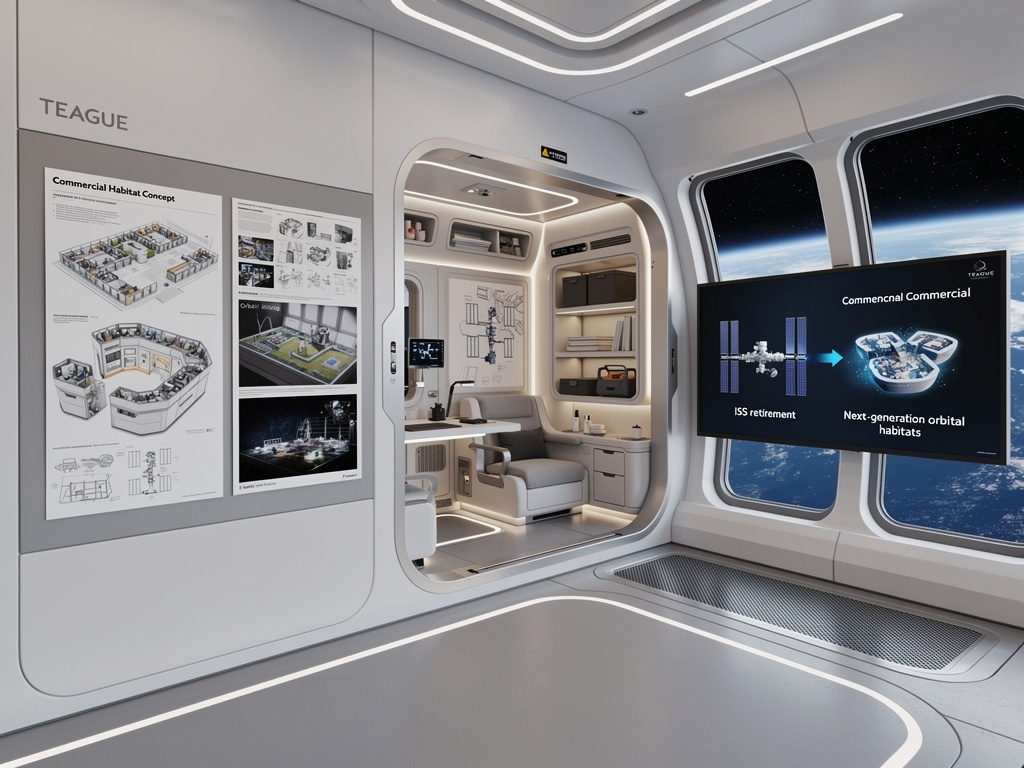
For decades, the name Teague has been synonymous with the interior experience of commercial aviation. The Seattle-based design firm has shaped the cabins of Boeing aircraft, crafted the look of Nike retail spaces, and reimagined how millions of passengers interact with the confined quarters of air travel. Now, the firm is taking its deep expertise in human-centered design to an environment far more extreme and far more consequential: outer space.
As the commercial space station race accelerates — with NASA’s International Space Station slated for deorbiting around 2030 — Teague has quietly positioned itself as one of the most important design voices in the next chapter of human habitation beyond Earth. The firm is working on interior concepts for commercial space stations, applying lessons learned from decades of designing for the constraints of pressurized aluminum tubes hurtling through the atmosphere to the even more demanding constraints of pressurized modules orbiting 250 miles above the planet’s surface.
A Design Pedigree Built at 35,000 Feet — Now Aimed at Low Earth Orbit
According to GeekWire, Teague’s involvement in space station design represents a natural evolution of the firm’s core competency: making small, enclosed spaces livable, functional, and even enjoyable for human beings. The firm has spent more than 80 years working with Boeing on aircraft interiors, an engagement that has given Teague an unrivaled understanding of how people behave, move, sleep, eat, and maintain psychological well-being in cramped environments where every cubic inch matters. That knowledge base is now being translated directly into orbital habitat design.
The challenge of designing a space station interior is, in many ways, an amplified version of the challenge of designing an airplane cabin. In both cases, volume is severely limited, weight is a critical constraint, and the human occupants must be able to live and work for extended periods without the psychological toll of confinement becoming debilitating. But in microgravity, the problems multiply. There is no fixed “floor” or “ceiling.” Fluid dynamics behave differently. Sleep architecture changes. Even the simple act of eating a meal becomes an engineering and design problem. Teague’s designers have had to rethink spatial orientation from first principles.
Why NASA’s ISS Retirement Is Creating a Multibillion-Dollar Design Opportunity
The urgency behind this work is driven by a hard deadline. NASA has committed to transitioning from the International Space Station to commercially operated successors by the end of the decade. The agency has awarded contracts to multiple companies — including Axiom Space, Blue Origin’s Orbital Reef consortium, and Vast — to develop commercial destinations in low Earth orbit. These stations will not merely serve government astronauts; they are expected to host private researchers, manufacturing operations, tourists, and potentially even media productions. The design requirements for such a diverse user base are fundamentally different from those of a government research laboratory.
This is where Teague’s airline heritage becomes a strategic asset. Commercial aviation underwent a similar transformation decades ago, evolving from a utilitarian mode of military-derived transport into a consumer experience industry where seat pitch, lighting color temperature, and lavatory design became competitive differentiators. Teague was at the center of that transformation. The firm’s designers understand that when you are selling an experience — whether it is a 14-hour transpacific flight or a 10-day orbital stay — the quality of the interior environment is not a secondary consideration. It is the product.
Microgravity Demands a Complete Rethinking of How Humans Use Space
As reported by GeekWire, one of the most fascinating aspects of Teague’s space station work is the way microgravity forces designers to abandon assumptions that are so deeply embedded in terrestrial architecture that they are almost invisible. On Earth, gravity organizes human life along a vertical axis. Furniture sits on floors. Lighting comes from above. People orient themselves relative to the ground beneath their feet. In orbit, none of these conventions apply. A well-designed orbital habitat must allow occupants to use all surfaces of a module — what would be walls, floors, and ceilings on Earth become equally valid work and rest surfaces in space.
Teague’s designers have explored concepts that take advantage of this three-dimensional freedom rather than fighting it. Instead of trying to recreate the illusion of a terrestrial room — an approach that some early space habitat concepts have attempted — the firm has investigated designs that embrace the unique possibilities of weightlessness. This includes configurable interior zones that can be reoriented depending on the task at hand, lighting systems that provide spatial cues without enforcing a single “up” direction, and personal quarters that maximize privacy and comfort in volumes that would feel impossibly small on the ground but become surprisingly spacious when every surface is usable.
The Psychology of Confinement: Lessons From Long-Haul Aviation
Perhaps the most underappreciated dimension of Teague’s contribution is in the realm of environmental psychology. Decades of research — much of it conducted in partnership with airlines — have given the firm a sophisticated understanding of how lighting, color, material texture, acoustic dampening, and spatial proportion affect human mood, stress levels, and cognitive performance. These factors are even more critical in an orbital environment, where crew members cannot step outside for fresh air, cannot open a window for natural light, and cannot escape the constant hum of life-support machinery.
On the ISS, astronauts have frequently reported that the station’s interior — a utilitarian tangle of cables, equipment racks, and Velcro strips — contributes to a sense of psychological monotony that can erode morale over the course of a six-month mission. NASA has studied this problem extensively, and the agency’s human factors research has emphasized the importance of what designers call “restorative environments” — spaces that provide visual and sensory variety, opportunities for solitude, and connections to nature or other calming stimuli. Teague’s space station concepts incorporate these principles, drawing on the firm’s experience creating premium airline cabin environments that use carefully calibrated lighting transitions, natural material palettes, and intuitive spatial organization to reduce passenger stress.
Commercial Viability Hinges on the Interior Experience
The commercial imperative driving this design work cannot be overstated. Unlike the ISS, which was funded almost entirely by government space agencies, the next generation of orbital stations must generate revenue from a mix of government contracts, private research clients, in-space manufacturing, and space tourism. For the tourism segment in particular, the interior experience will be the primary value proposition. A ticket to orbit may cost tens of millions of dollars. At that price point, customers will expect an environment that is not merely functional but genuinely extraordinary.
This is a lesson the luxury hospitality industry learned long ago, and it is one that Teague is well positioned to apply. The firm’s work on premium airline cabins — including first-class suites that rival boutique hotel rooms in their attention to detail — has given its designers fluency in the language of high-end experiential design. Translating that fluency into a microgravity context requires significant adaptation, but the underlying principles are the same: understand the user’s emotional journey, anticipate their needs before they articulate them, and create an environment that feels simultaneously safe and inspiring.
The Competitive Field and Teague’s Distinctive Position
Teague is not the only design firm eyeing the commercial space station market. Philippe Starck has contributed interior concepts for Axiom Space’s planned station modules, and various aerospace contractors have in-house industrial design teams working on habitat interiors. But Teague’s combination of deep Boeing heritage, decades of human-factors research in pressurized environments, and a portfolio that spans consumer electronics, automotive, and aviation gives it a breadth of cross-disciplinary expertise that few competitors can match.
The firm’s Seattle location also places it at the geographic epicenter of the commercial space industry’s design and engineering talent pool. Blue Origin’s headquarters is in nearby Kent, Washington. Boeing’s space division has a significant Pacific Northwest presence. And the region’s broader technology ecosystem — anchored by Amazon, Microsoft, and a dense network of aerospace suppliers — provides a rich environment for the kind of cross-pollination between software, hardware, and design thinking that next-generation space habitats will require.
What the Next Five Years Will Determine for Orbital Living
The decisions being made now about space station interiors will have consequences that extend far beyond the first generation of commercial orbital habitats. The design patterns, material choices, and spatial configurations that are validated in the late 2020s and early 2030s will establish precedents for decades of human life in space — much as the early decisions about aircraft cabin layout in the mid-20th century established conventions that persist to this day. Teague’s designers appear acutely aware of this responsibility.
As the ISS retirement clock ticks down, the race to build its commercial successors is intensifying. Billions of dollars in NASA contracts and private investment are flowing into companies developing orbital infrastructure. But hardware alone will not determine which stations succeed. The stations that attract and retain customers — whether they are government astronauts, pharmaceutical researchers, or wealthy tourists — will be the ones that get the interior experience right. In that contest, a design firm that has spent 80 years making people comfortable in pressurized tubes at altitude may hold the most relevant expertise on the planet — or above it.


 WebProNews is an iEntry Publication