
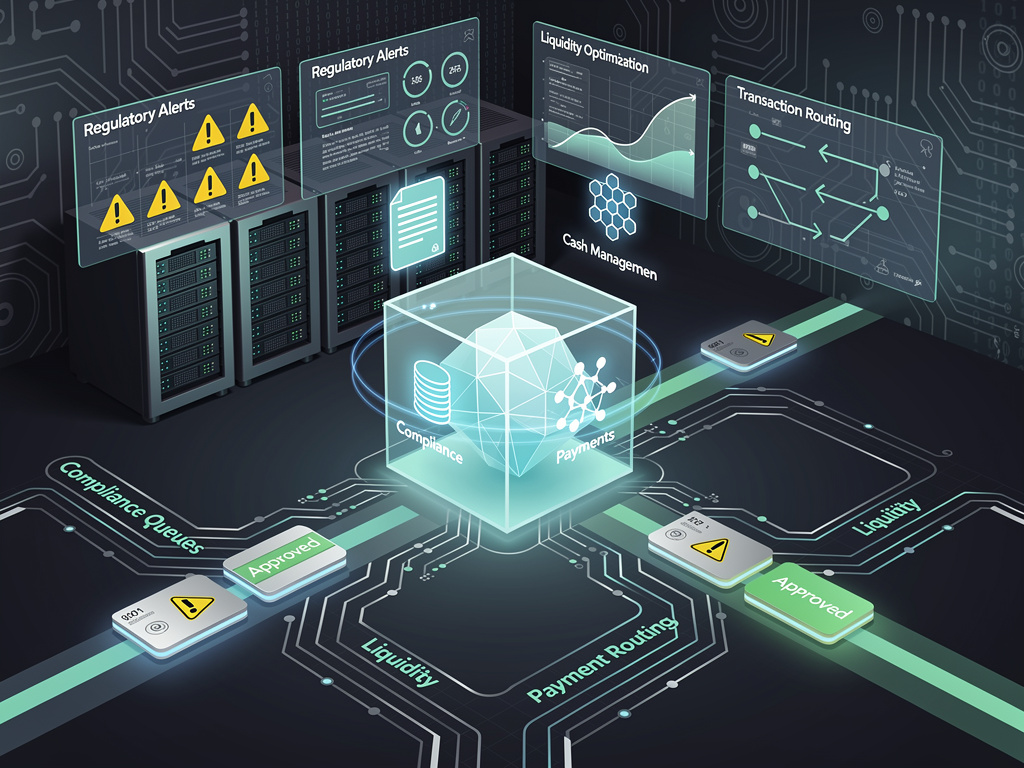
For years, artificial intelligence in banking meant one thing to most consumers: a chatbot that could answer questions about account balances or help reset a password. That era is rapidly drawing to a close. The industry’s largest institutions are now deploying AI agents — autonomous software systems capable of initiating, executing, and monitoring financial transactions — deep inside the operational machinery that moves trillions of dollars daily.
The shift represents a fundamental evolution in how banks think about automation. Rather than serving as a digital concierge at the front door of a financial institution, AI is migrating into the back office, embedding itself in compliance queues, cash management dashboards, and payment routing engines where it doesn’t just advise — it acts. As PYMNTS reported, banks are shifting AI from chatbots to autonomous money movement, a transition that is redefining the operational architecture of modern finance.
The Quiet Revolution Inside Bank Operations
The transformation is not happening on consumer-facing apps or marketing websites. It is unfolding in the less visible but far more consequential infrastructure that underpins global banking. AI agents are now being tasked with initiating wire transfers, flagging and resolving compliance exceptions, optimizing liquidity positions across multiple accounts, and dynamically routing payments through the most cost-effective channels — all with minimal human intervention.
According to the PYMNTS report, these agents are designed to operate within tightly defined guardrails, executing tasks that previously required teams of analysts and operations staff to manage manually. The distinction between a chatbot and an AI agent is critical: a chatbot responds to queries; an agent takes action. In the context of banking, that action increasingly involves the movement of real money, governed by real regulations, with real consequences for error.
Why Banks Are Moving Beyond Conversational AI
The impetus for this shift is partly economic and partly competitive. Banks have spent the better part of a decade investing in conversational AI, and while those tools have improved customer satisfaction scores and reduced call center volumes, they have done little to address the structural inefficiencies that consume billions in operating costs annually. Payment processing, regulatory compliance, and treasury management remain labor-intensive functions where errors are costly and delays are common.
AI agents promise to change that calculus. By embedding intelligence directly into workflow systems, banks can automate not just the decision-making process but the execution that follows. A compliance agent, for example, can review a flagged transaction, cross-reference it against sanctions lists and customer profiles, determine that it meets regulatory requirements, and release it from the queue — all in seconds. The same process, handled manually, might take hours or even days, particularly during periods of high transaction volume.
The Architecture of Autonomous Finance
The technical architecture behind these deployments is worth examining. Unlike traditional rule-based automation, which follows rigid if-then logic, AI agents leverage large language models and reinforcement learning to interpret ambiguous situations, weigh multiple variables, and select optimal courses of action. They operate within what engineers call “bounded autonomy” — a framework that grants the agent authority to act independently within predefined parameters while escalating edge cases to human operators.
This design philosophy reflects a pragmatic understanding of the risks involved. No bank is prepared to hand over full autonomy to an AI system when billions of dollars are at stake. But the middle ground — where agents handle routine decisions and flag exceptions — is proving enormously productive. As PYMNTS noted, the agents are being deployed in environments where the volume of decisions overwhelms human capacity, making automation not just desirable but necessary.
Cash Management Gets an Intelligent Upgrade
One of the most promising applications is in cash management and treasury operations. Corporate treasurers have long struggled with the complexity of managing liquidity across multiple accounts, currencies, and time zones. AI agents can now monitor cash positions in real time, predict short-term funding needs based on historical patterns and incoming data, and initiate transfers to optimize balances — all without waiting for a human to log into a dashboard and make the call.
This capability is particularly valuable for multinational corporations and the banks that serve them. The traditional approach to cash management involves end-of-day sweeps and manual forecasting, processes that are inherently reactive. AI agents make the function proactive, continuously adjusting positions based on a stream of real-time inputs including payment schedules, foreign exchange movements, and counterparty behavior. The result is tighter liquidity management, reduced borrowing costs, and fewer instances of idle cash sitting in low-yield accounts.
Payment Routing: Where Milliseconds and Basis Points Matter
Payment routing is another area where AI agents are delivering measurable value. When a bank processes a cross-border payment, it must choose among multiple correspondent banking relationships, each with different fee structures, processing times, and reliability records. Historically, these routing decisions were made based on static rules or, in many cases, institutional inertia — payments went through the same channels they always had, regardless of whether better options existed.
AI agents can evaluate routing options dynamically, factoring in real-time data on network congestion, fee changes, currency conversion rates, and regulatory requirements in both the originating and receiving jurisdictions. The savings on any individual transaction may be modest, but across millions of transactions per day, the aggregate impact is substantial. Banks that deploy intelligent routing agents are reporting measurable reductions in processing costs and improvements in straight-through processing rates, according to industry analyses.
Compliance: The Highest-Stakes Testing Ground
Perhaps nowhere is the deployment of AI agents more consequential — or more fraught — than in compliance. Anti-money laundering (AML) and know-your-customer (KYC) processes generate enormous volumes of alerts, the vast majority of which turn out to be false positives. Compliance teams at major banks can spend upwards of 90% of their time investigating alerts that ultimately require no action, a staggering misallocation of skilled labor.
AI agents are being trained to triage these alerts, conducting initial investigations that include pulling customer transaction histories, comparing activity against known typologies, and making preliminary risk assessments. When the agent determines that an alert is a clear false positive, it can close the case with appropriate documentation. When the situation is ambiguous or high-risk, it escalates to a human analyst with a pre-assembled case file that dramatically reduces investigation time. The efficiency gains are significant, but so are the regulatory stakes: a compliance agent that incorrectly dismisses a genuine suspicious activity report could expose the bank to severe penalties.
Regulatory and Ethical Guardrails Remain the Central Challenge
This tension between efficiency and accountability is the central challenge facing banks as they expand their use of AI agents. Regulators have not yet issued comprehensive guidance on the use of autonomous AI in financial services, leaving institutions to navigate a patchwork of existing rules that were written for a world of human decision-makers. Questions of liability — who is responsible when an AI agent makes an error that results in a regulatory violation or financial loss — remain largely unresolved.
Banks are addressing these concerns through extensive testing, audit trails, and human-in-the-loop oversight structures. Every action taken by an AI agent is logged and traceable, creating a record that can be reviewed by internal auditors and regulators alike. Some institutions are also establishing dedicated AI governance committees that include compliance officers, technologists, and risk managers, ensuring that deployment decisions are made with full awareness of the potential consequences.
The Competitive Imperative Driving Adoption
Despite the risks, the competitive pressure to adopt AI agents is intensifying. Banks that move early stand to capture significant cost advantages, improve client service levels, and free up human talent for higher-value activities. Those that lag risk finding themselves burdened with legacy processes that are increasingly expensive to maintain and unable to match the speed and precision of AI-augmented competitors.
The transition from chatbots to autonomous agents also reflects a broader maturation of AI technology within financial services. The early wave of AI adoption was characterized by experimentation and proof-of-concept projects. The current wave is defined by production-grade deployments that are integrated into core banking systems and measured against hard operational metrics. As PYMNTS documented, this is no longer a story about what AI might do for banks someday — it is a story about what AI agents are doing right now, in real time, with real money.
The banking industry’s AI journey has entered a new and more consequential phase. The chatbot era delivered convenience; the agent era promises to deliver transformation. Whether that transformation unfolds smoothly will depend on how well banks balance the imperative to innovate with the obligation to protect the financial system’s integrity. For now, the agents are inside the walls — and they are moving money.


 WebProNews is an iEntry Publication