
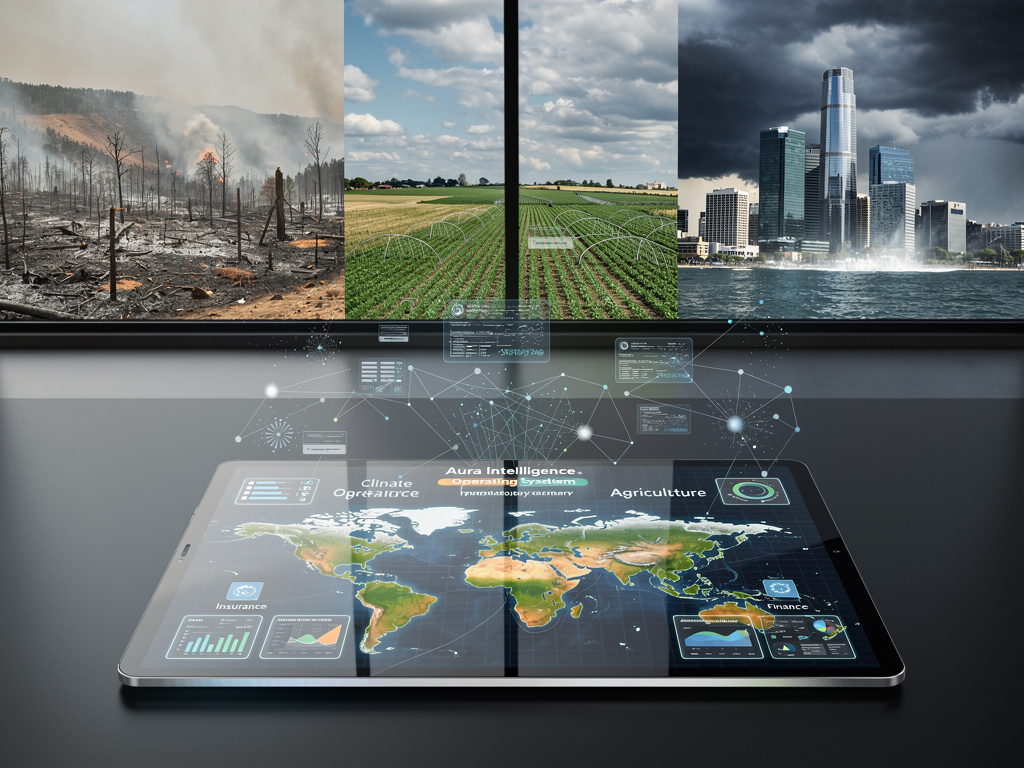
SAN FRANCISCO—For years, Alexi Volkov was celebrated in Silicon Valley and state capitals as the man who tamed fire. His first venture, Pyro-Logic, deployed a sophisticated network of sensors and AI-powered drones that could predict a wildfire’s path with uncanny accuracy, saving countless homes and lives. But now, Mr. Volkov is igniting a different kind of fire, this time in the boardrooms of the nation’s largest insurers, agricultural giants, and investment firms.
His new company, Aura Intelligence, is built on a simple yet audacious premise: the vast trove of granular environmental data collected in the name of public safety is now one of the most valuable private assets in an era of escalating climate volatility. According to a detailed profile in TechCrunch, Mr. Volkov has raised a staggering new round of funding to commercialize this data, creating what some investors are calling a new category of enterprise software: a Climate Operating System. The move represents a high-stakes pivot from public good to private profit, testing the ethical boundaries of technology developed for humanitarian ends.
The New Climate Barons and Their Data Moats
Aura Intelligence isn’t selling firefighting technology. It is selling foresight. The company’s core product is an API that allows subscribers to query the petabytes of data Pyro-Logic gathered over the last decade—everything from hyper-local soil moisture readings in the Sierra Nevada to real-time atmospheric wind shear patterns over the Rockies. For an insurance underwriter, this means being able to price a policy for a specific property not just by its zip code, but by its precise, modeled risk of fire, flood, or drought over the next 30 years. Agricultural conglomerates can use it to optimize crop selection and water usage with unprecedented precision.
This strategy places Aura at the forefront of the rapidly expanding climate intelligence services market. The demand for such analytics is surging as corporations grapple with the financial fallout of a warming planet. A recent report from the consulting firm McKinsey & Company highlights that physical climate risk is increasingly being priced into financial markets, creating a powerful incentive for businesses to seek out the kind of predictive power Aura claims to offer. As reported by McKinsey, enhanced data is becoming critical for companies to assess their exposure and for investors to make informed decisions.
An Unprecedented Glimpse into Planetary Systems
The technological foundation of Aura’s business is the sheer, unrivaled granularity of its dataset. While satellite imagery companies provide a macro view, Pyro-Logic’s network of ground sensors, atmospheric balloons, and low-altitude drones captured a micro-level reality of environmental conditions that was previously unimaginable. This multi-source data fusion, originally designed to model the chaotic behavior of a wildfire, can now be repurposed to model everything from agricultural yields to supply chain disruptions caused by extreme weather.
The technical challenge of processing such massive, unstructured datasets is immense, requiring sophisticated machine learning models to find signals in the noise. The approach is similar to that used by other pioneers in geospatial AI, who leverage vast amounts of information to create predictive analytics. As noted in a Wired article on AI in firefighting, the key is not just collecting data, but training algorithms to recognize complex patterns that precede catastrophic events. Mr. Volkov’s team is now applying those same principles to commercial risk, effectively turning a disaster-prevention tool into a profit-maximization engine.
A Treacherous Path Between Profit and Public Trust
The pivot, however, has not been without internal strife. The TechCrunch report notes that several of Pyro-Logic’s early engineers, who were drawn to the company’s humanitarian mission, have departed, citing concerns that Aura’s new model could lead to a form of “climate redlining.” The fear is that insurers, armed with Aura’s hyper-specific risk data, could make coverage prohibitively expensive or altogether unavailable for entire communities deemed too high-risk, exacerbating social inequities. This raises profound ethical questions about who should own and profit from environmental data that is, in essence, a public resource.
These ethical dilemmas are becoming a central conversation in the tech industry as AI’s capabilities grow. The potential for data-driven discrimination is a significant concern, with organizations like the Electronic Frontier Foundation warning about the societal costs of predictive algorithms. In a discussion on algorithmic bias, the EFF has previously pointed out that such systems can reinforce existing inequalities, a risk that is particularly acute when dealing with essential services like housing and insurance.
Investor Frenzy in the Face of Climate Chaos
Despite the ethical debates, investors are clamoring for a piece of the action. Aura Intelligence’s latest funding round, reportedly led by a top-tier Silicon Valley venture capital firm, has catapulted its valuation into the multi-billion-dollar range. For investors, Aura represents a rare opportunity: a company with a near-monopolistic hold on a proprietary dataset of immense value, protected by a formidable technological moat. The total addressable market for climate risk analytics is projected to grow exponentially, and Aura is positioned as a market-defining player.
This investor enthusiasm is part of a broader, if volatile, trend in climate tech, where capital is flowing toward solutions that can help industries adapt to or mitigate the effects of climate change. According to data from PitchBook, a financial data and software company, venture capital investment in the sector remains robust for companies with clear paths to profitability. A 2023 report from PitchBook noted that while the overall VC market has cooled, climate tech startups with strong commercial applications continue to attract significant funding, a category into which Aura Intelligence squarely falls.
Redefining the Future of Risk and Resilience
Mr. Volkov’s venture is more than just a clever business model; it signals a fundamental shift in how society will manage climate risk. By transforming environmental data into a tradable, high-value commodity, Aura is creating a new infrastructure for a climate-altered economy. The long-term vision, as hinted in the original TechCrunch piece, is to create a dynamic, real-time map of environmental and financial risk that could underpin everything from sovereign debt ratings to global supply chain management.
The implications are far-reaching. If a company like Aura can successfully become the definitive source for climate truth, its influence could rival that of credit rating agencies or financial data providers like Bloomberg. The very definition of asset value could be rewritten by its algorithms. This new era of planetary-scale analytics is forcing a conversation about who controls the data that will define our future, a topic explored in a Brookings Institution analysis on the need for new global data governance frameworks. The rise of Aura Intelligence suggests that future is arriving faster than anyone anticipated, born from the ashes of yesterday’s disasters.


 WebProNews is an iEntry Publication