
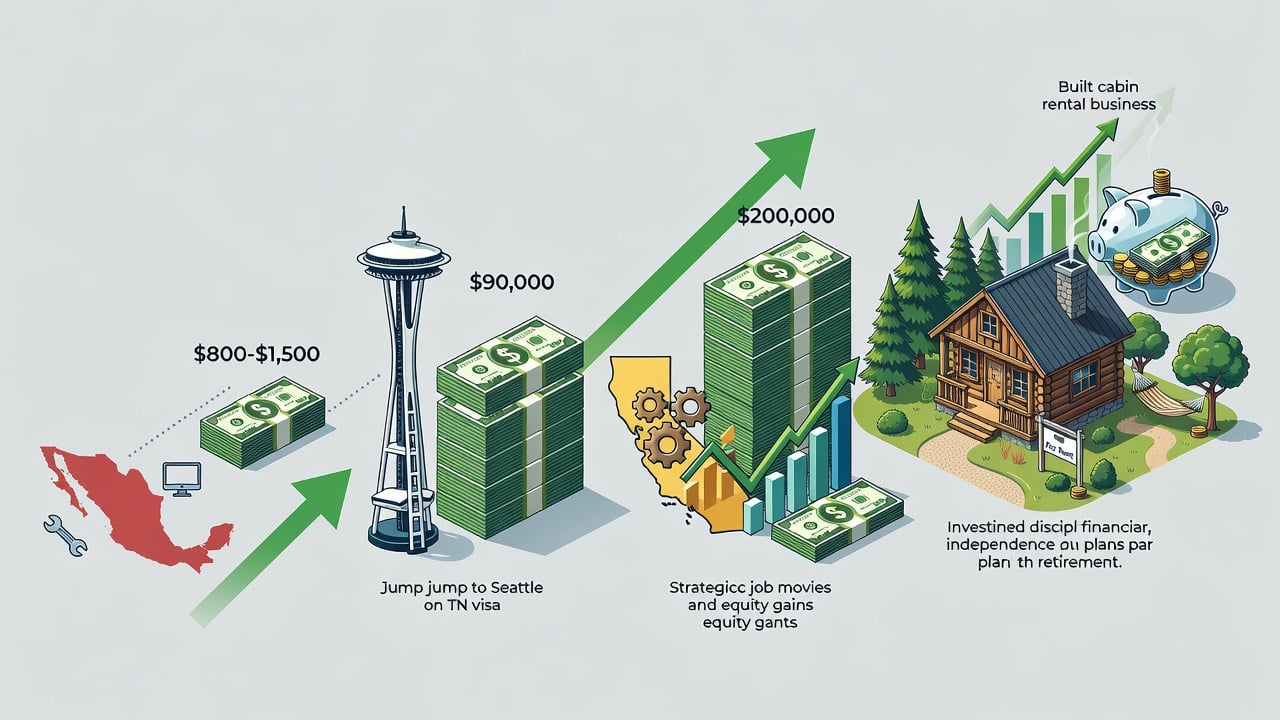
Carlos Santana Roldán once earned between $800 and $1,500 a month in Mexico. The pay came from local firms that contracted for American companies. Expenses stayed low. Savings happened naturally. Then he crossed the border.
In October 2013 he arrived in Seattle on a TN visa as a contractor for Globant. His first role at Disney paid $90,000 a year. The leap let him clear car loans and wedding costs almost immediately. No state income tax in Washington helped the take-home amount feel even larger. But the real story lies in the sequence of calculated moves that followed.
Roldán, now 38 and based in California, pulls in just over $200,000 annually as a lead full-stack engineer contractor for a large music corporation. He plans to step away from full-time coding within the next few years. His destination is Mexico, where he has spent the past five years building a cabin rental business. One more cabin, he figures, and the numbers will support a comfortable life with family. "I think my current software engineer job will probably be my last job as an employee," he told Business Insider. "I'll be able to be financially free and have enough money to just enjoy time with my family for the rest of my life."
The salary progression tells its own tale. From the $90,000 Disney contract he moved to California in 2015. State taxes trimmed the net pay, yet the role stayed the same. In 2016 he joined Beachbody at $120,000 and picked up React skills. The next year brought a tech lead position at Disney ABC News through Globant for $127,000. A layoff in 2018 forced him back to Mexico just before his visa expired. The TN visa offered only a 60-day grace period and required in-person interviews for new sponsorship.
Undeterred, he landed at a startup later acquired by Mindbody for $145,000 plus a $10,000 relocation package. In 2020 he received an offer from Snap while on vacation in Los Angeles. He accepted a developer position at $140,000 base with $225,000 in restricted stock units spread over four years. The equity funded cabin construction after he sold shares monthly. Stock prices climbed as high as $80 before dropping below $30. He stayed roughly two years and three months. The timing overlapped with personal milestones. He lost that job a week before his daughter was born. Insurance coverage delayed the birth by one day.
Next came a principal engineer role at APM Music starting around $175,000 base plus 10 percent bonus, later rising to $190,000 base plus 12 percent. Total compensation reached approximately $213,000 at its peak there. The current contracting arrangement exceeds $200,000 in a market still recovering from layoffs and AI-driven cost pressures. Throughout, Roldán kept investments focused on Mexico. "I'm a very adaptive person — I can live with $400,000, with $200,000, or with $50,000," he said. "I know that my visa isn't permanent. That's why I've invested basically all of my money in Mexico."
His experience highlights a persistent gap that draws talent northward while pushing some to plan returns south. Recent benchmarks show senior software engineers in Mexico earning roughly $65,000 to $75,000 annually when hired by U.S. companies through contractor or employer-of-record models, according to Howdy. Mid-level roles sit between $50,000 and $60,000. Junior pay lands at $40,000 to $45,000. These figures represent take-home pay after local adjustments but still reflect 60 to 65 percent savings for U.S. employers compared with domestic equivalents that often exceed $130,000 base for seniors.
Local Mexican market rates run lower. Median total pay for software engineers hovers around 42,000 Mexican pesos per month, or roughly $25,000 to $30,000 annually depending on exchange rates and city, per multiple 2026 analyses. Guadalajara, Mexico City and Monterrey show monthly ranges from $3,000 to $6,000 for roles contracted to foreign firms. The cost advantage holds even after adding 24 percent employer taxes, mandatory benefits such as aguinaldo and vacation premiums, and service fees of $499 to $699 per month for contractor support. Time to hire averages three to four weeks, faster than many U.S. searches.
Yet the move north remains attractive for ambitious engineers. Roldán's TN visa, available to Mexican and Canadian professionals in certain occupations including computer systems analysts, bypassed the H-1B lottery entirely. That lottery has grown fiercely competitive. For fiscal year 2026, more than 336,000 registrations competed for roughly 118,000 selections, producing a 35.3 percent success rate, according to data cited by immigration platform Alma.
Starting in February 2026, a new wage-based weighting system changes the odds. Registrations for higher wage levels receive multiple entries: four for Level IV roles typically above $150,000, three for Level III, two for Level II and one for Level I. The reform, finalized by the Department of Homeland Security in late 2025, aims to direct visas toward higher-skilled and higher-paid applicants. It favors senior software engineers whose offers clear prevailing wage thresholds set by the Department of Labor. For many positions in tech hubs, those thresholds now push well above $150,000 for top levels. Alma notes the shift benefits roles paying $150,000 and above while making sponsorship of entry-level positions far more difficult.
But permanent residency remains elusive for many. H-1B backlogs for certain nationalities stretch years. TN status must be renewed periodically and ties the holder to specific employment. Roldán never pursued a green card. Instead he poured earnings into property and the cabin venture in Mexico. The business now generates rental income. He even wrote reservation software for his own properties and expanded it into a small SaaS product for hotels. During the 2023 market downturn he removed the "open to work" banner from LinkedIn. Recruiter messages still arrived. Savings accumulated in Mexico during earlier lower-earning years helped bridge gaps between roles.
His story resonates beyond personal finance. U.S. companies continue to tap Mexican talent pools for cost and time-zone alignment. Nearshore teams in Guadalajara or Monterrey overlap easily with California or Texas hours. Talent supply grows rapidly. Mexico produces over 130,000 software engineers annually, a pace three times faster than U.S. growth, one industry analysis found. Retention rates at specialized staffing firms can reach 98 percent, far above broader market averages of 75 to 82 percent.
Still, lifestyle differences stand out. "In Mexico, it was totally different," Roldán observed. "Even when I was making way less money, I was saving or spending less than what I made. In the U.S., it feels like something in the system forces you to buy more stuff." That contrast informs his exit strategy. After one additional cabin project he expects to walk away from employee roles. The combination of U.S. compensation peaks, disciplined investing back home, and a side business built on skills developed along the way has created an off-ramp available to few.
Recent market data reinforces the underlying economics. U.S. software engineer medians sit near $130,000 base with total compensation for seniors in major markets often exceeding $200,000 when equity and bonuses factor in. In contrast, fully loaded costs for equivalent Mexican senior talent through efficient hiring channels stay below $100,000. The differential persists across 2026 benchmarks from multiple providers. For engineers who master the transition, the arithmetic can accelerate wealth accumulation dramatically before a return to lower-cost living.
Roldán adapted at each step. He learned new frameworks when opportunities demanded it. He accepted roles slightly below target compensation when equity or location aligned with family needs. He treated the visa limitation as a feature, not a bug, by keeping capital flows directed southward. The result is a financial position that supports early retirement in the country where his career began. Not every engineer will replicate the exact path. Fewer still will combine high U.S. earnings with a thriving hospitality micro-business. But the pattern reveals how large salary multiples, prudent capital allocation and targeted side ventures can compress a traditional four-decade career into something far shorter.
And the broader industry watches. With H-1B rules now explicitly rewarding higher compensation bands, companies may tilt sponsorship toward proven senior talent. Mexican engineers with strong English, relevant experience and TN eligibility gain an alternative route that avoids the lottery altogether. For those who time their moves well, the salary journey from under $20,000 a year to more than $200,000 can fund not just lifestyle upgrades but an entirely different second act. Roldán has already sketched his. Family time in Mexico, rental income from the cabins, and the quiet satisfaction of knowing the numbers finally work without another line of production code.


 WebProNews is an iEntry Publication