
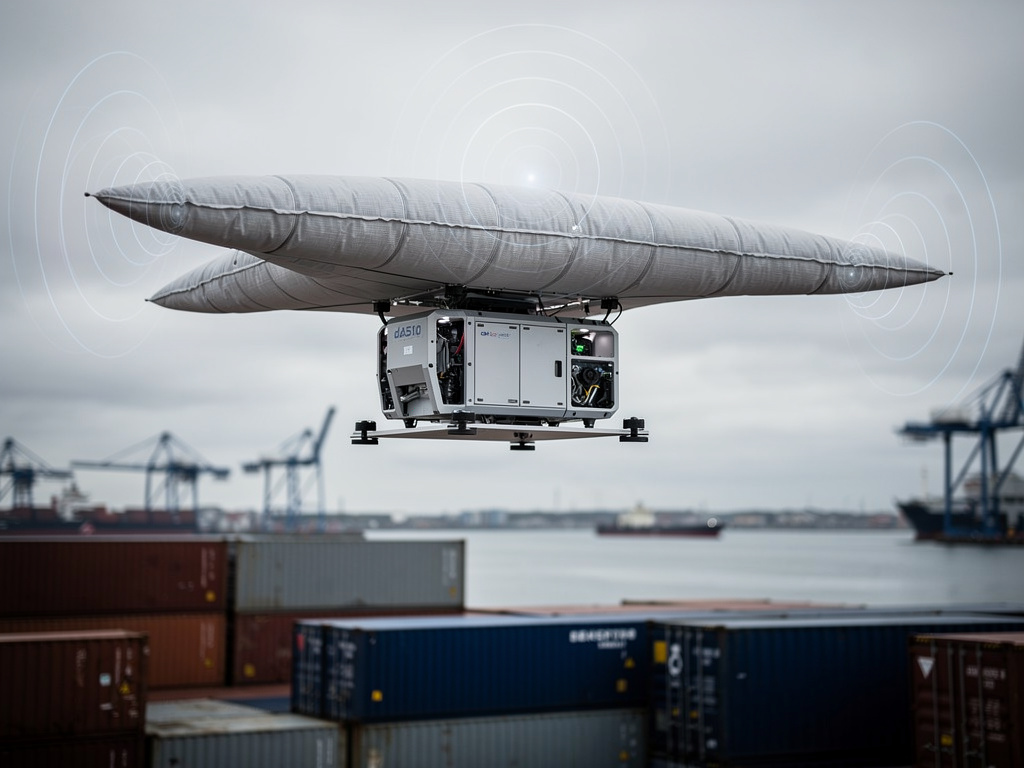
A French startup has achieved a modest but telling milestone in unmanned aviation. Celeste Ecoflyers recently completed initial take-off tests of its dAS10 experimental cargo drone at Le Havre airport. The eight-meter fixed-wing platform relies on a pressurized textile wing rather than conventional aluminum spars, ribs and rigid skin.
The tests, reported in recent days, saw the drone lift off for roughly a dozen seconds and reach a few meters of altitude. It carried ballast masses exceeding its empty structural weight. Company engineers emphasized a core point. Lift is aerodynamic, not buoyancy. The pneumatic element supports the wing structure itself.
But don’t mistake this for a blimp. “Celeste isn’t a blimp, it’s a fixed-wing aircraft,” the company stated, according to Defence Blog. “Lift is aerodynamic, not buoyancy. What’s pneumatic is the wing structure itself: a pressurized textile envelope replacing the rigid skin and spars.”
The distinction matters. Traditional cargo drones and aircraft depend on heavy composite or metal frameworks. Those add mass, limit portability and raise costs. Celeste’s approach inverts the equation. Air inside the high-pressure textile provides the necessary rigidity. The result is a lighter airframe. It folds for transport. A puncture can be patched in the field with basic tools. No specialized repair facility required.
From prototype hops to potential military supply lines
This early success builds on ground tests that included avionics activation and taxiing. The drone, registered as F-DCCH and qualified under French UAS rules, has claimed performance targets of 300 kilometers range and six hours of battery endurance. Solar panels on the upper wing surface could stretch that further. Yet the platform flies slower than rigid equivalents. It proves more sensitive to weather. Those trade-offs define its niche.
The original coverage from TechRadar highlighted military interest. Modern conflicts demand distributed logistics. Small units operate in contested areas far from secure bases. Helicopters and large drones prove expensive and vulnerable. They require prepared surfaces and skilled maintenance crews.
The dAS10 promises something different. It can deploy from rough, unprepared ground. Its unusual radar signature may reduce detectability compared with conventional metal aircraft. Deflation and compression shrink its transport volume dramatically. Soldiers could carry folded units forward, inflate them on site and launch resupply missions. And the lower structural weight supports higher lift reserves relative to size.
Recent reporting echoes these points. Defence Blog noted the design’s appeal for forward resupply to isolated positions in denied terrain. Field repairability stands out. A simple patch restores integrity where rigid wings might need workshop-level intervention. The concept aligns with broader experiments in low-cost, modular aerial logistics seen across defense circles.
Similar ideas appear elsewhere. Recent discussions on platforms like AeroFlex highlight drop-stitch TPU materials that deliver rigidity at a fraction of carbon-fiber cost while absorbing shocks. Though not directly tied to Celeste, such parallel efforts signal growing acceptance of inflatable structures for cargo roles. China’s HH-200 and Changying-8 cargo UAVs, by contrast, pursue long-range heavy-lift with more conventional architectures. Their recent flights underscore global momentum in unmanned logistics. Yet they lack the packable, repair-anywhere advantages Celeste pursues.
Challenges remain substantial. The dAS10 operates in a narrower flight envelope. Atmospheric sensitivity demands careful mission planning. Stabilized flight beyond short hops still lies ahead. Weight balance and control systems require refinement. Early tests lasted mere seconds at low altitude. Scaling to full 300-kilometer missions with real payloads will test the pneumatic wing’s durability under sustained loads and variable conditions.
Even so, the implications intrigue defense planners. Contemporary warfare in places like Ukraine has exposed vulnerabilities in traditional supply chains. Drones deliver small loads effectively but struggle with heavier or bulkier materiel. Helicopters face high operating costs and threat exposure. An inflatable-wing cargo platform could fill the gap. It offers slower but cheaper per-kilogram delivery over moderate distances. Its ability to launch from austere sites reduces dependence on vulnerable forward operating bases.
Analysts note the radar profile. A textile wing scatters electromagnetic waves differently than metal or composite surfaces. That could complicate targeting by enemy air defenses. Combined with low-altitude flight and rapid deployment, the system might survive longer in contested airspace than larger, louder alternatives.
Celeste Ecoflyers positions the dAS10 toward sustainable long-range logistics. Battery power and potential solar augmentation fit wider industry moves away from fossil fuels for smaller platforms. Yet the design accepts slower speeds in exchange for efficiency and portability. Whether militaries will adapt operational concepts around those limits remains an open question.
The tests come at a moment of rapid evolution in military drones. Heavy-lift models from various makers target industrial, commercial and defense sectors. Most retain rigid structures. Celeste’s bet on pneumatics stands apart. It trades structural familiarity for logistical flexibility. Success could influence how forces move supplies in future conflicts. Failure would reinforce preference for proven rigid designs.
So far the signs encourage. The drone lifted more than its empty weight in initial runs. That validates the aerodynamic claim. Further flights should reveal control characteristics and endurance in real weather. Industry observers will watch closely. Parallel research into inflatable-wing UAVs, including academic studies on roll control, suggests the concept holds technical promise beyond this single prototype.
For now Celeste has demonstrated proof of principle. A pressurized textile wing can generate real aerodynamic lift. It can support flight while promising easier transport, field maintenance and lower costs. Those attributes matter deeply in military contexts where speed of deployment and resilience under duress determine outcomes. The coming months of testing will decide if this approach scales from short hops at Le Havre to reliable cargo missions on the battlefield.


 WebProNews is an iEntry Publication