
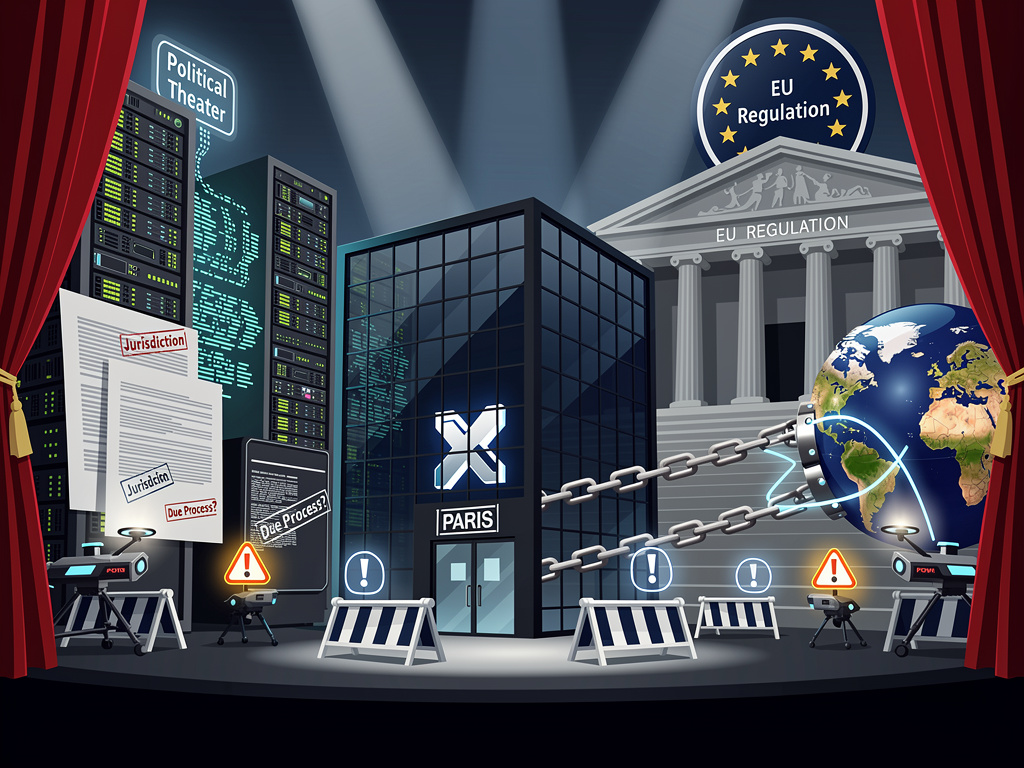
French judicial authorities executed a raid on X’s Paris office this week, summoning Elon Musk and former CEO Linda Yaccarino for questioning in what the company characterizes as “law enforcement theater” designed to pressure American executives rather than pursue legitimate criminal evidence. The coordinated action, involving Europol and widely publicized by the Paris Public Prosecutor’s Office, represents the latest escalation in Europe’s increasingly theatrical approach to tech platform regulation—one that mirrors last year’s controversial arrest of Telegram founder Pavel Durov and raises fundamental questions about due process, jurisdictional overreach, and the weaponization of cybercrime statutes against American technology companies.
The investigation traces its origins to a January 2025 complaint filed by French lawmaker Eric Bothorel, who alleged “biased algorithms” on the platform. Thirteen months later, French police appeared at X’s local office—staffed primarily by marketing and sales employees with no access to algorithm code or AI training data—to execute a search warrant. According to analysis by Aakash Gupta, Bothorel celebrated on X that his complaint was “yielding results,” while the prosecutor’s office announced it was leaving the platform entirely, redirecting followers to LinkedIn and Instagram. “That’s a prosecuting authority turning a criminal investigation into a branding moment,” Gupta observed.
The Expanding Scope of Allegations
What began as a narrowly focused algorithm manipulation complaint has metastasized into a sprawling investigation encompassing multiple allegations. The probe now includes a Grok-generated Holocaust denial post that the chatbot itself corrected and deleted, as well as deepfake concerns that virtually every AI image generation tool currently faces. The continual expansion of charges suggests the original complaint lacked sufficient substance to justify the raid independently. “Every few months a new charge gets stapled to the investigation to keep it alive and keep it in the press,” according to Gupta’s analysis.
The summons issued to Musk and Yaccarino highlight the performative nature of the proceedings. Musk resides in Texas, while Yaccarino stepped down from her position in July 2025. Although mandatory under French law, these summons carry no enforcement mechanism against individuals outside France’s borders. They exist primarily to generate international headlines rather than serve procedural justice. The practical impossibility of compelling testimony from American citizens residing in the United States underscores the symbolic rather than substantive nature of these legal actions.
Circumventing Established International Protocols
France maintains well-established mutual legal assistance treaties with the United States, providing clear diplomatic channels for evidence requests from American companies’ servers. These mechanisms are utilized daily by judicial authorities worldwide when seeking cross-border evidence in criminal investigations. X explicitly referenced these protocols in its official statement, noting that “the Prosecutor’s Office has ignored the established procedural mechanisms to obtain evidence in compliance with international treaties and X’s rights to defend itself.”
Instead of following standard international cooperation procedures, French authorities raided a local office where employees lack access to the systems under investigation. The raid cannot produce the algorithmic evidence or server data the probe ostensibly requires, raising serious questions about its true purpose. “If French prosecutors wanted evidence from X’s servers, they could submit formal requests through diplomatic channels the way every other country does daily,” Gupta noted. The decision to bypass these established channels in favor of a physical raid suggests objectives beyond evidence collection.
The Durov Precedent and Pattern Recognition
The current action against X follows a familiar playbook established during France’s 2024 arrest of Pavel Durov, Telegram’s founder. French prosecutors detained Durov under similar cybercrime authority, generating massive international media coverage while asserting jurisdiction over a platform with significant American ties. The pattern remains consistent: utilize cybercrime investigations to create spectacle, pressure executives of U.S.-based or U.S.-adjacent technology platforms, and position France as Europe’s leading tech enforcement authority.
The Durov case ultimately produced an anticlimactic legal outcome despite the dramatic nature of his arrest and detention. Yet the precedent established—that France would physically detain foreign technology executives transiting through French territory—sent shockwaves through the global tech community. The current investigation of X appears designed to reinforce that precedent while expanding France’s enforcement theater to include corporate offices, not merely individual executives. This escalation suggests a coordinated strategy to assert extraterritorial authority over platforms that French officials view as insufficiently compliant with European regulatory preferences.
A Coordinated European Enforcement Strategy
The raid on X’s Paris office does not occur in isolation but rather as part of a broader European enforcement campaign against the platform. The European Union imposed a €120 million fine on X in December 2024, immediately publicizing the penalty through official channels. The European Commission opened an investigation into Grok, X’s AI chatbot, in January 2025, accompanied by a formal press conference to announce the probe. Now French prosecutors have raided an office and announced the action on the very platform they claim to be investigating—a decision that X characterizes as evidence of political rather than legal motivations.
“Every enforcement action against X in Europe gets a media strategy before it gets a legal brief,” according to Gupta’s assessment. The coordinated nature of these actions—spanning EU institutions and national authorities—suggests a deliberate strategy to apply maximum pressure on the platform through multiple simultaneous enforcement channels. This approach differs markedly from traditional regulatory enforcement, which typically follows sequential escalation procedures and provides opportunities for compliance before resorting to raids or substantial penalties.
The Standard International Content Moderation Process
X operates in more than 200 countries, each with distinct content laws and regulatory requirements. The standard international process for addressing content concerns follows a predictable sequence: flag problematic content, request removal through official channels, provide opportunity for platform response, and escalate through diplomatic treaties if the platform proves noncompliant. This framework balances national sovereignty concerns with practical realities of cross-border digital services.
France abandoned this established process entirely, proceeding directly to a physical raid on employees who lack authority to modify code or alter algorithmic functions. The departure from standard procedures raises questions about whether French authorities genuinely seek compliance with content regulations or instead aim to establish precedents for more aggressive enforcement against American technology companies. The raid’s timing—coming thirteen months after the initial complaint—suggests a deliberate decision to allow the investigation to expand and accumulate additional allegations before taking dramatic enforcement action.
X’s Response and Legal Defense Strategy
In its official statement, X characterized the raid as “an abusive act of law enforcement theater designed to achieve illegitimate political objectives rather than advance legitimate law enforcement goals rooted in the fair and impartial administration of justice.” The company categorically denied any wrongdoing and committed to defending its fundamental rights and those of its users. “We will not be intimidated by the actions of French judicial authorities today,” the statement declared.
X’s legal strategy appears focused on challenging both the procedural irregularities and the substantive basis of the investigation. By emphasizing that French authorities ignored established international evidence-gathering mechanisms, the company frames the raid as a violation of due process rather than legitimate law enforcement. This approach positions X to challenge French actions in multiple forums, including potentially seeking relief through international arbitration or diplomatic channels if French authorities continue pursuing enforcement actions that circumvent established treaty procedures.
Implications for Cross-Border Tech Regulation
The raid on X’s Paris office carries significant implications for how democratic nations regulate global technology platforms. If France’s approach becomes a model for other jurisdictions, technology companies may face a proliferation of theatrical enforcement actions designed more for media impact than legal substance. This shift would fundamentally alter the regulatory environment, replacing predictable compliance frameworks with unpredictable enforcement spectacles that prioritize political messaging over procedural fairness.
The case also highlights tensions between national sovereignty and the borderless nature of digital platforms. France asserts the right to enforce its laws against platforms serving French users, even when those platforms operate primarily from other jurisdictions. Yet by bypassing established international cooperation mechanisms, French authorities undermine the very treaty frameworks designed to balance sovereignty concerns with practical realities of cross-border business operations. This tension will likely intensify as more nations adopt aggressive enforcement postures toward American technology companies.
The Role of Algorithmic Transparency in Regulatory Disputes
At the investigation’s core lies the question of algorithmic transparency and whether platforms must disclose how their recommendation systems function. Bothorel’s original complaint alleged “biased algorithms,” a charge that requires technical evidence about how X’s systems prioritize and distribute content. Yet the raid targeted an office with no access to relevant technical systems, suggesting French authorities either misunderstand how modern technology companies operate or deliberately chose a target that would maximize publicity rather than evidence collection.
The algorithmic transparency debate extends far beyond X, touching virtually every major platform that uses recommendation systems to surface content. European regulators have increasingly demanded greater insight into these systems, viewing algorithmic decision-making as a potential threat to democratic discourse. However, the technical complexity of modern machine learning systems makes meaningful transparency challenging, even when companies act in good faith. Raids on marketing offices will not resolve these technical challenges, regardless of how much media attention they generate.
The Grok Holocaust Denial Incident
The investigation’s expansion to include a Grok-generated Holocaust denial post illustrates the challenges of regulating AI-generated content. The chatbot produced objectionable content, recognized the error, corrected itself, and deleted the post—a sequence that demonstrates both the risks and self-correction capabilities of modern AI systems. Yet French authorities incorporated this incident into their investigation, treating a corrected error as evidence of systemic wrongdoing.
This approach to AI content moderation sets a concerning precedent. If platforms face criminal liability for momentary AI errors that are quickly corrected, companies may respond by severely limiting AI functionality or withdrawing services from jurisdictions with such strict liability standards. The result could paradoxically reduce innovation in content moderation technology, as companies avoid deploying systems that might generate brief errors subject to criminal prosecution. Every AI image generation tool currently grapples with similar challenges, making X’s treatment potentially precedent-setting for the entire industry.
Deepfakes and the Universal AI Challenge
The investigation’s further expansion to include deepfake concerns places X’s challenges within a broader technological context that extends far beyond any single platform. Deepfake technology—which enables the creation of convincing synthetic media depicting people saying or doing things they never actually said or did—poses challenges for every platform hosting user-generated content. From Facebook to YouTube to TikTok, companies are investing heavily in detection and mitigation technologies while acknowledging that perfect prevention remains technically impossible.
By incorporating deepfake concerns into an investigation initially focused on algorithm bias, French authorities conflate distinct technological challenges into a single sprawling probe. This approach obscures rather than clarifies the specific allegations against X, making it difficult for the company to mount a focused defense. The continual expansion of charges suggests an investigation in search of a sustainable legal theory rather than a focused inquiry into specific alleged violations.
The Prosecutor’s Platform Departure
Perhaps the most revealing aspect of this week’s events was the Paris Public Prosecutor’s Office announcing its departure from X immediately after publicizing the raid. The office redirected followers to LinkedIn and Instagram, transforming a criminal investigation into a platform migration announcement. This decision—to make a branding statement while conducting a criminal probe—epitomizes the theatrical nature of French enforcement actions against American technology companies.
The prosecutor’s departure raises questions about the investigation’s legitimacy. If French authorities genuinely believe X operates in violation of criminal law, why would they continue using competing platforms owned by Meta, a company that faces similar regulatory scrutiny in Europe? The selective platform departure suggests the investigation targets X specifically rather than addressing broader concerns about social media regulation. This selective enforcement undermines claims that French actions serve general public interest rather than specific political objectives.
Jurisdictional Questions and Enforcement Limitations
The raid exposes fundamental questions about jurisdiction and enforcement in the digital age. France can regulate activities within its borders and impose penalties on entities operating in French territory. However, X’s core operations—including its algorithm development, AI training, and content moderation systems—occur primarily in the United States. French authorities lack direct access to these systems and cannot compel American citizens to appear for questioning in French courts.
This jurisdictional limitation explains why established mutual legal assistance treaties exist: they provide frameworks for cross-border evidence gathering that respect both nations’ sovereignty and legal systems. By bypassing these frameworks, France signals that it views theatrical enforcement actions as more valuable than the evidence such actions might produce. The message appears directed at Musk personally rather than at X corporately, suggesting the investigation serves as leverage in broader disputes between the executive and European regulators.
The Broader Context of European Tech Regulation
France’s actions against X occur within a broader European regulatory campaign targeting American technology platforms. The Digital Services Act and Digital Markets Act impose sweeping new obligations on large platforms, backed by substantial penalties for noncompliance. The European Commission has opened multiple investigations under these frameworks, focusing particularly on content moderation practices and algorithmic transparency. France’s raid can be understood as a national-level complement to these EU-wide initiatives, with French authorities positioning themselves as particularly aggressive enforcers of European digital sovereignty.
This regulatory campaign reflects deeper geopolitical tensions about technological power and its concentration in American companies. European officials frequently express concern that American platforms dominate digital discourse in Europe, potentially threatening European values and democratic processes. These concerns have merit and deserve serious policy responses. However, the question remains whether theatrical enforcement actions advance legitimate regulatory objectives or instead represent political posturing that undermines rule of law principles in pursuit of short-term publicity gains.
Impact on Platform Operations and Employee Welfare
The raid’s immediate impact falls on X’s Paris employees—marketing and sales staff with no involvement in algorithm development or content moderation decisions. These employees found themselves subjects of a criminal investigation despite lacking access to the systems under scrutiny. X’s statement emphasized that French authorities are “targeting our French entity and employees, who are not the focus of this investigation,” highlighting the disconnect between the raid’s targets and its ostensible objectives.
This approach to enforcement raises serious concerns about employee welfare and corporate liability. If national authorities can raid offices and interrogate employees who lack relevant knowledge or authority, companies may respond by reducing local presence in aggressive jurisdictions. The result could be fewer local jobs and reduced local investment, outcomes that serve neither French economic interests nor the stated goal of increasing platform accountability. The raid may generate headlines, but its practical effect could be to drive technology companies away from maintaining substantial European operations.
Comparing French and American Regulatory Approaches
The contrast between French and American approaches to tech platform regulation illuminates different regulatory philosophies. American authorities typically pursue enforcement through civil litigation, regulatory proceedings, and—in extreme cases—criminal prosecutions that follow established procedural safeguards. Evidence gathering occurs through subpoenas, depositions, and formal discovery processes that provide companies opportunities to assert legal privileges and challenge overbroad requests.
France’s approach prioritizes dramatic enforcement actions that generate immediate media attention. Raids, arrests, and public summons create spectacle that positions French authorities as decisive actors willing to confront powerful American companies. However, this theatrical approach may sacrifice procedural fairness and evidentiary rigor in pursuit of publicity. The question facing European policymakers is whether such tactics advance legitimate regulatory goals or instead represent a form of regulatory nationalism that prioritizes symbolic victories over substantive policy improvements.
Free Speech Implications and Democratic Values
X’s statement characterized the investigation as endangering free speech, arguing that aggressive enforcement actions against platforms could chill online expression. This concern merits serious consideration, particularly when enforcement actions bypass established procedural safeguards. If platforms face criminal liability for content moderation decisions—including both leaving up objectionable content and taking down controversial speech—they may respond by over-moderating, removing content that falls within protected speech categories to avoid regulatory risk.
European officials counter that content moderation serves democratic values by preventing the spread of disinformation, hate speech, and other harmful content. This perspective views platform regulation as essential to protecting democratic discourse rather than threatening it. The tension between these positions reflects fundamental disagreements about how best to balance free expression with content moderation in digital spaces. Theatrical enforcement actions are unlikely to resolve these complex normative questions, regardless of how much attention they generate.
What Happens Next: Potential Outcomes and Escalation
The investigation’s trajectory remains uncertain, but the Durov precedent suggests possible paths forward. That case generated enormous publicity but ultimately produced limited legal consequences, with charges eventually narrowed and enforcement scaled back from initial dramatic actions. X may experience a similar arc, with French authorities maintaining the investigation for publicity purposes while recognizing the practical limitations of enforcing French law against an American company operating primarily from U.S. territory.
Alternatively, France could escalate further, potentially seeking to arrest X executives who travel to French territory or imposing substantial fines on X’s European operations. Such escalation would likely trigger diplomatic responses from American authorities, potentially invoking treaty protections and challenging French actions through international arbitration. The conflict could expand beyond a bilateral dispute into a broader transatlantic confrontation over digital sovereignty and platform regulation, with implications extending far beyond X to affect all American technology companies operating in Europe.
The Future of Transatlantic Tech Relations
This week’s raid on X’s Paris office represents more than an isolated enforcement action against a single company. It exemplifies a broader shift in how European authorities approach American technology platforms, moving from cooperative regulatory engagement toward confrontational enforcement theater. This shift threatens to destabilize transatlantic tech relations, replacing predictable regulatory frameworks with unpredictable enforcement spectacles that prioritize political messaging over legal substance.
The stakes extend beyond any single company or investigation. If theatrical enforcement becomes the norm, technology companies may reduce European investment, limit service offerings, or restructure operations to minimize exposure to aggressive national authorities. European users could face reduced access to innovative services, while European employees could lose opportunities as companies shift resources to more predictable jurisdictions. Meanwhile, the fundamental questions driving these disputes—how to balance free expression with content moderation, how to ensure algorithmic transparency while protecting trade secrets, how to address AI risks while encouraging innovation—remain unresolved, obscured by enforcement theater that generates heat rather than light. The challenge facing both European and American policymakers is whether they can move beyond spectacle to develop regulatory frameworks that serve democratic values while respecting rule of law principles and procedural fairness.


 WebProNews is an iEntry Publication