
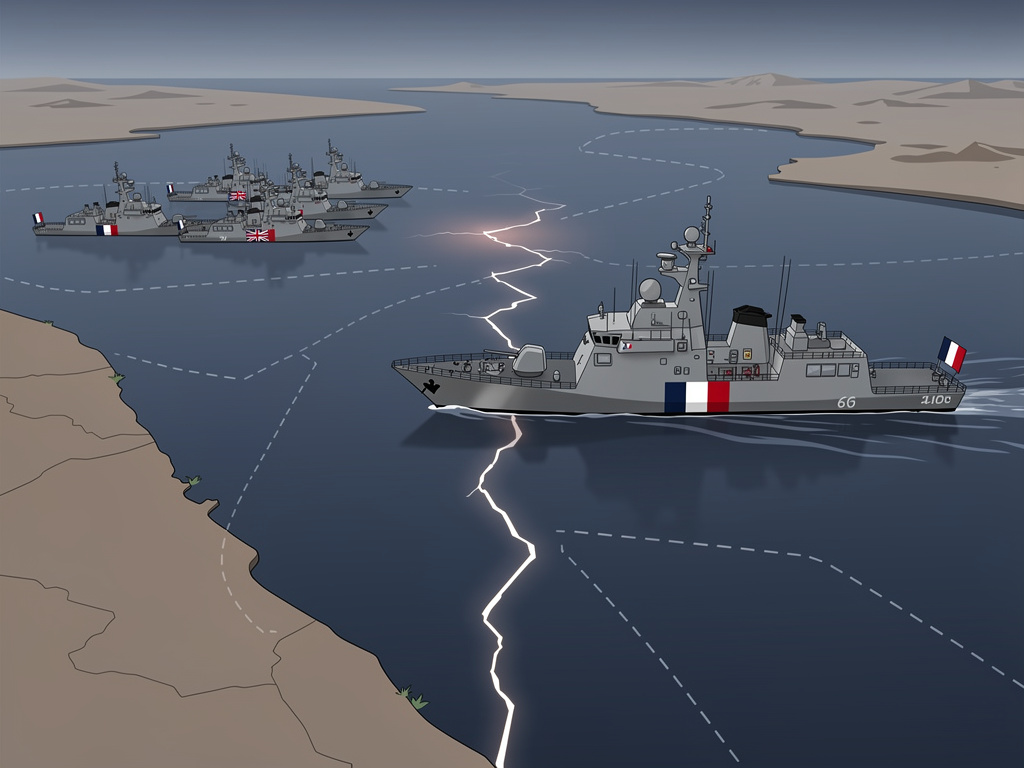
A French naval frigate slipped through the Strait of Hormuz this week without American escort — a quiet but unmistakable signal that Washington’s grip on allied military coordination in the Persian Gulf is loosening at a moment when the Trump administration needs it most.
The transit, first reported by Investing.com, marks the first time a French warship has passed through the contested waterway independently since the Trump administration began pressuring European allies to fall in line with its maximum-pressure campaign against Iran. The move wasn’t announced with fanfare. No press conference. No communiqué from the Élysée Palace. But the implications are reverberating through diplomatic circles from Washington to Tehran.
For the Trump White House, which has spent months trying to build a unified front against Iranian provocations in the Gulf, France’s decision to go it alone represents a pointed rebuke. The administration had been pushing for coordinated naval operations through the strait, where roughly a fifth of the world’s oil supply passes daily. The idea was straightforward: present a wall of allied steel to deter Iranian aggression. France just punched a hole in that wall.
The Strait of Hormuz, barely 21 miles wide at its narrowest point, has been a flashpoint for decades. Iran has repeatedly threatened to close it in retaliation for sanctions, and in recent years has seized tankers, harassed commercial vessels, and deployed fast-attack boats to shadow foreign warships. The Trump administration’s withdrawal from the 2015 Iran nuclear deal — and subsequent reimposition of crushing economic sanctions — raised tensions to a pitch not seen since the 1980s Tanker War.
So why would France break formation now?
The answer lies in a widening transatlantic rift over how to handle Iran that predates this particular transit but has accelerated dramatically in recent months. Paris has long maintained that diplomacy, not confrontation, is the path to containing Tehran’s nuclear ambitions. President Macron has repeatedly clashed with Washington over Iran policy, and France — along with Germany and the United Kingdom — has tried to preserve elements of the original nuclear accord even as the U.S. walked away from it.
A solo transit through Hormuz is the military expression of that diplomatic divergence. By sending a warship through without coordinating with U.S. Central Command, France is asserting operational independence in a theater where America has long been the unquestioned conductor. It’s a statement of sovereignty wrapped in a hull of gray steel.
The Strategic Calculus Behind Paris’s Move
French defense officials have been careful not to frame the transit as adversarial to the United States. Publicly, the line from Paris is that France maintains the right to freedom of navigation wherever international law permits — a principle, ironically, that the U.S. itself champions aggressively in the South China Sea and elsewhere. But the timing and unilateral nature of the move tell a different story.
France operates a permanent naval base in Abu Dhabi, just across the Gulf from Iran, and has maintained a consistent military presence in the region for years. The base, home to roughly 700 French personnel, gives Paris independent logistical capacity that most European allies lack. That infrastructure made this transit possible without any American assistance — and that’s precisely the point.
The broader context matters enormously. Trump’s approach to alliances has been transactional from the start, demanding that partners pay more, contribute more, and align more closely with American priorities. NATO allies have chafed under this pressure, and France has been among the most vocal in pushing back. Macron famously declared NATO “brain dead” in 2019, and his government has consistently argued for European strategic autonomy — the ability to act militarily without depending on Washington.
This transit is that philosophy made tangible.
For Iran, the French move creates a diplomatic opening. Tehran has long sought to exploit divisions among Western powers, and a visible crack in the allied naval posture in the Gulf is exactly the kind of leverage Iranian negotiators can use. If France is willing to operate independently in Hormuz, it suggests that the maximum-pressure coalition isn’t as unified as Washington claims — a message that could embolden Iranian hardliners who argue that waiting out American pressure is a viable strategy.
The energy markets, predictably, are watching closely. Oil prices have been volatile throughout 2025, buffeted by sanctions enforcement, OPEC+ production decisions, and the ever-present threat of a Hormuz disruption. Any sign that the Western security architecture in the Gulf is fragmenting tends to push risk premiums higher. Traders don’t need a shooting war to get nervous. Ambiguity is enough.
And ambiguity is what this transit introduces in abundance. If France can sail through Hormuz on its own terms, what stops other allies from doing the same? The United Kingdom, which has its own complicated relationship with both Washington and Tehran after the 2019 seizure of the Stena Impero tanker, may face pressure to clarify its own posture. Germany, which has been reluctant to contribute naval assets to Gulf operations, could use French precedent as cover for continued abstention.
The Pentagon has not issued a formal response to the French transit, though officials speaking on background to reporters have described it as “unhelpful” — a diplomatic understatement that masks genuine frustration. The U.S. Fifth Fleet, headquartered in Bahrain, coordinates the vast majority of allied naval activity in the Gulf, and an uncoordinated transit by a major NATO ally complicates operational planning and sends mixed signals to adversaries.
There’s also a domestic political dimension in France. Macron, facing persistent pressure from both the left and the far right, has found that asserting French independence on the world stage plays well across the political spectrum. Standing up to American pressure — or at least being seen to — is one of the few things that unites French voters from Marine Le Pen’s National Rally to Jean-Luc Mélenchon’s France Unbowed. The Hormuz transit, whatever its strategic merits, is also good politics in Paris.
But the risks are real. A French warship operating independently in one of the world’s most dangerous waterways, without the protective umbrella of American surveillance, electronic warfare capabilities, and rapid-response assets, is more exposed than one operating within a coalition framework. Iran’s Islamic Revolutionary Guard Corps Navy has demonstrated both the willingness and the capability to harass foreign vessels in the strait. A confrontation between Iranian fast boats and a lone French frigate could escalate quickly — and without pre-coordinated American backup, the response options narrow considerably.
French naval commanders are well aware of this. The frigate that made the transit is reportedly equipped with advanced anti-ship and air-defense systems, and France’s intelligence-gathering capabilities in the region, while not on par with America’s, are substantial. Paris isn’t being reckless. It’s being deliberate.
The question now is whether this becomes a pattern or remains an isolated gesture. If France continues to conduct independent transits, it could establish a new norm — one where allied navies operate in the Gulf on their own schedules and under their own rules of engagement. That would represent a fundamental restructuring of the security order in a region where American primacy has been the organizing principle since the British withdrawal east of Suez in 1971.
For the Trump administration, the response options are limited. Publicly criticizing a NATO ally for exercising freedom of navigation would be hypocritical, given America’s own insistence on that right in contested waters worldwide. Privately pressuring Paris risks deepening the very rift that France’s transit has exposed. And ignoring it altogether signals acquiescence to a trend that could accelerate.
The most likely outcome, at least in the near term, is quiet diplomacy — back-channel conversations between military officials aimed at preventing a repeat without creating a public spectacle. The U.S. and France have deep military-to-military ties that predate and will outlast any single political disagreement. But the structural forces driving the two countries apart on Gulf policy aren’t going away.
Iran’s nuclear program continues to advance. Sanctions haven’t brought Tehran to the negotiating table on American terms. And European allies increasingly see their interests in the Middle East as distinct from — and sometimes opposed to — Washington’s. A French frigate in the Strait of Hormuz didn’t create these tensions. It just made them impossible to ignore.


 WebProNews is an iEntry Publication