
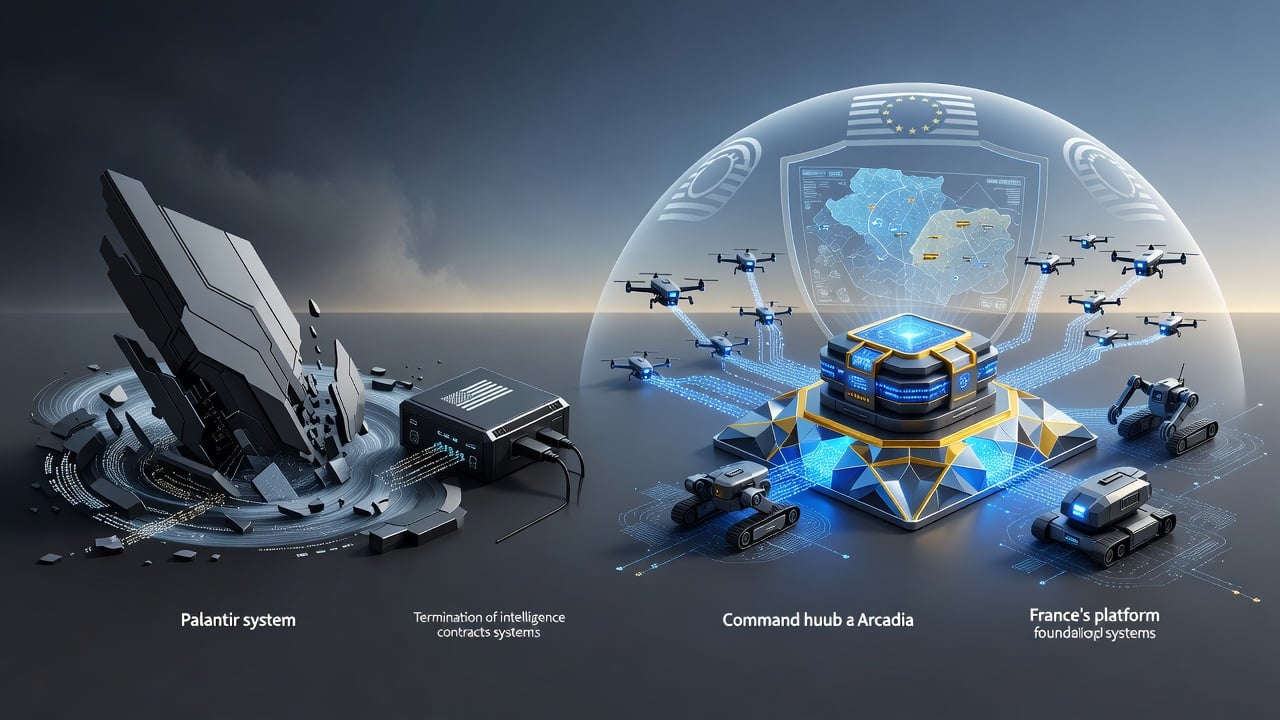
Paris and Berlin have drawn a line. After years of relying on American technology for some of their most sensitive intelligence and defense work, the two governments pledged this week to create a homegrown alternative to software from Palantir Technologies.
The commitment came in a joint declaration signed by French President Emmanuel Macron and German Chancellor Friedrich Merz following talks on July 17. It calls for examination of “a European sovereign digital backbone” that would handle data-centric security, artificial intelligence and cloud computing. Officials specifically pointed to France’s Arcadia platform, an AI-powered command and control system, as one foundation. They also mentioned comparable German offerings.
But this isn’t just about new code or flashy interfaces. It’s a direct response to mounting worries over data control. European leaders fear that critical military information could become vulnerable if transatlantic ties fray. And the shift has already begun in practice.
France’s domestic intelligence agency, the DGSI, ended its contract with Palantir in June. The move came just six months after renewing the deal. Germany’s domestic intelligence service, the BfV, opted instead for technology from French firm ChapsVision. The Bundeswehr, Germany’s armed forces, has ruled Palantir out of its defense cloud procurement process altogether. Actions speak.
A NATO commander told Politico recently that no genuine European substitute existed for Palantir’s Maven software, which processes battlefield data for the alliance. The declaration aims to change that calculation.
Palantir Chief Executive Alex Karp didn’t mince words about the snub. In an interview with Bild last month, he described Germany’s stance as “conversations about witchcraft.” He insisted his company’s tools have proven themselves on every major battlefield. Yet Berlin remains unmoved. The core dispute centers not on whether the software performs but on who controls the data flowing through Europe’s defense systems.
This latest push builds on a pattern. European nations have grown wary of overdependence on U.S. vendors amid shifting political winds in Washington. The intelligence switches to ChapsVision’s ArgonOS platform marked an early signal. Now the effort extends to military operations. From spies to soldiers.
The joint statement reaches beyond software. France, Germany and Britain plan to study cooperation on long-range missiles capable of striking targets up to 2,500 kilometers away. They intend to draw on expertise at ArianeGroup. The Franco-German Main Ground Combat System, or MGCS, which seeks to succeed the Leopard 2 and Leclerc tanks, will see new research into autonomous driving, advanced sensors and battlefield networking. The goal is a proof-of-concept stage that integrates crewed and uncrewed vehicles.
Absent from the document was any mention of the Future Combat Air System, a troubled next-generation fighter program. Instead, the two countries agreed to establish a “European collaborative combat standard.” This framework would let fighter jets, combat drones and other aircraft from different nations share information and operate together in real time.
In space, the declaration promotes tighter coordination on reconnaissance satellites and expanded use of European launchers such as Ariane 6 for military payloads. Both sides also voiced support for a potential stock market listing of KNDS, the joint venture behind the tank program, provided market conditions allow and both governments consent.
Analysts see this as part of a broader European drive for technological autonomy in defense. The European Union has poured funds into AI initiatives, though military applications face strict oversight under the bloc’s Artificial Intelligence Act, which entered into force in 2024 and applies risk-based rules to high-stakes systems. Recent coverage from The Next Web on July 18 highlighted how the pledge directly counters the NATO commander’s assessment.
Yet challenges loom large. Developing software that matches Palantir’s speed and scale won’t happen overnight. Integration across national systems brings technical headaches. Budget pressures persist even as both countries increase defense spending in response to Russia’s war in Ukraine. And questions remain about whether Arcadia and its German counterparts can scale to handle the volume and complexity of modern combat data.
ChapsVision has gained traction quickly. Its selection by two major intelligence agencies suggests the technology offers a viable path. French officials have praised its alignment with national data rules. German counterparts appear to value the reduced reliance on foreign providers. But moving from intelligence to full-spectrum military use demands far more.
Palantir, for its part, continues to expand in other NATO nations and with the U.S. military. The company recently secured major contracts for data analytics that support decision-making at the Pentagon. Its Gotham and Foundry platforms process vast information streams for intelligence and logistics. Karp has positioned the firm as indispensable to Western security.
Still, the European moves carry symbolic weight. They reflect a continent determined to reduce vulnerabilities in its supply chains for critical technology. Similar sentiments have appeared in discussions around semiconductors, quantum computing and secure communications. Defense AI sits at the intersection of all these concerns.
Industry observers note that success will hinge on execution. Joint projects in Europe have a mixed record. The MGCS program itself has faced delays and disagreements over workshare. FCAS has seen costs balloon and timelines slip. Turning a declaration into deployed systems requires sustained political will, aligned requirements and private-sector buy-in.
So far the signals are mixed. The explicit naming of Arcadia signals French confidence in its solution. Inviting German contributions suggests a collaborative spirit. But details on funding, governance and timelines stayed vague in the joint text. Follow-on work will need to address those gaps.
One thing appears clear. The era of defaulting to American platforms for core European defense functions is under review. Whether the alternative takes shape as a true rival or remains a patchwork of national tools will shape the continent’s military posture for years ahead. And with geopolitical tensions rising, the clock is ticking.
Recent reporting from Clash Report echoed the commitment to lessen dependence on U.S. defense technology. Posts on X from accounts including @POLITICOEurope and defense watchers amplified the news within hours of the announcement, underscoring the market interest in European defense stocks and potential headwinds for Palantir in the region.


 WebProNews is an iEntry Publication