
Sacrificing Fir for Circuits: Fox News’s Call to Ditch Real Christmas Trees for AI’s Power Hunger
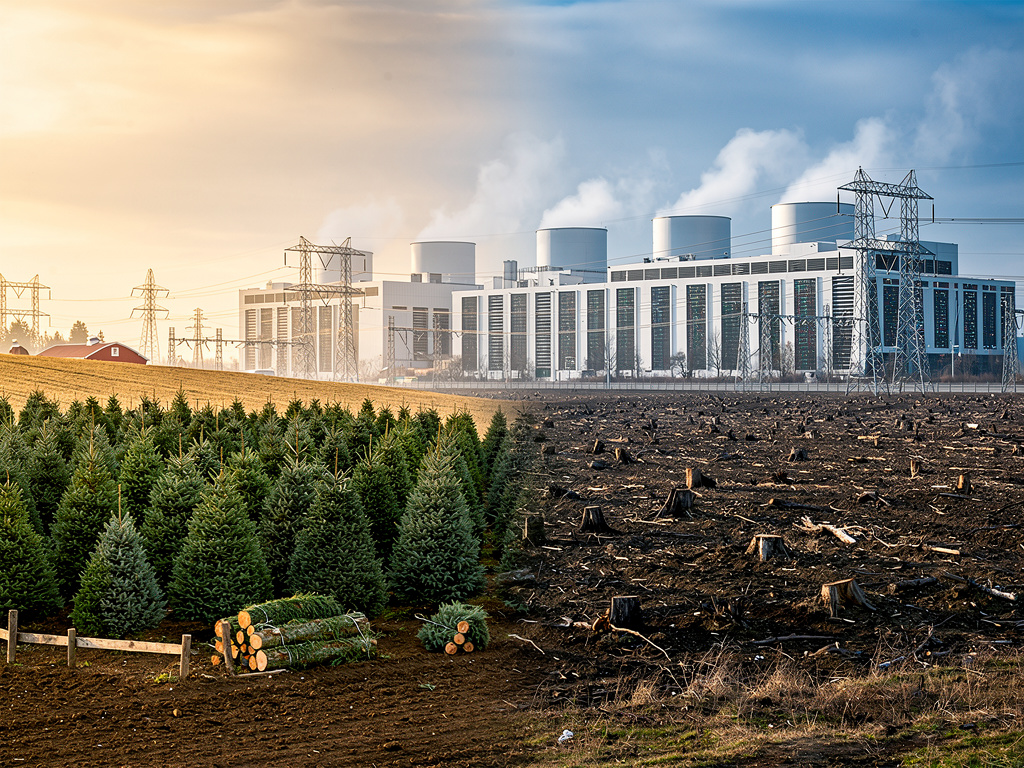
In a bizarre twist that blends holiday traditions with the relentless march of technology, a Fox Business host recently sparked outrage by suggesting Americans abandon real Christmas trees in favor of artificial ones to make way for AI data centers. The segment, aired on “The Big Money Show,” featured co-host Dagen McDowell dismissing concerns over a Maryland Christmas tree farm potentially disrupted by a proposed energy transmission line. McDowell urged viewers to “buy a fake tree” and “get on board” with progress, framing the farm as an obstacle to powering the AI boom. This comment, reported by Futurism, highlights a growing tension between seasonal customs and the voracious energy demands of artificial intelligence infrastructure.
The controversy stems from a specific project in Maryland, where a 67-mile transmission line is proposed to deliver power from a Pennsylvania substation to support new data centers in the region. These facilities, essential for training and running AI models, require immense electricity—often more than entire cities. The line’s path threatens Butler’s Orchard, a family-run farm known for its Christmas trees, prompting local backlash. McDowell, undeterred, argued that sacrificing such land is necessary for technological advancement, even joking about the farm’s fate. Her remarks quickly went viral, drawing mockery from figures like California Governor Gavin Newsom, who quipped on social media about a “war on Christmas” under the Trump administration.
Beyond the holiday angle, this incident underscores a broader clash in the tech sector: the environmental toll of AI’s expansion. Data centers, the backbone of cloud computing and machine learning, are proliferating across the U.S., driven by companies like Microsoft, Google, and Amazon. According to recent analyses, these hubs consume electricity equivalent to millions of households, with AI workloads pushing demand even higher. Posts on X, formerly Twitter, have amplified concerns, with users highlighting how AI infrastructure has led to extended lifespans for coal plants in some states to meet surging needs.
The Energy Appetite of AI Giants
Industry experts note that a single large data center can draw up to 1 gigawatt of power—enough to light a midsize city. This hunger is exacerbating grid strains, particularly in regions like Northern Virginia, dubbed the “data center capital of the world.” There, Dominion Energy has warned of potential blackouts if new transmission infrastructure isn’t built swiftly. The Maryland proposal is part of this pattern, aimed at bolstering supply for AI-driven operations that process vast datasets for everything from chatbots to autonomous vehicles.
Environmental advocates argue that this rush overlooks sustainable alternatives. Renewable sources like solar and wind are scaling up, but their intermittency requires robust storage solutions, which lag behind demand. A report from the International Energy Agency projects that data centers could account for 8% of global electricity by 2030, with AI contributing significantly. In the U.S., utilities are resurrecting fossil fuel plants to bridge gaps, as evidenced by delays in retiring coal facilities in states like West Virginia and Kentucky.
The Fox News segment, detailed in a piece by HuffPost, didn’t just ignite social media; it exposed ideological divides. Conservative commentators like McDowell view such projects as economic boons, creating jobs and fostering innovation. Critics, however, see it as prioritizing corporate profits over community heritage. Butler’s Orchard, for instance, isn’t just a tree supplier—it’s a cultural staple, hosting families for pick-your-own experiences that embody rural American life.
Local Farms Versus Tech Titans
Zooming in on Maryland, the proposed transmission line by PJM Interconnection would cut through agricultural lands, including the orchard, to feed data centers in Frederick County. Local residents, as covered in reports from Mediaite, have mobilized against it, citing not only the loss of farmland but also potential health risks from high-voltage lines. The farm’s owners have expressed devastation, noting that the project could render parts of their 300-acre property unusable.
This isn’t an isolated case. Across the country, data center expansions are encroaching on rural areas, drawn by cheap land and proximity to power sources. In Georgia, for example, Meta’s planned facility has faced opposition over water usage, as cooling systems in these centers guzzle millions of gallons daily. The environmental footprint extends to carbon emissions: even with pledges from tech firms to go carbon-neutral, the immediate reliance on existing grids often means more fossil fuels in the mix.
Social media reactions, particularly on X, reflect widespread unease. Users have shared statistics showing AI’s role in a 48% spike in Google’s emissions since 2019, as noted in posts referencing environmental outlets. Others draw parallels to historical land grabs, where industrial progress trampled traditional livelihoods. The Fox host’s flippant advice to switch to plastic trees symbolizes for many a disconnect between elite media and everyday concerns.
Policy and Regulatory Crossroads
Regulators are grappling with these issues. The Federal Energy Regulatory Commission has approved measures to expedite transmission projects, but environmental reviews often slow them down. In Maryland, the Public Service Commission is reviewing the proposal amid public hearings, where farmers and tech advocates clash. Broader federal efforts, like the Biden-era Infrastructure Investment and Jobs Act, allocate billions for grid upgrades, yet AI’s pace outstrips planning.
Tech companies defend their expansions by touting economic benefits. Microsoft, a major player in AI, claims its data centers generate thousands of jobs and billions in tax revenue. However, a study by the Electric Power Research Institute suggests that without innovation in energy efficiency, AI could double U.S. electricity demand by 2030. Innovations like liquid cooling and edge computing aim to mitigate this, but deployment is uneven.
The holiday angle adds irony. Christmas tree farming, a $1.3 billion industry per the National Christmas Tree Association, supports rural economies in states like North Carolina and Oregon. Uprooting them for data centers raises questions about priorities: Is AI’s promise worth eroding cultural touchstones? McDowell’s co-hosts on the show appeared stunned, with one quipping about the “war on Christmas,” echoing past Fox narratives now turned on their head.
Global Echoes and Future Trajectories
Internationally, similar debates rage. In Ireland, data centers consume 21% of national electricity, prompting moratoriums on new builds. China, a leader in AI, faces its own energy crunches, balancing tech ambitions with emission goals. These parallels suggest the U.S. incident is a microcosm of a worldwide dilemma: harnessing AI without overheating the planet.
Environmental groups push for greener data practices, such as siting centers near renewables or using AI itself to optimize energy use. Startups are developing software that predicts and reduces peak loads, potentially cutting consumption by 30%. Yet, as demand surges—fueled by generative AI like ChatGPT—short-term fixes often prevail.
Back in Maryland, the tree farm’s fate hangs in the balance. If approved, the transmission line could set a precedent, encouraging more such trade-offs. For industry insiders, this saga warns of the need for balanced growth: integrating AI’s benefits with sustainable strategies that preserve what’s irreplaceable.
Voices from the Ground and the Cloud
Farmers like those at Butler’s Orchard represent a human element often overlooked in tech discourses. “This isn’t just about trees; it’s our way of life,” one local producer told reporters. On the flip side, AI proponents argue that data centers enable breakthroughs in medicine, climate modeling, and more, justifying the costs.
Public sentiment, gauged from X discussions, leans skeptical. Posts lament how AI’s “insatiable hunger,” as one user put it, distorts priorities, with some linking it to distorted electricity flows affecting millions. Newsom’s troll, reported by The Daily Beast, amplified the absurdity, turning a niche debate into national fodder.
As 2025 unfolds, with AI investments soaring past $100 billion annually, stakeholders must navigate these conflicts. Utilities are exploring nuclear restarts and microgrids, while policymakers eye incentives for efficient designs. The Fox News flap, while comical, serves as a stark reminder: in the race for digital dominance, even holiday icons aren’t sacred.
Innovation Amid the Evergreens
Looking ahead, hybrid solutions could emerge. Some data centers are co-locating with farms, using waste heat for greenhouses or integrating solar panels. In Virginia, Amazon has piloted such models, blending agriculture with tech. These experiments hint at a path where progress doesn’t demand sacrifice.
Yet, the underlying issue persists: AI’s energy intensity. Training a model like GPT-4 consumes electricity akin to 1,300 U.S. households annually, per estimates. Scaling this globally amplifies impacts, from water scarcity to biodiversity loss.
For insiders, the takeaway is clear: regulatory foresight and technological tweaks are essential. As debates evolve, incidents like the Christmas tree controversy will likely multiply, forcing a reckoning between innovation’s allure and its earthly costs. Whether fake trees become the norm or real ones endure, the episode encapsulates a pivotal moment in tech’s integration with society.


 WebProNews is an iEntry Publication