
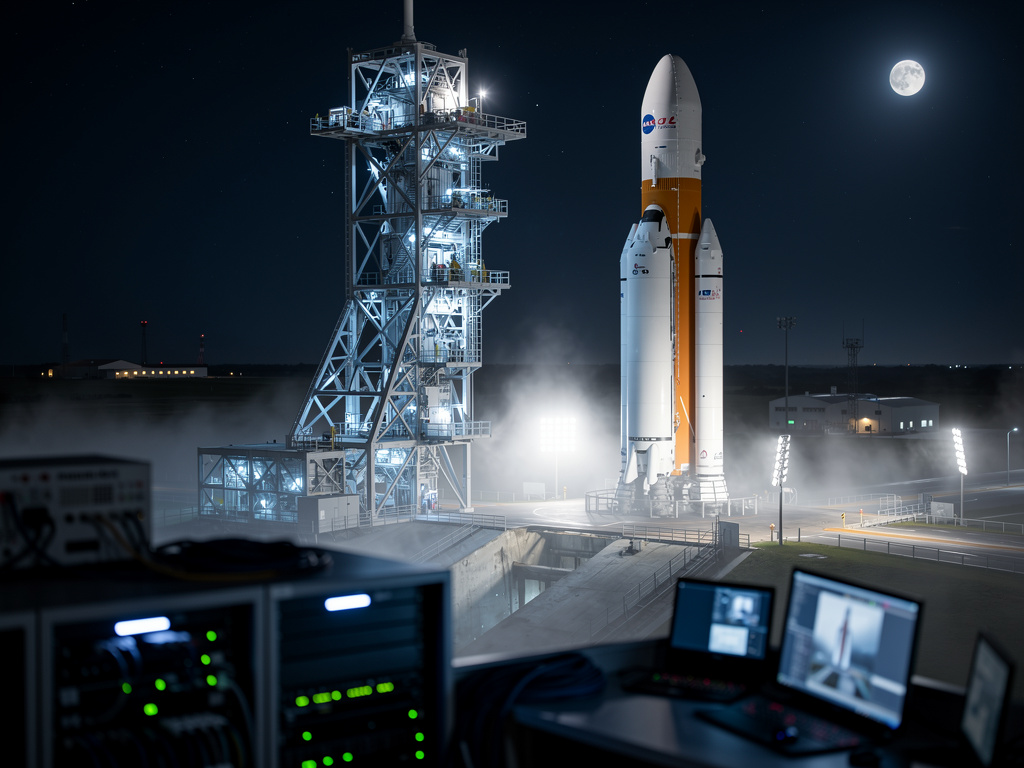
Inside Kennedy Space Center’s Neil Armstrong Operations and Checkout Building, four astronauts are now living through what NASA calls the most critical phase yet of the Artemis II mission — a full-scale countdown rehearsal that will test every system, every procedure, and every human link in the chain before they attempt something no one has done in more than half a century: fly humans around the Moon.
Commander Reid Wiseman, pilot Victor Glover, mission specialist Christina Koch, and Canadian Space Agency astronaut Jeremy Hansen began the Terminal Countdown Demonstration Test, or TCDT, this week. It’s a multi-day exercise that simulates the final hours before launch without actually lighting the engines. And it represents the first time a crew has run through this particular gauntlet for a lunar mission since the Apollo era.
The stakes are enormous. Not just for the four people strapping into the Orion capsule, but for the entire Artemis program — a sprawling, multi-decade effort to return humans to the lunar surface and eventually push toward Mars. Artemis II is the linchpin. If this crewed test flight around the Moon succeeds, it validates the architecture for everything that follows. If it doesn’t, the cascading delays could set back American deep-space ambitions by years.
A Countdown Without Fire — But With Real Consequences
The TCDT isn’t a simulation in the casual sense. As Digital Trends reported, the crew is executing the same timeline they’ll follow on launch day. They suit up in the Orion Crew Survival System — the bright orange pressure suits designed to keep them alive in an emergency during ascent or reentry. They ride the crew transport vehicle to Launch Pad 39B. They board the Orion spacecraft atop the towering Space Launch System rocket. And then they run through the countdown sequence all the way to the final seconds, stopping just short of ignition.
Every step is choreographed. Every step matters.
The exercise also tests emergency egress procedures — what happens if something goes catastrophically wrong on the pad and the crew needs to get out fast. That means practicing with the launch pad’s emergency escape system, including the slide wire baskets that would carry astronauts away from an exploding rocket. It’s the kind of thing you desperately hope never gets used in real life, which is exactly why it has to be rehearsed until it’s automatic.
NASA has been here before, of course. Every crewed mission going back to Gemini has included some version of a dress rehearsal. But the gap matters. The agency hasn’t launched humans beyond low Earth orbit since Apollo 17 in December 1972. The institutional muscle memory is gone. The workforce is almost entirely new. The rocket is new. The spacecraft is new. The ground systems are new. So this TCDT isn’t just checking boxes — it’s building the operational confidence that only comes from doing the thing, not just planning it.
According to Digital Trends, the crew’s TCDT activities represent the “most critical phase so far” in Artemis II preparations, a characterization NASA itself has endorsed. The agency views this rehearsal as the final major crew-integrated milestone before committing to a launch date.
And about that launch date: NASA is currently targeting a window in 2025, though the agency has been careful not to lock in a specific day. There’s good reason for that caution. Artemis II has already slipped multiple times. The mission was originally expected to fly in late 2024 before being pushed back due to issues identified during the Artemis I uncrewed test flight in 2022, including unexpected heat shield erosion on the Orion capsule during reentry.
The Heat Shield Problem That Haunted Artemis I
That heat shield issue deserves attention, because it’s the kind of problem that doesn’t announce itself loudly but can kill a mission — or a crew — if left unresolved.
During Artemis I, which successfully sent an uncrewed Orion capsule around the Moon and back in November 2022, engineers discovered that the heat shield’s ablative material had charred and flaked off in unexpected patterns during the 25,000-mph reentry. The material, called AVCOAT, is designed to burn away in a controlled fashion, absorbing the extreme heat of atmospheric reentry. But chunks came off in ways that weren’t predicted by models.
NASA spent months investigating. The conclusion: the issue was manageable but required a modified reentry profile for Artemis II. Instead of the “skip” reentry used on Artemis I — where the capsule briefly dips into the atmosphere, skips back out like a stone on water, and then plunges in again — Artemis II will use a direct, single-pass reentry. It’s a more conservative approach that reduces the thermal stress on the heat shield.
The fix works on paper. The TCDT is part of confirming it works in practice — not the thermal aspect specifically, but the overall systems integration that makes the entire mission viable.
Meanwhile, the SLS rocket and Orion capsule have been undergoing their own preparations at Kennedy Space Center. The rocket’s core stage and solid rocket boosters have been stacked in the Vehicle Assembly Building, and Orion has been mated to the stack. The integrated vehicle will eventually roll out to Pad 39B on the massive crawler-transporter — the same basic machine, upgraded significantly, that carried Saturn V rockets to the pad during Apollo.
There’s a certain poetry in that continuity. But poetry doesn’t fly spacecraft. Engineering does.
The four Artemis II crew members have been training for this mission for years. Wiseman, a Navy test pilot and veteran of a long-duration stay on the International Space Station, leads a crew that’s notable for its firsts. Glover will become the first Black astronaut to fly beyond low Earth orbit. Koch, who holds the record for the longest single spaceflight by a woman (328 days on the ISS), will be the first woman on a lunar mission. Hansen will be the first non-American to fly to the Moon.
Those milestones matter. But the crew’s primary job is technical: verify that Orion’s life support systems, navigation, communication links, and manual control capabilities all work as intended with humans aboard. Artemis I proved the hardware could survive the trip. Artemis II has to prove humans can work inside it.
The mission profile itself is relatively straightforward by Apollo standards. The crew will launch from Kennedy Space Center, enter a high Earth orbit, perform a translunar injection burn to send Orion toward the Moon, loop around the far side at an altitude of roughly 6,400 miles, and return to Earth. Total mission duration: approximately 10 days. No lunar orbit insertion. No landing. Just a proving flight — but one that covers roughly 685,000 miles and subjects the crew to conditions no human has experienced in over 50 years.
The broader Artemis architecture depends on this flight going well. Artemis III, which aims to land astronauts on the lunar south pole using SpaceX’s Starship as the human landing system, can’t proceed until Artemis II validates the Orion-SLS combination with a crew. And Artemis IV and beyond — missions that will involve the Gateway lunar space station, more complex surface operations, and eventually sustained human presence on and around the Moon — are all downstream.
Budget pressures add another dimension. NASA’s Artemis program has faced scrutiny from Congress and the Government Accountability Office over cost growth and schedule delays. The SLS rocket, in particular, has drawn criticism for its per-launch cost, estimated at over $2 billion per flight. Supporters argue the rocket’s heavy-lift capability is unmatched and essential for deep-space missions. Critics point to the rapidly advancing capabilities of commercial providers like SpaceX, whose Starship — if it achieves full operational status — could theoretically perform similar missions at a fraction of the cost.
None of that political and budgetary turbulence changes what’s happening right now at Kennedy Space Center. Four astronauts are rehearsing for a flight that will carry them farther from Earth than any human has traveled since 1972. The countdown clock is running.
What Comes After the Rehearsal
Once the TCDT concludes, NASA will conduct a thorough review of the data collected during the exercise. Any anomalies — a valve that didn’t respond correctly, a communication dropout, a suit integrity issue — will be investigated and resolved before the agency commits to a launch readiness date. The crew will continue mission-specific training, including time in simulators replicating every phase of the flight from launch through splashdown in the Pacific Ocean.
There’s also the matter of weather. Florida’s Space Coast is notorious for scrubbing launches due to lightning, anvil clouds, and other atmospheric hazards. The SLS rocket, with its solid rocket boosters that cannot be shut down once ignited, has particularly strict weather constraints. A launch window may be available, but nature gets a vote.
So does hardware. The SLS uses RS-25 engines — upgraded versions of the Space Shuttle Main Engines — and twin five-segment solid rocket boosters that together produce 8.8 million pounds of thrust at liftoff. It’s the most powerful rocket NASA has ever flown. Artemis I proved it works. But every new stack is, in some sense, a new vehicle. Manufacturing variability, assembly tolerances, and the sheer complexity of integrating millions of components mean that no two rockets are identical.
The Orion capsule’s European Service Module, built by the European Space Agency and Airbus Defence and Space, provides propulsion, power, and thermal control. It’s another critical element that must perform flawlessly. The service module performed well on Artemis I, but again — that was uncrewed. Human-rating a system means accepting a different standard of risk, one measured not in dollars or schedule but in lives.
For Wiseman, Glover, Koch, and Hansen, the TCDT is where abstraction becomes physical. Years of classroom training, simulator sessions, and procedure reviews compress into the tangible reality of sitting in a spacecraft on top of a fully stacked rocket. The sounds are real. The vibrations during rollout are real. The view from the crew access arm, looking out at the Florida coastline from 300 feet up, is real.
And soon, if everything goes according to plan, the fire will be real too.
The last time humans left Earth’s gravitational influence, Richard Nixon was president, the Vietnam War was still being fought, and the internet didn’t exist. The world that Artemis II’s crew will return to after their 10-day flight will be the same one they left — but the program they’re proving out aims to build something that lasts far longer than any single mission. A permanent human presence beyond Earth.
That’s the ambition. Right now, it starts with four people in orange suits, practicing how to get into a spaceship and, if necessary, how to get out of one very quickly.


 WebProNews is an iEntry Publication