
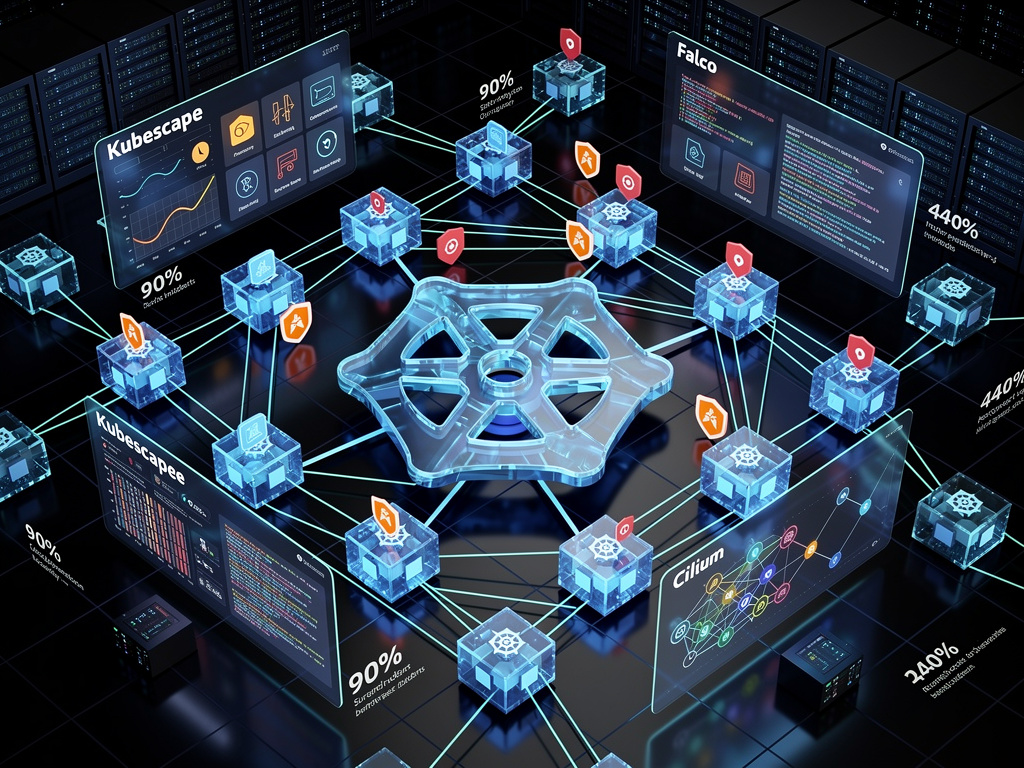
As Kubernetes powers over 90% of containerized production workloads, security incidents plague 90% of organizations, per Red Hat’s State of Kubernetes Security Report. Vulnerabilities surged 440% from 2018 to 2023, driven by misconfigurations and unpatched components, according to SentinelOne. Open-source tools now deliver enterprise-grade defenses across the 4C model—cloud accounts, clusters, containers, and code—without vendor lock-in.
These solutions integrate eBPF for low-overhead monitoring, policy-as-code for enforcement, and CI/CD scanners to shift security left. Industry insiders prioritize CNCF-graduated projects like Falco and Cilium for maturity, combining them for layered protection against runtime exploits and supply-chain threats.
Runtime Sentinels Unmask Hidden Threats
Falco, a CNCF-graduated project, dominates runtime security by monitoring kernel syscalls and Kubernetes audit logs for anomalies like privilege escalations or shell spawns in containers. “Falco excels at detecting live threats inside running containers, which many solutions do not cover,” notes Portainer. It integrates with SIEMs via Falcosidekick, alerting on PCI-DSS/NIST violations with custom rules.
Kubescape complements Falco as the sole fully open-source platform spanning CI/CD to runtime, scanning against NSA-CISA, MITRE ATT&CK, and CIS benchmarks. With 11.2k GitHub stars, it uses eBPF for reachability analysis, slashing actionable CVEs by 90% by identifying loaded vulnerabilities. “Kubescape leads as it provides runtime context that connects vulnerable images to misconfigured RBAC,” states ARMO.
Tetragon, from the Cilium project, adds enforcement via LSM hooks, blocking malicious processes in real-time. These tools reduce alert fatigue by correlating events across layers, essential as attackers probe clusters within minutes of deployment, per Wiz’s 2025 Kubernetes Report.
Configuration Auditors Block Deploy-Time Risks
Kube-bench, the CIS benchmark gold standard, runs as a cluster job to validate control-plane, etcd, and node configs. “It generates reports highlighting deviations, enabling quick remediation,” explains Spacelift. Pair it with KubeLinter, a lightweight Go-based linter for YAML and Helm charts, enforcing 50+ checks like resource limits and security contexts pre-deployment.
Checkov scans IaC across Kubernetes manifests, Terraform, and Helm for 1,000+ policies, integrating seamlessly into GitHub Actions. Terrascan extends this with Rego-based custom policies for K8s and clouds, rejecting non-compliant objects via admission control. These shift-left scanners caught misconfigs in 45% of incidents, Wiz reports.
Trivy, Aquasecurity’s all-in-one scanner, audits images, clusters, and IaC for vulns, secrets, and compliance—”trivy k8s –report summary” delivers instant posture overviews. Its SBOM generation pairs with Grype for precise dependency matching, vital amid 2026 supply-chain attacks on Helm charts.
Policy Engines Lock Down Access and Workloads
Open Policy Agent (OPA) with Gatekeeper enforces Rego policies at admission, blocking privileged pods or untrusted images. Kyverno offers YAML-native alternatives for validate/mutate/generate actions, easing adoption—”lower learning curve than Rego,” per ARMO. Both support image verification via Cosign, securing supply chains as Sigstore gains traction.
StackRox, revived open-source in January 2026 by Help Net Security, ingests API and runtime data for policy-driven enforcement on configs, vulns, and behavior. It blocks risky deployments, addressing exposed services and privilege escalations flagged in NSA guidance.
Kubescape’s operator automates VAP enforcement and auto-remediation, patching images via Copacetic. These engines ensure consistent rules across multi-cluster setups, critical as 61% of orgs expose secrets, Wiz finds.
Network Firewalls Segment Lateral Movement
Calico implements Kubernetes NetworkPolicy with BGP routing and eBPF for L3-L7 controls, powering 8 million nodes daily. “Granular segmentation reduces lateral movement risks,” Wiz emphasizes. Cilium advances this with identity-aware policies and Hubble observability, integrating Tetragon for unified runtime-network defense.
Istio’s service mesh layers mutual TLS and traffic routing via Envoy sidecars, automating canary deployments against DDoS. As native policies remain limited, these CNCF staples—Calico and Cilium graduated—enforce zero-trust, aligning with CISA hardening.
Scanning Powerhouses Hunt Vulns Everywhere
Kube-hunter actively probes clusters for exploits like API exposures, though maintenance lags post-2023. Kubeaudit provides static compliance audits, flagging RBAC gaps. From the Awesome Kubernetes Security list, tools like audit2rbac auto-generate policies from logs, minimizing over-privileging.
For 2026, eBPF dominance (Cilium, Tetragon, Kubescape) and AI integrations like Kubescape’s MCP server for natural-language queries signal evolution. Insiders stack Kubescape+Falco+Trivy+Cilium for minimal overhead (1-2.5% CPU), correlating alerts to full attack paths. Regular CIS audits via kube-bench, paired with runtime baselines, fortify against the dynamic threats defining cloud-native operations.
DevSecOps teams must test stacks in staging, prioritizing CNCF maturity and GitHub velocity—Kubescape’s 11k stars and 150+ contributors exemplify community trust. As Kubernetes 1.35 adds kubeconfig allowlists, these tools amplify built-in hardening for resilient clusters.


 WebProNews is an iEntry Publication