
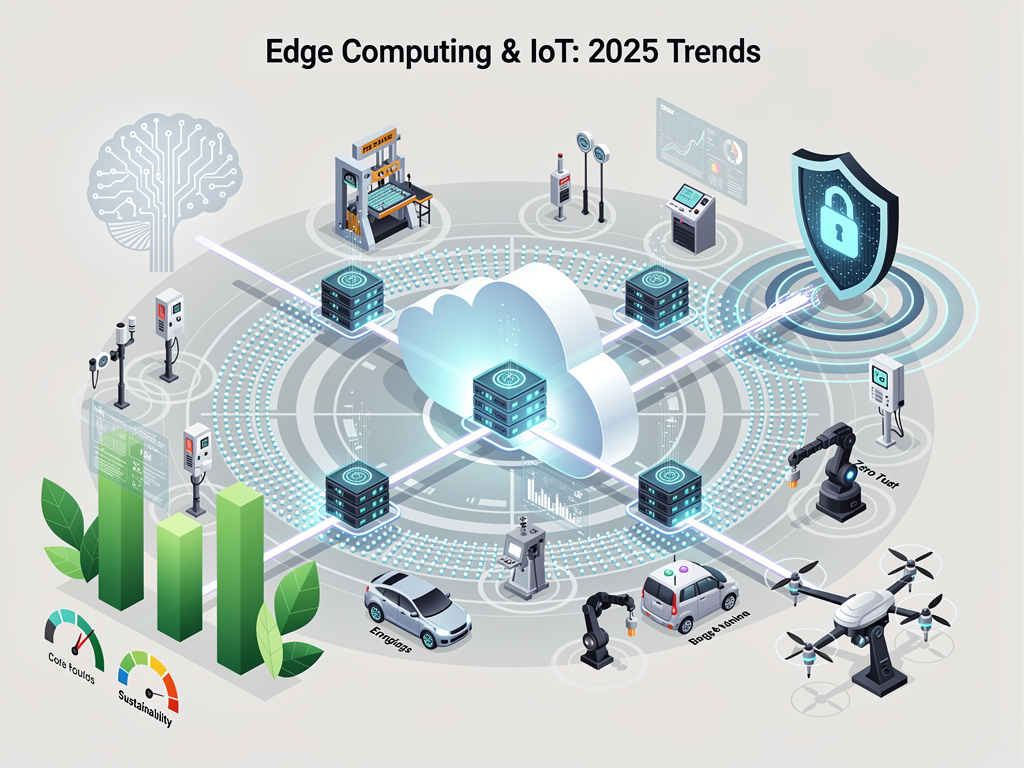
Edge computing and the internet of things have transitioned from experimental initiatives to core components of enterprise operations, with Forrester projecting 10 pivotal trends that will drive deployments through 2025. These shifts emphasize AI integration at the periphery, bolstered observability, fortified security, and sustainability imperatives, addressing latency constraints, bandwidth limitations, and reliability demands in distributed systems.
“Edge computing and IoT are no longer niche technologies—they are foundational to enterprise resilience,” said Michele Pelino, principal analyst at SecurityBrief New Zealand. Her assessment underscores how organizations are prioritizing local decision-making for applications like predictive maintenance on industrial gateways and drones equipped with computer vision for disaster response.
Recent surveys reveal most global enterprises are ramping up IoT investments despite persistent worries over security, upkeep, and privacy, as detailed in Forrester’s The State Of IoT, 2025. This momentum aligns with broader market forecasts, where edge spending is poised to surge amid AI acceleration.
AI Takes Command at the Periphery
Leading the trends, AI-driven edge intelligence enables autonomous operations, with agentic AI and AI PCs emerging via semiconductor breakthroughs and neural processing units. These allow on-device analytics in sectors like healthcare and manufacturing, minimizing cloud dependency. Forrester highlights how such capabilities support real-time personalization and IoT insights without constant central processing.
Networking innovations complement this, including SASE extensions to remote sites with Zero Trust enforcement, alongside private 5G—though still maturing—and noncellular mesh for bandwidth-scarce areas. “Integrated networking and security platforms that push Zero Trust capabilities to remote sites,” notes SecurityBrief UK, reducing complexity while enhancing protection.
Retail stands to benefit from mobile point-of-sale systems leveraging IoT for seamless transactions and elevated customer interactions, streamlining operations in dynamic environments.
Observability Emerges as Resilience Anchor
Observability tools are flagged as essential for unifying fragmented data from decentralized edge devices and IoT sensors, enabling performance monitoring and reliability optimization. Enterprises are deploying these to navigate the complexities of distributed setups, where traditional centralized monitoring falls short.
Forrester’s report stresses cross-functional IT-OT collaboration to align IoT use cases with business goals, countering persistent confusion over edge basics. This is critical as edge adoption matures, per insights from Forrester’s Top 10 Trends In Edge Computing And IoT, 2025.
IoT security evolves from mere device discovery to comprehensive lifecycle management and risk evaluation, vital amid rising threats to connected ecosystems.
Sustainability Drives IoT Innovation
Sustainability-focused IoT solutions gain traction, deploying real-time monitoring for energy use, air quality, and emissions in transportation and supply chains. These tools help firms meet regulatory and environmental targets while optimizing resource efficiency.
Edge development platforms are proliferating to simplify management of dispersed environments, supporting edge-optimized app delivery. Critical event management platforms integrate edge and IoT for swift incident response in high-stakes scenarios, such as emergency services or industrial safety.
Market data reinforces this trajectory: IoT Analytics reports 21.1 billion devices in 2025, surging to 39 billion by 2030, fueling demand for edge processing where 75% of enterprise data will originate by year-end, according to Gartner projections cited in multiple analyses.
Security Evolves for Distributed Realities
The inaugural Forrester Wave: IoT Security Solutions, Q3 2025 evaluates vendors like Nozomi Networks and Claroty, identifying trends beyond edge equipment protection. Enterprises now manage 6 to 10 IoT devices per employee, spanning printers to medical pumps, necessitating advanced defenses.
“Protecting IoT devices from threats is no longer relegated to your edge equipment,” the Wave states, urging holistic strategies including network segmentation and Zero Trust.
Convergence of AI, device fleets, networking, and security demands new governance, with AIOps aiding observability in edge-IoT-OT integrations, as explored in Forrester blogs.
Industrial and Retail Transformations Accelerate
Industrial deployments spotlight predictive maintenance and autonomy, while retail IoT enables frictionless experiences. Forrester’s The State Of Edge Computing, 2025 provides data on global adoption, motivators like customer anticipation, and barriers including budgets.
Hardware trends amplify this: Edge AI chips from Qualcomm, post its Edge Impulse acquisition, unify model development for IoT, per SumatoSoft. Gartner forecasts 75% of data processed at the edge by 2025, up from 10%.
Private networks, from 5G to LPWAN, proliferate for control in factories, cutting idle time by 30% and boosting throughput 25%, as Procter & Gamble and Schneider Electric report.
Enterprise Strategies for 2025 and Beyond
Forrester advises tech leaders to prioritize observability and collaboration to harness these trends fully. With edge markets projected to hit $380 billion by 2028 per IDC, firms aligning IT with OT will gain competitive edges in resilience and efficiency.
Recent X discussions echo this, with posts highlighting 30 billion IoT devices by 2030 and 65% edge deep learning by 2027. As agentic AI and edge intelligence mature, per Forrester’s broader emerging tech list, investments in hybrid models will define winners.


 WebProNews is an iEntry Publication