
Defying Gravity: An Engineer’s Audacious Bid to Rewrite Physics and Space Travel
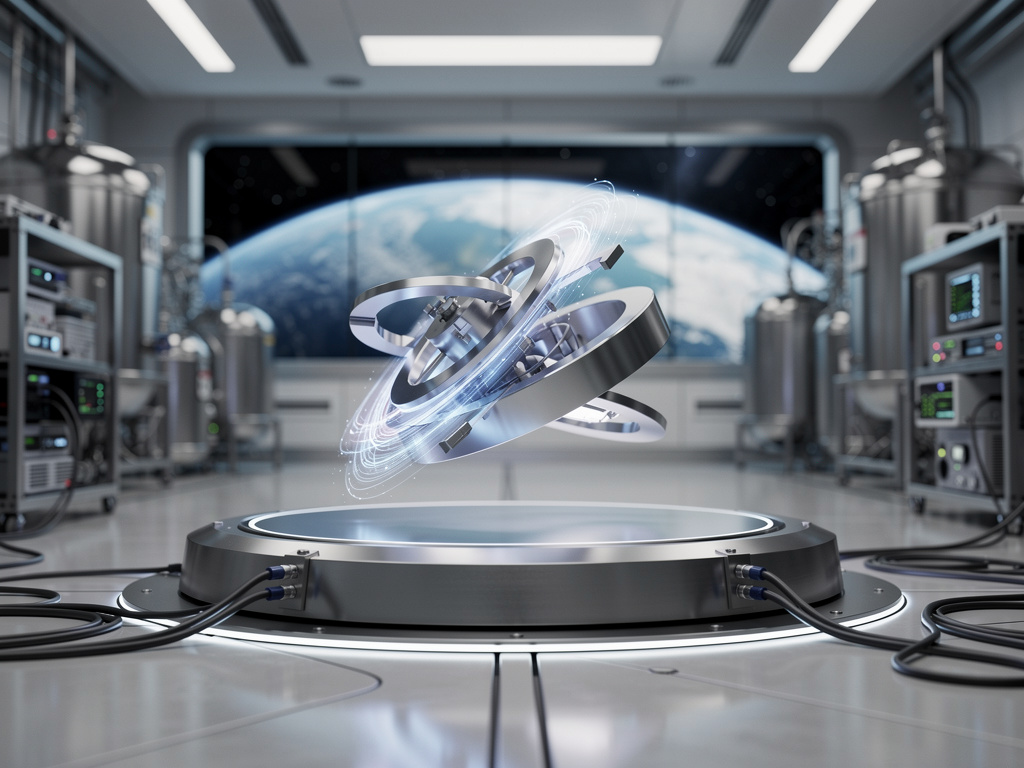
In the high-stakes world of aerospace innovation, few claims generate as much buzz—and skepticism—as those purporting to upend fundamental laws of physics. Enter Dr. Charles Buhler, a veteran NASA engineer and co-founder of Exodus Propulsion Technologies, who asserts he’s developed a propulsion system that overcomes Earth’s gravity without traditional propellants. This isn’t just another incremental advance in rocket science; it’s a potential paradigm shift that could transform everything from satellite deployment to interstellar exploration. Drawing from recent reports, Buhler’s work involves a “propellantless” drive that allegedly harnesses asymmetric electrostatic fields to generate thrust, challenging Newton’s third law in the process.
Buhler’s journey began during his tenure at NASA, where he contributed to projects like the electrostatic charging systems for Mars missions. Now, through Exodus, he’s pivoting to what he describes as a breakthrough in electromagnetic propulsion. According to details shared in a feature by Popular Mechanics, the system uses patented technology to create a net force without expelling mass, potentially enabling vehicles to hover or accelerate indefinitely. Industry insiders are watching closely, as this could slash the colossal costs associated with fuel-heavy launches, which currently run into billions for major space agencies.
Skeptics abound, of course. Physics as we know it demands that for every action, there’s an equal and opposite reaction—typically achieved by blasting out exhaust. Buhler’s device, however, claims to sidestep this by manipulating electric fields in a vacuum, producing measurable thrust in lab tests. Early demonstrations reportedly showed small-scale models lifting off tabletops, defying gravity’s pull without visible means of support. This has sparked debates in scientific circles, with some drawing parallels to past hoaxes like cold fusion, while others see echoes of legitimate fringe research in quantum vacuum thrusters.
Unpacking the Science Behind the Claim
To understand Buhler’s proposition, one must delve into the intricacies of electrostatic propulsion. The core idea revolves around creating an imbalance in electric charges that results in a directional force. In controlled experiments, Exodus engineers applied high-voltage differentials across specially designed electrodes, observing consistent upward motion. As detailed in a discussion on Hacker News, commentators noted that if this manipulates spacetime fabric efficiently, it could indeed bypass mass ejection—a concept that’s theoretically plausible but far from proven.
Critics point out potential measurement errors or environmental interferences, such as air currents or magnetic fields, that might mimic true thrust. Yet Buhler counters with data from vacuum chamber tests, where the effect persisted. This aligns with broader explorations in advanced propulsion, including NASA’s own EmDrive experiments, which similarly claimed propellantless thrust but faced reproducibility issues. For industry veterans, the real test will be independent verification; until then, Buhler’s work remains in the realm of promising anomaly.
The implications for space travel are profound. Traditional rockets expend vast amounts of fuel just to escape Earth’s atmosphere, limiting payload capacities and mission durations. A gravity-overcoming system could enable lightweight, reusable spacecraft that launch vertically without the fireworks of combustion. Imagine satellites repositioning themselves indefinitely or probes venturing to distant planets with minimal energy input. This vision has attracted attention from venture capitalists eyeing the trillion-dollar space economy.
From Lab Bench to Launchpad: Challenges Ahead
Scaling up presents formidable hurdles. Buhler’s prototypes are small, generating thrust in the millinewton range—enough for tabletop demos but insufficient for orbital insertion. Engineering a version capable of lifting meaningful payloads would require advances in materials science to handle extreme voltages without breakdown. Moreover, regulatory bodies like the FAA and international space agencies would demand rigorous safety validations before approving such tech for flight.
Funding is another battleground. Exodus has secured initial investments, but breaking into the aerospace sector dominated by giants like SpaceX and Blue Origin demands substantial capital. Buhler has been vocal about seeking partnerships, as evidenced in posts on X where enthusiasts share his announcements, amplifying calls for more research. One such post highlighted his NASA background, underscoring credibility amid the hype.
Intellectual property plays a crucial role here. Exodus holds patents on their asymmetric field technology, positioning them to license it if validated. However, patent offices have historically granted claims on unconventional propulsion, only for them to falter under scrutiny. Industry analysts compare this to the Wright brothers’ era, when flight seemed impossible until demonstrated—suggesting Buhler’s team might need a public, undeniable proof-of-concept to silence doubters.
Echoes of Past Breakthroughs and Broader Context
Historical precedents offer both caution and inspiration. In the 1990s, inventor Robert Shawyer’s EmDrive promised similar miracles but ultimately couldn’t replicate results consistently, leading to its dismissal by mainstream science. Buhler’s approach differs by grounding itself in electrostatics rather than microwaves, potentially offering a more testable framework. A report from 3DVF questions why serious outlets are entertaining this again, citing past letdowns, yet acknowledges the allure of disrupting physics.
Beyond propulsion, this ties into ongoing debates about unifying general relativity and quantum mechanics. If Buhler’s device truly warps local gravity, it could provide empirical data for theories like quantum gravity. Physicists on forums like Reddit’s r/abovethenormnews have dissected the claims, with threads garnering hundreds of comments debating feasibility. One popular thread, linked via Reddit, mirrors the excitement and division, blending optimism with calls for peer-reviewed evidence.
The timing couldn’t be more opportune. With 2026 shaping up as a pivotal year for space, marked by India’s Gaganyaan missions and private rocket launches as reported in The Economic Times, innovations like Buhler’s could accelerate humanity’s off-world ambitions. Meanwhile, global efforts in high-gravity simulations, such as China’s new centrifuge detailed in Good News Network, underscore the race to master gravitational forces.
Industry Ripples and Economic Stakes
Aerospace executives are quietly assessing the ripple effects. If validated, this technology could democratize space access, enabling startups to compete with established players. Cost savings alone—eliminating fuel logistics—might redirect billions toward habitat construction or resource extraction on other worlds. Venture firms are already circling, drawn by parallels to disruptive tech like reusable rockets, which Elon Musk’s SpaceX pioneered.
Yet ethical and security concerns loom. Unrestricted gravity manipulation could have military applications, from stealth drones to orbital weapons, prompting calls for international oversight. Buhler emphasizes peaceful uses, focusing on sustainable exploration, but history shows dual-use potential often emerges.
Public sentiment, gauged from X posts, reveals a mix of awe and cynicism. Users share clips of alleged anti-gravity demos, fueling viral discussions, while others demand transparency. This grassroots buzz, combined with media coverage, pressures Exodus to deliver tangible results soon.
Pushing Boundaries: What’s Next for Anti-Gravity Research
Looking ahead, Buhler’s team plans larger-scale tests, potentially collaborating with academic institutions for validation. Partnerships with entities like IEEE, which highlighted emerging tech in IEEE Spectrum, could provide the credibility boost needed. Meanwhile, competitors in the propulsion field are ramping up, from ion thrusters to laser sails, each vying for the next big leap.
For insiders, the true value lies in the questions Buhler’s work raises about our understanding of the universe. Even if it falls short, it could inspire refinements in electromagnetic theory, benefiting fields like energy storage or medical imaging.
Ultimately, as space ambitions grow—with 2026 forecasts from SpaceNews predicting surges in commercial launches—the pursuit of gravity-defying tech embodies the relentless drive to expand human frontiers. Whether Buhler’s claim holds or not, it reminds us that innovation often starts with the audacious.


 WebProNews is an iEntry Publication