
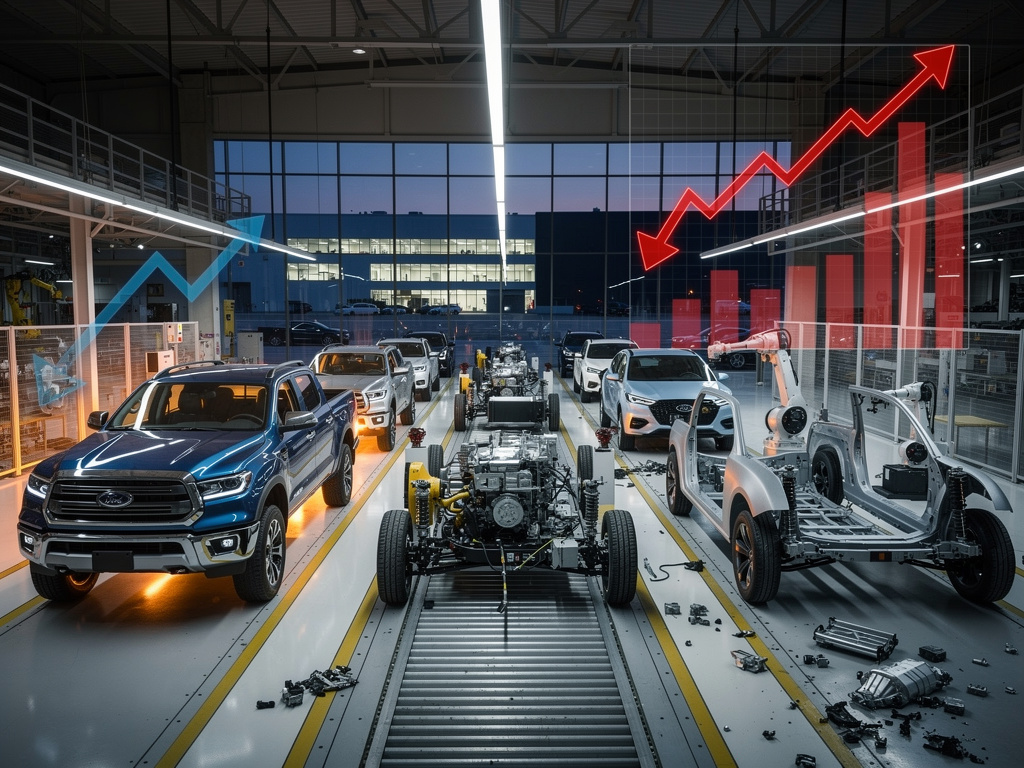
DEARBORN, Mich.—Ford Motor Co. CEO Jim Farley has delivered a blunt message to Wall Street and rivals alike: the automaker will no longer chase every buyer in a bid to dominate every corner of the market. “Ford will not try to make cars for everyone,” Mr. Farley stated, according to a report by AgriNews. The declaration marks a pivotal recalibration for the 122-year-old Blue Oval, prioritizing trucks, commercial vans and hybrids over broad-spectrum sedans and high-cost pure electrics.
This strategic pivot comes amid mounting losses in Ford’s Model e electric-vehicle division, which has hemorrhaged billions since its 2022 launch. Consumer aversion to EVs priced above $50,000 has forced the hand, with production of the all-electric F-150 Lightning ceasing after 2025 models. Executives, including Mr. Farley, have acknowledged that much of the EV lineup failed to achieve sales volume, flattening the anticipated adoption curve.
The company disclosed a staggering $19.5 billion in special charges tied to the EV restructuring, primarily affecting Model e. Of this, $8.5 billion stems from asset impairments and program write-downs, with $5.5 billion in cash outflows mostly hitting in 2026 and the rest in 2027, per details from Fortune. Despite the hit, Ford raised its 2025 adjusted EBIT guidance to $7 billion, signaling underlying strength in its core operations.
Workforce and Factory Fallout
The human toll is stark. Ford’s BlueOval SK battery plant in Glendale, Kentucky—built for EV production—laid off all 1,600 workers as it repurposes for battery storage serving data centers, utilities and AI infrastructure. BlueOval SK CEO Michael Adams notified staff via video that the shift ends all joint-venture positions in Kentucky, with pay and benefits continuing for 60 days, as reported by WDRB. Kentucky officials are scrambling with job fairs and renegotiated incentives to cushion the blow.
One-third of the displaced F-150 Lightning workforce shifts to gas and hybrid F-150 variants, while Ford invests $2 billion over two years in the energy storage venture. Production of lithium iron phosphate prismatic cells at Marshall, Michigan, stays on track for 2026 to power a forthcoming midsize EV pickup. Model e profitability slips to 2029 from 2026 targets, with annual gains expected from 2026, according to The Detroit News.
By 2030, Ford eyes 50% of global volume from hybrids, extended-range EVs and full electrics, up from 17% in 2025—a pragmatic blend responding to buyer preferences for hybrids over pure battery models.
Core Strengths Take Center Stage
Ford doubles down on profit powerhouses: F-Series trucks, Ford Pro commercial vehicles and vans. Mr. Farley emphasized reallocating capital to these segments where demand thrives and margins hold firm. Hybrids and extended-range electrics—EREVs with gas generators—emerge as bridges, mirroring moves by rivals like Stellantis on its Ram 1500 REV.
Sedans, once axed for unprofitability, linger as a possibility amid soaring new-vehicle prices topping $50,000. Mr. Farley told Motor1 Ford “couldn’t find a way to compete and be profitable” on models like Fiesta and Focus, though he hasn’t ruled out a revival. This selective focus echoes past decisions, freeing capacity for high-margin SUVs and pickups.
The Universal EV Platform anchors future electrics, a modular architecture for compact, affordable models starting with a 2027 midsize pickup at Louisville Assembly. It slashes parts by 20%, fasteners by 25% and assembly workstations by 40%, enabling Level 3 eyes-off autonomy by 2028, per Car and Driver.
Global Maneuvers and Rival Pressures
In Europe, Ford partners with Renault Group on two small EVs built on Ampere platforms at a French plant, debuting 2028 to counter Chinese imports like BYD. A letter of intent covers joint light commercial vans, boosting scale against low-cost threats, as detailed by Ford Media. Renault CEO François Provost noted the Chinese “will come soon,” prompting preemptive action.
Mr. Farley’s rhetoric signals a philosophical shift: Ford targets work-oriented buyers and off-road enthusiasts, not universal appeal. On X, Ford Authority highlighted his stance, underscoring focus on trucks amid EV winter. Rivals like GM pause Lyriq production, validating the retreat from aggressive electrification.
Ford’s path balances legacy strengths with selective innovation, navigating Trump-era policy shifts like relaxed fuel standards—hailed by Mr. Farley as enabling U.S.-made affordability, per Fox Business. Investors watch if this precision sharpens the Blue Oval’s edge or exposes flanks to agile newcomers.


 WebProNews is an iEntry Publication