
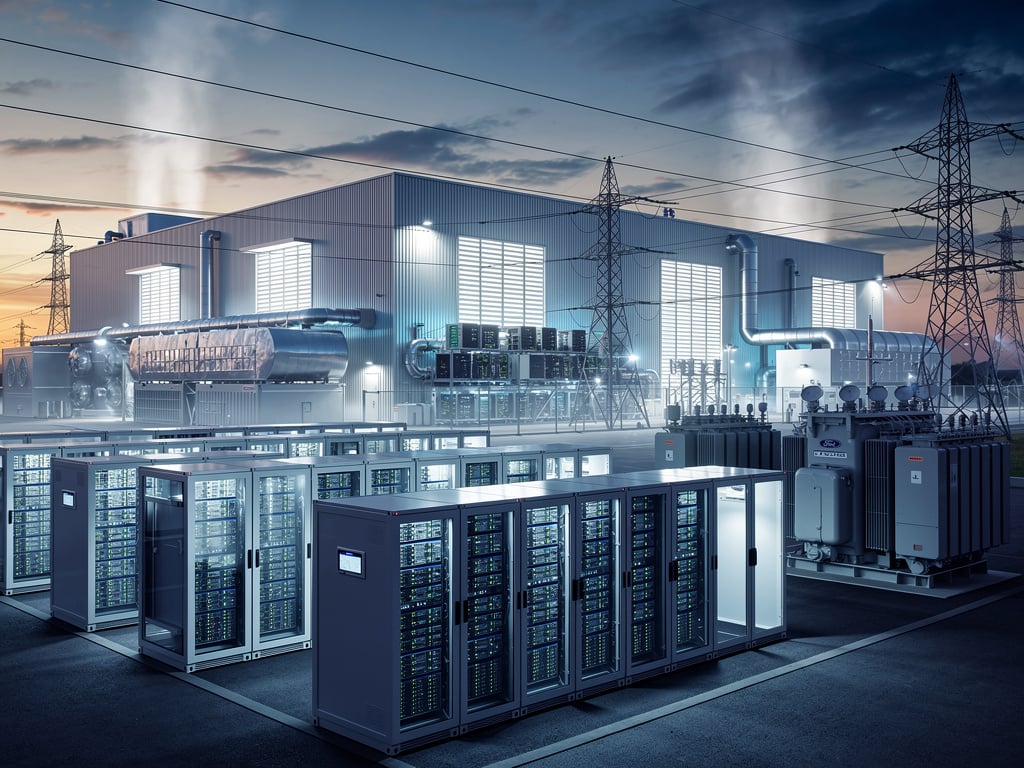
Ford Motor Company, the enterprise that put America on wheels, is making a calculated pivot that would have seemed absurd even five years ago. The Dearborn, Michigan automaker is repositioning itself not just as a vehicle manufacturer but as a provider of artificial intelligence infrastructure — renting out computing power and data center capacity to technology companies hungry for GPU resources.
The move is audacious. And it’s not without precedent in Ford’s long history of reinvention.
According to Yahoo Finance, Ford has been quietly building out its AI infrastructure capabilities, leveraging existing real estate, power supply agreements, and industrial-scale operational expertise to carve out a position in one of the most capital-intensive sectors of the modern economy. The company’s manufacturing plants — sprawling complexes with massive electrical capacity and cooling infrastructure already in place — present a natural fit for the kind of high-density computing that AI workloads demand.
This isn’t a side project. Ford’s leadership sees it as a strategic imperative.
From Assembly Lines to Server Racks
The logic behind Ford’s pivot starts with a simple observation: automakers already operate some of the most energy-intensive facilities in America. Ford’s Rouge Complex in Dearborn, for instance, spans 600 acres and has its own power plant. The company’s manufacturing footprint includes dozens of facilities across North America with robust electrical interconnections, industrial cooling systems, and the kind of redundant power infrastructure that data center operators spend years and billions of dollars trying to build from scratch.
What Ford recognized is that these assets — many of which are underused as the company transitions portions of its production toward electric vehicles and away from certain legacy platforms — represent enormous latent value in an AI-driven economy where computing capacity is the scarcest commodity on earth.
The demand side of the equation is staggering. According to recent estimates from the International Energy Agency, data center electricity consumption is expected to more than double by 2026, reaching over 1,000 terawatt-hours globally. In the United States alone, utilities are scrambling to accommodate new data center connections, with wait times for grid access stretching to four years or more in some regions. Companies like Microsoft, Amazon, and Google are spending tens of billions annually on AI infrastructure and still can’t build fast enough.
Ford doesn’t need to compete with hyperscalers head-to-head. It just needs to offer what they desperately lack: permitted, grid-connected, industrially zoned sites with available power capacity. That alone is worth a fortune right now.
The company has reportedly been in discussions with multiple technology firms about hosting arrangements, colocation agreements, and hybrid models where Ford would maintain and operate computing infrastructure on behalf of AI companies. Some of these arrangements could involve Ford purchasing GPU clusters — most likely Nvidia’s H100 or next-generation Blackwell chips — and renting out compute time, effectively becoming a cloud infrastructure provider with an automotive pedigree.
It’s a model that echoes what CoreWeave, the Nvidia-backed AI cloud startup, has done — except Ford brings something CoreWeave doesn’t: a century of industrial real estate and power contracts already locked in at rates that predate the current energy crunch.
Wall Street has taken notice, though the reaction has been mixed. Some analysts view the infrastructure play as a clever monetization of underperforming assets. Others worry it’s a distraction from Ford’s core business at a time when the company is hemorrhaging money on its electric vehicle division, Ford Model e, which lost $4.7 billion in 2023 and is on pace for similar losses this year.
But Ford CEO Jim Farley has been consistent in arguing that the company must diversify its revenue streams. In recent earnings calls, Farley has emphasized that Ford’s future won’t look like its past — that the company needs to think of itself as a technology and services business, not merely a manufacturer of trucks and SUVs.
The Competitive Calculus and the Risks Ahead
Ford isn’t the only non-tech company eyeing the AI infrastructure gold rush. Utilities, real estate investment trusts, mining companies, and even oil majors have explored data center plays. Equinix and Digital Realty dominate the colocation market. But the barrier to entry isn’t expertise in servers — it’s access to power and real estate at scale, and that’s where industrial companies have a surprising edge.
Still, the risks are real. Data center operations require specialized talent in areas like thermal management, network architecture, and cybersecurity that Ford’s existing workforce doesn’t possess. The company would need to hire aggressively or partner with managed service providers. There’s also the question of capital allocation: every dollar Ford spends on GPU clusters and data center buildouts is a dollar not spent on vehicle development, battery technology, or its profitable Ford Pro commercial division.
And then there’s the cyclical risk. AI infrastructure spending is white-hot right now, but the history of technology investment is littered with boom-bust cycles. If the current wave of AI spending cools — or if the major cloud providers build enough capacity to meet demand internally — Ford could find itself holding depreciating assets in a market it doesn’t fully understand.
The counterargument is timing. Even skeptics of the AI hype acknowledge that demand for computing infrastructure will remain elevated for years. Training large language models requires enormous computational resources, and the emerging wave of AI agents, multimodal models, and enterprise AI applications promises to keep demand growing. McKinsey estimated in a recent report that global spending on AI could reach $1.8 trillion annually by 2030. Ford doesn’t need to capture a large share of that market to generate meaningful returns.
There’s also a defensive rationale. Ford itself is a major consumer of AI — for autonomous driving research, manufacturing optimization, supply chain management, and customer experience applications. Building its own AI infrastructure gives the company leverage in negotiating with cloud providers and reduces its dependence on external computing resources that are becoming increasingly expensive and difficult to procure.
The broader context matters too. The U.S. government, under both the current and previous administrations, has pushed aggressively to expand domestic AI infrastructure capacity. Tax incentives, permitting reforms, and energy policy changes are all tilting in favor of companies willing to invest in American computing capacity. Ford, as an iconic American manufacturer with deep political relationships on both sides of the aisle, is well-positioned to benefit from these tailwinds.
Recent reporting from Reuters has highlighted how traditional industrial firms across the U.S. are exploring data center conversions, with several automakers and steel producers in early-stage discussions about repurposing excess facility capacity. Ford appears to be the furthest along among automakers in formalizing this strategy.
The financial structure of these deals also works in Ford’s favor. Colocation and infrastructure-as-a-service contracts typically run five to fifteen years, providing the kind of predictable, recurring revenue that Wall Street values far more highly than the cyclical, capital-intensive cash flows of vehicle manufacturing. If Ford can build even a modest AI infrastructure business generating $1-2 billion in annual revenue at data center margins — which typically run 40-60% EBITDA — it could meaningfully re-rate the stock.
That’s the bet Jim Farley is making. Not that Ford will become the next AWS. But that a company with 122 years of industrial know-how, thousands of acres of powered real estate, and a willingness to think differently about its asset base can find a profitable niche in the most important infrastructure buildout since the interstate highway system.
Whether it works depends on execution — always Ford’s Achilles’ heel. The company’s track record on technology initiatives is uneven at best. Its investment in Argo AI, the autonomous driving startup, ended in a $2.7 billion write-off in 2022. Its software platforms have been plagued by delays and quality issues. And the Model e electric vehicle division remains a cash furnace with no clear path to profitability.
But AI infrastructure is different from those bets in one critical respect: the demand is here now, it’s enormous, and it’s growing. Ford doesn’t need to invent new technology or change consumer behavior. It needs to rent out power and space to companies that are desperate for both. That’s a much simpler value proposition than building a self-driving car or convincing truck buyers to go electric.
Simple doesn’t mean easy. But for Ford, a company that has survived world wars, oil crises, a near-bankruptcy in 2008, and the ongoing upheaval of electrification, it might just be the right kind of hard.


 WebProNews is an iEntry Publication