
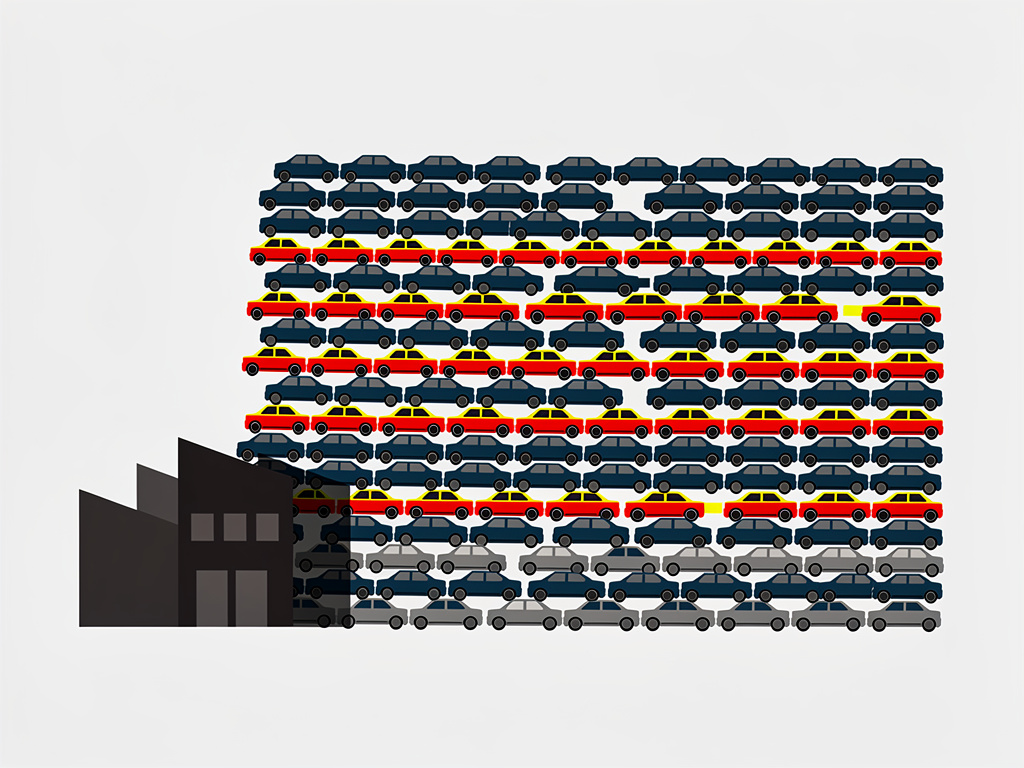
Ford Motor Company is sitting on a mountain of returned vehicles — roughly 100,000 of them — and the question of what to do with this inventory has become one of the more unusual logistical puzzles in modern automotive history. The cars and trucks piling up in storage lots across the country aren’t defective in any traditional sense. Most run fine. But they’ve been bought back from consumers under state lemon laws, and getting them back on the road involves a regulatory maze that varies state by state, title by title, and buyer by buyer.
The scale is staggering.
According to Yahoo Finance, Ford’s buyback inventory has ballooned to an estimated 100,000 vehicles, representing somewhere around $1.5 billion in tied-up capital. The company has been acquiring these vehicles back from dissatisfied customers faster than it can resell them, creating a bottleneck that has drawn attention from analysts, dealers, and competitors alike. Ford confirmed in recent weeks that it’s exploring new strategies to liquidate the stockpile, including potentially becoming the world’s largest used car operation — at least temporarily.
The roots of this problem aren’t hard to trace. Ford’s quality issues over the past several years have been well documented. The company’s own warranty costs have surged, driven by persistent problems across several model lines. Transmissions in certain Ford and Lincoln vehicles have been a recurring headache. Electrical gremlins in newer models haven’t helped. And the launch quality of some vehicles — particularly during the pandemic-era supply chain disruptions — fell below the standards customers expected from a brand with Ford’s heritage.
Lemon laws exist in every U.S. state, though they differ considerably in their specifics. Generally, if a manufacturer can’t fix a substantial defect after a reasonable number of attempts, the consumer is entitled to a replacement vehicle or a full buyback. Ford, to its credit, hasn’t fought most of these claims aggressively. The company has largely honored buyback requests, which is the right thing to do from a customer relations standpoint. But the sheer volume tells a story about underlying product quality that no amount of goodwill can fully mask.
CEO Jim Farley has acknowledged the quality gap publicly, calling it one of Ford’s most pressing priorities. The company has invested billions in improving manufacturing processes and has reorganized its business into three distinct units — Ford Blue for internal combustion vehicles, Ford Model e for electric vehicles, and Ford Pro for commercial customers. Part of the rationale behind this restructuring was to create clearer accountability for quality within each division. Whether that organizational surgery translates into fewer buybacks remains to be seen.
So what happens to 100,000 returned vehicles?
It’s not as simple as slapping a discount sticker on the windshield and parking them on a dealer lot. Lemon law buyback vehicles carry branded titles in most states — meaning the title is permanently marked to indicate the vehicle was repurchased due to a defect. This branding significantly reduces resale value. Some states allow these vehicles to be resold with proper disclosure. Others impose strict inspection and recertification requirements before a branded-title vehicle can change hands again. A few states make resale so cumbersome that it’s barely worth the effort.
Ford has been working with a network of wholesale partners and auction houses to move the inventory, but the pace hasn’t kept up with the inflow. The company reportedly explored creating its own direct-to-consumer resale channel for these vehicles, which would be an unprecedented move for a legacy automaker. Think of it as Ford becoming its own Carmax — but exclusively for cars that customers already rejected once.
The financial implications are material. Ford’s warranty and recall costs hit $4.8 billion in 2023, a figure that made Wall Street wince. The buyback inventory sitting in lots isn’t just depreciating — it’s costing money to store, insure, and maintain. Every month a vehicle sits unsold, Ford loses value on the asset. Analysts at Deutsche Bank estimated earlier this year that Ford’s per-unit warranty cost significantly exceeds that of rivals General Motors and Toyota, a gap that directly impacts margins in an already thin-margin business.
And the problem feeds on itself. High warranty costs pressure profitability. Lower profitability limits the capital available for quality improvements. Slower quality improvements lead to more buybacks. More buybacks add to the inventory pile. It’s a cycle that Ford needs to break decisively, and soon.
The used car market itself offers both opportunity and complication. Used vehicle prices, while down from their pandemic-era peaks, remain elevated by historical standards. This means Ford’s buyback inventory theoretically holds decent value — if the company can find buyers willing to accept branded titles. For budget-conscious consumers, a Ford F-150 or Explorer with a lemon law history but a verified repair might represent genuine value, especially at a meaningful discount to comparable clean-title vehicles.
But consumer perception is a tricky thing. The word “lemon” carries emotional weight that goes beyond the mechanical reality of any individual vehicle. Many of these buyback units had relatively minor issues — an infotainment system that kept crashing, a sensor that threw false warnings, a transmission that shuddered under specific conditions. Once repaired, they may be perfectly reliable. Convincing buyers of that, however, requires transparency and trust that takes time to build.
Ford isn’t the only automaker dealing with buyback inventory, but it appears to be dealing with it at a scale that dwarfs competitors. Stellantis, which owns Jeep, Ram, and Chrysler, has faced its own quality criticisms but hasn’t accumulated a comparable stockpile. General Motors has generally maintained tighter quality metrics in recent years, though it’s had its own high-profile recall episodes. Tesla, for its part, operates under a different model entirely, with over-the-air software updates resolving many issues that would trigger buyback claims at traditional manufacturers.
The strategic question for Ford goes beyond logistics. It’s a branding question. How does a company that’s simultaneously trying to position itself as an innovation leader in electric trucks and commercial vehicles reconcile that image with being the automaker that bought back 100,000 vehicles? The answer probably lies in how Ford handles the situation from here — whether it’s seen as a company that stood behind its products and made customers whole, or one that simply couldn’t build them right in the first place.
Farley has bet heavily on Ford Pro, the commercial division, as the company’s profit engine going forward. That unit has delivered strong results, with margins that subsidize the losses still flowing from Ford’s EV operations. But commercial customers are even less tolerant of quality problems than retail buyers. A plumbing company that loses a Transit van to warranty issues loses revenue every day that vehicle is off the road. If Ford’s quality reputation erodes among fleet buyers, the financial consequences would be far more severe than any consumer buyback program.
There’s a historical parallel worth considering. In the 1990s, Ford faced a crisis of confidence around the Explorer and Firestone tire debacle. The company eventually emerged stronger, but it took years of investment in safety and quality — and a CEO willing to make it the top priority — to rebuild trust. The current situation isn’t a safety crisis on that scale. Not even close. But the accumulation of smaller quality failures across a broad product line can be just as corrosive to a brand over time.
Ford’s stock has reflected these concerns. Shares have underperformed the broader market over the past twelve months, weighed down by EV losses, tariff uncertainty, and persistent questions about quality spending. The buyback inventory represents a tangible, quantifiable drag on the balance sheet — one that investors can point to when arguing that Ford’s turnaround still has a long way to go.
For now, the 100,000 vehicles sit and wait. Some will find buyers at auction. Some will be sold through dealer networks with appropriate disclosures. Some may eventually be exported to markets where branded-title stigma matters less. And some, inevitably, will be parted out or scrapped — a final indignity for vehicles that rolled off the assembly line with the Blue Oval on their grilles and the full weight of Henry Ford’s legacy behind them.
The real measure of Ford’s response won’t be how quickly it clears the lots. It will be whether the lots stop filling up.


 WebProNews is an iEntry Publication