
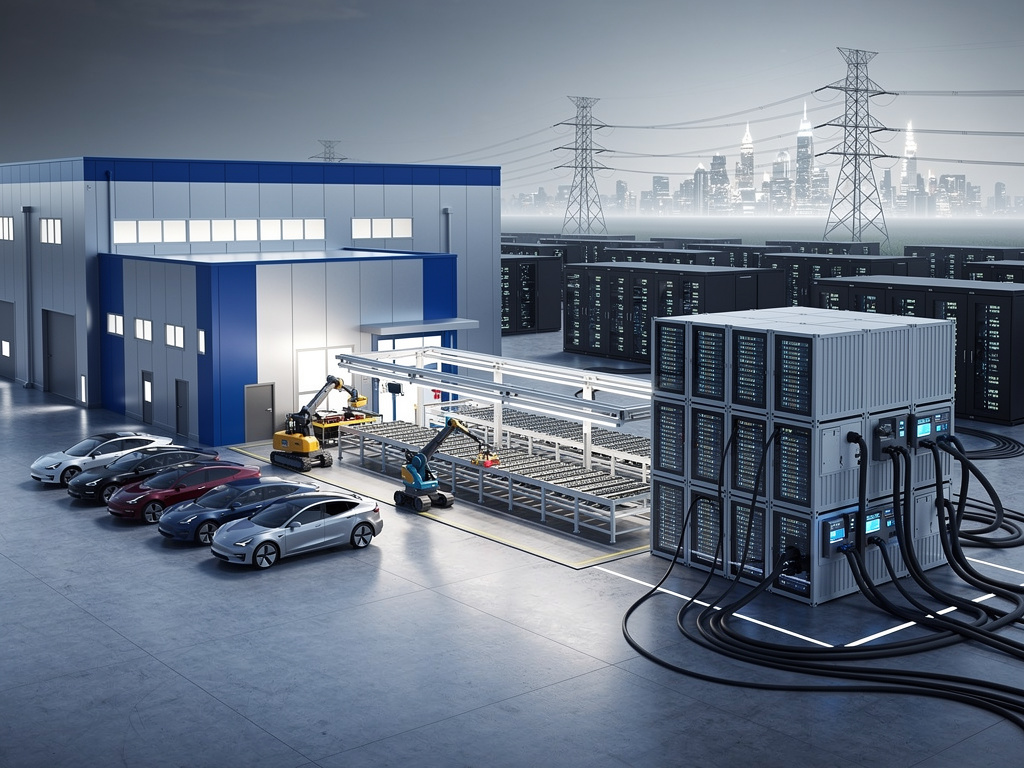
Ford’s Bold Battery Bet: Pivoting from EV Dreams to AI Power Plays
Ford Motor Co. is charting a dramatic course correction in its business strategy, shifting resources away from ambitious electric vehicle plans toward a burgeoning opportunity in energy storage for artificial intelligence data centers. This move comes amid softening demand for battery-powered cars and a surge in power needs from the tech sector’s AI expansion. Announced on Monday, the Detroit automaker revealed it would incur a staggering $19.5 billion charge related to scaling back EV investments, a decision influenced by market dynamics and policy shifts under the incoming Trump administration. As detailed in a recent report from Business Insider, Ford plans to repurpose its battery manufacturing capabilities to supply storage solutions for data centers, tapping into the AI boom that’s straining global energy grids.
The pivot underscores broader industry trends where traditional automakers are reassessing their electrification strategies. Ford’s CEO, Jim Farley, cited changing customer preferences as a key factor, noting that hybrid vehicles—combining gasoline engines with battery tech—are gaining traction over pure EVs. This isn’t just a retreat; it’s a strategic redeployment. The company intends to invest about $2 billion over the next two years into a new battery storage business, aiming to power data centers and stabilize electrical grids. Sources from TechCrunch highlight how Ford will leverage its existing EV battery plants, converting them to produce large-scale storage systems that can store excess energy and release it during peak demand periods.
This shift arrives at a pivotal moment for the automotive sector. With EV sales growth slowing—projected to represent only about 8% of U.S. vehicle sales in 2025, down from earlier optimistic forecasts—Ford is doubling down on hybrids while keeping select EV models like the F-150 Lightning in production, albeit with modified technology. The financial hit is substantial, encompassing writedowns on EV-related assets and canceled projects, including a planned three-row electric SUV. Yet, as reported in Reuters, this is seen as the most vivid illustration of how automakers are responding to weakened EV incentives and regulatory rollbacks anticipated under President-elect Donald Trump.
Strategic Realignment Amid Market Pressures
Ford’s entry into battery storage isn’t merely a defensive play; it’s an offensive strike into a high-growth arena. The AI industry’s voracious appetite for electricity has data centers projected to consume up to 8% of U.S. power by 2030, according to some estimates. Ford aims to capitalize on this by providing modular battery systems that integrate with renewable sources like solar and wind, ensuring reliable power for AI computations. Posts on X, formerly Twitter, reflect growing sentiment around this trend, with users noting how companies like Tesla are already exploring similar integrations, using parked vehicles as distributed computing nodes. One such discussion emphasized the potential for battery storage to quadruple global power demand in the coming decade, positioning players like Ford as key enablers.
Internally, Ford is restructuring its workforce to support this new venture. The company plans to add thousands of jobs in the U.S., redeploying about one-third of the F-150 Lightning production team to hybrid models after wrapping up the 2025 lineup. This job creation aligns with Farley’s vision of maintaining American manufacturing strength, even as the firm scales back on all-electric ambitions. Insights from Detroit Free Press reveal that Ford will continue producing the Mustang Mach-E and E-Transit van, but with a sharper focus on profitability rather than volume.
Comparisons to rivals are inevitable. Tesla, under Elon Musk, has long blended automotive and energy storage through its Powerwall and Megapack products, which already serve data centers. Ford’s move could position it as a direct competitor, especially as Tesla explores innovative ideas like leveraging idle vehicles for AI inference, as buzzed about in various X threads. Meanwhile, General Motors and others are also tempering EV plans, but Ford’s aggressive pivot into data center energy stands out for its scale and speed.
Technological Innovations Driving the Shift
At the heart of Ford’s strategy is a bet on advanced battery chemistries originally developed for EVs. These include lithium-iron-phosphate (LFP) cells, which offer cost advantages and longer lifespans ideal for stationary storage. By repurposing plants in Tennessee and Michigan—facilities that were slated for EV battery production—Ford can quickly scale output. A piece in The New York Times explains that the $19.5 billion charge covers not just asset impairments but also the costs of pivoting these operations, reflecting a calculated risk to enter a market where demand for grid-scale batteries is exploding.
The AI connection is particularly intriguing. Data centers running large language models and machine learning algorithms require uninterrupted power, often in remote locations where grid infrastructure lags. Ford’s systems could provide backup during outages or peak loads, integrating with nuclear and renewable sources. X posts from industry analysts underscore this, with one noting that battery storage will be crucial for stabilizing grids amid AI’s inference cycles, potentially benefiting companies like Ford alongside Tesla and emerging players in nuclear energy.
Moreover, Ford’s approach includes software integrations for smart energy management, drawing from its connected vehicle expertise. This could allow data center operators to optimize power usage dynamically, reducing costs and emissions. As EV demand cools—blamed on high prices, charging infrastructure gaps, and policy uncertainty—Ford’s leadership sees battery storage as a more immediate revenue stream, with projections suggesting the global market could reach $150 billion by 2030.
Policy and Economic Influences
The timing of Ford’s announcement coincides with significant policy changes. The Trump administration’s expected rollback of EV tax credits and emissions standards has accelerated the industry’s retreat from aggressive electrification timelines. Reuters coverage points out that Ford’s decision mirrors actions by other automakers, but its $19.5 billion hit is among the largest, signaling a profound reassessment of capital allocation.
Economically, the move makes sense in a high-interest-rate environment where EV projects have become costlier to finance. Ford’s stock reacted positively to the news, rising modestly as investors applauded the pivot to higher-margin opportunities. From a broader perspective, this reflects a maturing view in Detroit: electrification isn’t abandoned but recalibrated. Hybrids, which Ford plans to expand across its lineup, offer a bridge technology that appeals to consumers wary of full EVs.
Looking ahead, Ford’s battery storage business could forge partnerships with tech giants like Google or Microsoft, whose data centers are power-hungry behemoths. X discussions highlight competitive dynamics, with users speculating on how Ford’s entry might challenge Tesla’s dominance in energy storage, especially as AI demands innovative solutions like distributed networks of vehicle batteries.
Competitive Dynamics and Future Prospects
Ford isn’t entering this field in isolation. Rivals like Tesla have a head start, with Megapacks already deployed in major data centers. However, Ford’s automotive-scale manufacturing could provide a cost edge, producing batteries at volumes that undercut smaller specialists. TechCrunch reports emphasize Ford’s $2 billion investment as a commitment to rapid scaling, potentially creating a new revenue pillar separate from vehicle sales.
Challenges remain, including supply chain vulnerabilities for critical minerals like lithium and cobalt. Ford has been diversifying suppliers, but geopolitical tensions could disrupt this. Additionally, the company must navigate regulatory hurdles for energy products, which differ from automotive standards.
Industry insiders view this as a savvy adaptation. By pivoting from EV overcommitment to AI-enabling tech, Ford positions itself at the intersection of mobility and digital infrastructure. Business Insider’s analysis suggests this could offset EV losses, with battery storage margins potentially rivaling those of software services.
Global Implications and Industry Ripple Effects
On a global scale, Ford’s strategy resonates with energy transitions worldwide. In Europe and Asia, where EV adoption varies, similar pivots are emerging. For instance, Chinese automakers are flooding markets with affordable EVs, pressuring U.S. firms to innovate elsewhere. Ford’s focus on domestic job growth—thousands of positions in battery and hybrid production—aligns with nationalist policies, potentially earning favor in Washington.
X sentiment captures excitement around AI’s energy needs, with posts predicting a “hockey stick” ramp in demand for storage solutions. This could spur collaborations, such as Ford teaming with renewable firms to create integrated power ecosystems.
Ultimately, Ford’s pivot exemplifies resilience in a volatile sector. By repurposing EV assets for AI power, the company not only mitigates losses but also stakes a claim in the next technological frontier, blending Detroit’s industrial might with Silicon Valley’s digital ambitions. As the AI boom intensifies, Ford’s batteries may well become as iconic as its trucks, powering not roads, but the invisible highways of data.


 WebProNews is an iEntry Publication