
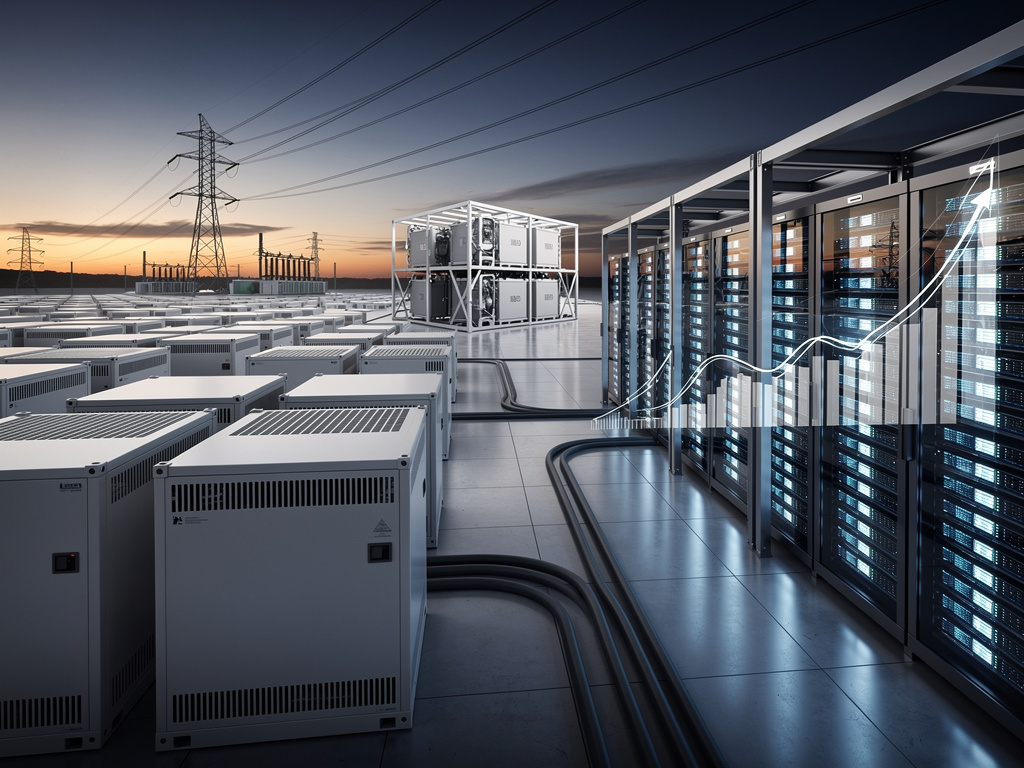
Ford Motor just created a new subsidiary called Ford Energy. The unit will build battery systems for utilities, factories and the data centers powering artificial intelligence. First deliveries start in late 2027. The announcement sent Ford shares up 13 percent in a single day. Its largest one-day gain in years.
The move marks a stark change. Late last year Ford recorded a $19.5 billion write-down on its electric-vehicle programs. It canceled several EV models and doubled down on hybrids. CEO Jim Farley called battery storage one of the company’s “high-margin opportunities.” A welcome contrast to the thin profits typical in vehicle manufacturing.
General Motors follows a similar path. Through its Ultium Cells joint venture with LG Energy Solution, GM will convert an EV battery plant in Spring Hill, Tennessee, to produce lithium-iron phosphate cells for storage systems. Production begins in the second quarter. The shift allows the recall of 700 laid-off workers. “We don’t have enough demand to fill three factories,” said Kurt Kelty, GM’s vice president of battery, propulsion and sustainability, in a Reuters report.
Stellantis has already redirected some output from its Samsung SDI battery plant in Kokomo, Indiana, toward energy storage. The company is reportedly seeking an exit from that venture as EV losses grow, according to a Bloomberg article.
Policy, Profits and the AI Surge Drive the Change
These decisions reflect hard realities. Consumer demand for EVs cooled faster than expected. Federal incentives for passenger EV purchases faded under new legislation. Support for commercial battery storage projects, however, remains. Tax credits favor systems built with American materials and in American factories. The result? Carmakers can repurpose billions in sunk battery-plant costs without abandoning electrification entirely.
Energy storage also taps a different customer base. Data centers hungry for reliable power. AI training creates enormous and fluctuating electricity loads. Batteries provide backup, smooth peaks, and ease pressure on local grids. Shan Tomouk, who leads battery energy storage research at Benchmark Mineral Intelligence, told WIRED, “If the huge market of data centers keeps growing every year, it does make sense for automakers to pivot.” He expects that growth to continue as the United States pushes to lead in AI.
Benchmark forecasts energy storage will account for 41 percent of total U.S. battery demand this year. That’s up from 26 percent two years ago. A Wall Street Journal report noted analysts expect Tesla’s energy storage revenue to rise 45 percent while its EV sales grow just 2.3 percent. Tesla, with more than a decade in the business, remains the leader. Its Megapack and Powerwall lines have offset softness in vehicle sales, though energy revenue dipped in the most recent quarter.
Ford plans to produce at least 20 gigawatt-hours of storage systems annually from the repurposed Glendale, Kentucky, facility by late 2027. It will draw on its four-year partnership with Chinese battery maker CATL for manufacturing know-how. GM partners with Redwood Materials for recycled content in storage batteries. Eleven battery plants worldwide are being retooled for storage, eight of them in the United States, per BloombergNEF data cited in the WIRED piece.
Yet success is far from guaranteed. Converting EV lines to storage systems brings technical hurdles. Demand must materialize quickly enough to absorb excess capacity. Gil Tal, director of the EV Research Center at UC Davis, offered a blunt assessment to WIRED: “If automakers aren’t making money from storage and not making money from EVs, they would prefer not to make money from storage because they’re not competing with their own gas car production. It makes perfect sense, unfortunately.”
The shift also highlights broader industry caution. Many automakers have slowed ambitious EV timelines. Hybrids now claim renewed investment. Some explore hydrogen for commercial fleets. Toyota, Honda and Hyundai have increased focus on fuel-cell technology for trucks and heavy-duty applications, as detailed in a May Autoblog analysis.
Still, the storage pivot offers Detroit a pragmatic bridge. It keeps battery expertise alive. It generates revenue from a market boosted by AI infrastructure needs. And it avoids further bleeding cash on vehicles many buyers still reject at current prices.
Ford, GM and others aren’t abandoning cars. They are hedging. The bet is that stationary batteries can deliver profits while the vehicle market sorts itself out. Whether those systems scale fast enough, and whether data-center demand proves as steady as hoped, will determine if this energy turn becomes a lasting strategy or merely a temporary reprieve. One thing is clear. The era when every new battery plant targeted only passenger EVs has ended.


 WebProNews is an iEntry Publication