
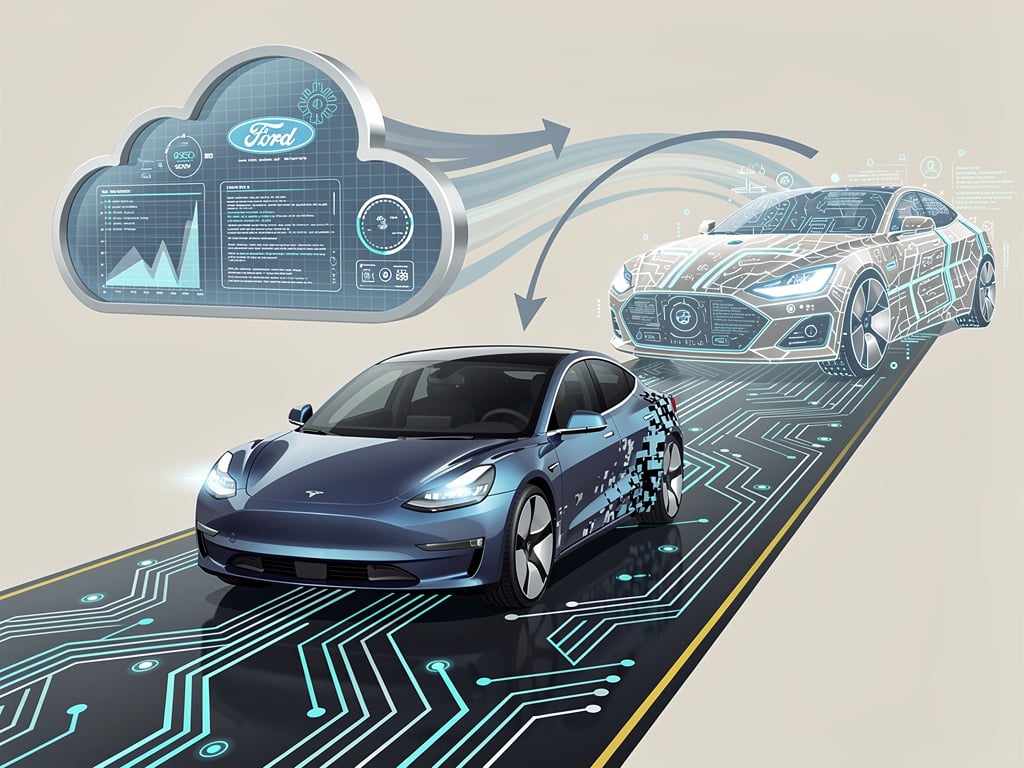
In a remarkably candid admission that has reverberated across the automotive industry, Ford Motor Company has publicly acknowledged that its current lineup of electric vehicles falls short of competitors when it comes to software-defined technology. The confession, delivered by Ford’s own leadership, marks a rare moment of corporate transparency in an industry where automakers typically tout their products as best-in-class, even when the evidence suggests otherwise.
The Dearborn, Michigan-based automaker’s concession comes at a time when the EV market is undergoing rapid transformation, with Tesla, Chinese rivals like BYD, and even newer entrants setting a blistering pace on software integration, over-the-air updates, and digital user experience. Ford’s willingness to name its own shortcomings, rather than paper over them, signals a broader strategic recalibration that could define the company’s trajectory for the next decade.
A Blunt Assessment From the C-Suite
According to reporting by MSN, Ford executives have openly stated that the company’s present-generation electric vehicles — including the Mustang Mach-E and the F-150 Lightning — do not match the software sophistication offered by key competitors. The acknowledgment is particularly striking given that Ford was among the first legacy automakers to bring a mainstream electric SUV and an electric pickup truck to market, earning early plaudits for its willingness to embrace electrification.
But being first to market and being best in market are two very different things. Ford’s EV software architecture, while functional, has been criticized by reviewers and owners alike for sluggish infotainment response times, inconsistent over-the-air update rollouts, and a general lack of the kind of integrated digital experience that Tesla owners have come to expect as standard. The company’s leadership appears to have internalized this feedback and is now using it as a catalyst for change rather than a point of defensiveness.
The Software Gap: Where Ford Falls Short
The core issue for Ford — and indeed for most legacy automakers — is architectural. Traditional car companies built their vehicles around hardware, with software layered on top as an afterthought. Tesla, by contrast, was conceived from the ground up as a software company that happens to make cars. This fundamental difference in philosophy has created a widening gap that Ford is now racing to close.
Ford’s current EVs run on a patchwork of software systems sourced from multiple suppliers, making unified updates and feature deployment significantly more complex. Tesla’s vertically integrated software stack allows it to push updates to its entire fleet simultaneously, adding features, improving performance, and even fixing bugs without requiring a dealership visit. Chinese manufacturers, particularly BYD and NIO, have also made enormous strides in software integration, with NIO’s vehicles offering sophisticated AI-driven features and frequent software enhancements that keep the ownership experience feeling fresh.
Ford’s Plan to Close the Gap
Ford has not simply thrown up its hands in defeat. The company has been investing heavily in its next-generation EV platform, which is expected to feature a completely redesigned electrical and software architecture. Ford CEO Jim Farley has repeatedly emphasized that the company’s future vehicles will be built around a centralized computing platform, replacing the current distributed system of dozens of individual electronic control units with a more unified, updatable architecture.
The company’s restructuring into three distinct business units — Ford Blue for internal combustion vehicles, Ford Model e for electric vehicles, and Ford Pro for commercial customers — was designed in part to give the EV division the startup-like agility needed to compete on software. Ford Model e has been tasked with developing the next-generation platform that will underpin a new family of more affordable electric vehicles expected to begin arriving in 2026 and 2027. These vehicles are being designed with software-defined principles from the outset, rather than having digital capabilities retrofitted onto existing platforms.
The Competitive Pressure From All Sides
Ford’s admission does not exist in a vacuum. The company faces intensifying competition from virtually every direction. Tesla continues to dominate the U.S. EV market in terms of both sales volume and software capability, despite recent controversies surrounding CEO Elon Musk’s political activities. General Motors has made significant progress with its Ultium platform and has been rolling out increasingly polished software experiences in vehicles like the Cadillac Lyriq and the Chevrolet Equinox EV. Hyundai and Kia, meanwhile, have emerged as formidable competitors with their E-GMP platform, earning praise for both driving dynamics and digital integration.
Perhaps most concerning for Ford is the looming threat from Chinese automakers. While tariffs currently keep most Chinese-made EVs out of the U.S. market, companies like BYD, NIO, and Xiaomi are rapidly gaining ground in Europe and Southeast Asia, offering vehicles with sophisticated software at price points that legacy Western automakers struggle to match. Ford’s next-generation platform will need to compete not just on features but on cost, a dual challenge that will test the company’s engineering and manufacturing capabilities to their limits.
Why Honesty May Be Ford’s Best Strategy
There is a school of thought in corporate strategy that says admitting weakness is itself a form of strength — provided the admission is accompanied by a credible plan for improvement. Ford appears to be betting on this approach. By publicly acknowledging that its current EVs lag on software, the company is managing expectations with investors, signaling to customers that better products are on the way, and creating internal urgency around the need to accelerate development.
This stands in contrast to the approach taken by some competitors, who have overpromised on software capabilities and underdelivered. General Motors’ troubled rollout of its hands-free Super Cruise system and the buggy initial software in early Ultium-platform vehicles serve as cautionary tales about the risks of overselling technology that isn’t ready for prime time. Ford’s decision to be upfront about its current limitations could ultimately build more consumer trust than a glossy marketing campaign that doesn’t match the reality of the ownership experience.
The Financial Stakes Are Enormous
Ford’s Model e division has been hemorrhaging money, losing billions of dollars annually as the company invests in next-generation technology while selling current-generation vehicles at thin or negative margins. The company reported that its EV division lost approximately $4.7 billion in 2024, a staggering figure that underscores the financial burden of the transition. Ford has indicated that it expects losses to narrow as it transitions to its next-generation platform, which is being designed with a keen focus on cost reduction and manufacturing efficiency.
The financial pressure has forced Ford to make difficult decisions, including delaying or canceling certain EV programs. The company scrapped plans for a three-row electric SUV and has shifted its strategy toward smaller, more affordable electric vehicles that can achieve profitability more quickly. This pragmatic approach reflects a broader industry reckoning with the economics of EV production, as the initial wave of enthusiasm gives way to hard questions about how to make electric vehicles that consumers actually want to buy at prices that generate acceptable returns.
What Comes Next for Ford’s Electric Ambitions
The next 18 to 24 months will be critical for Ford’s EV strategy. The company needs to demonstrate tangible progress on its next-generation platform while continuing to sell and support its current lineup of electric vehicles. It must also contend with a shifting regulatory environment, as the Trump administration’s approach to EV mandates and emissions standards introduces additional uncertainty into long-term planning.
Ford’s willingness to publicly confront its software shortcomings is, in many ways, a reflection of Jim Farley’s leadership style. The CEO has consistently argued that the auto industry is undergoing a fundamental transformation and that legacy companies must be willing to cannibalize their own products and processes to survive. His candor about Ford’s current position is consistent with that philosophy — an acknowledgment that the company cannot fix what it refuses to name.
Whether Ford can translate this honesty into competitive products remains to be seen. The auto industry is littered with companies that correctly diagnosed their problems but failed to execute on the solutions. Ford has the brand recognition, the manufacturing scale, and the financial resources to mount a credible comeback in software-defined EVs. What it needs now is flawless execution — and time, which is the one resource its competitors are least likely to grant.


 WebProNews is an iEntry Publication