
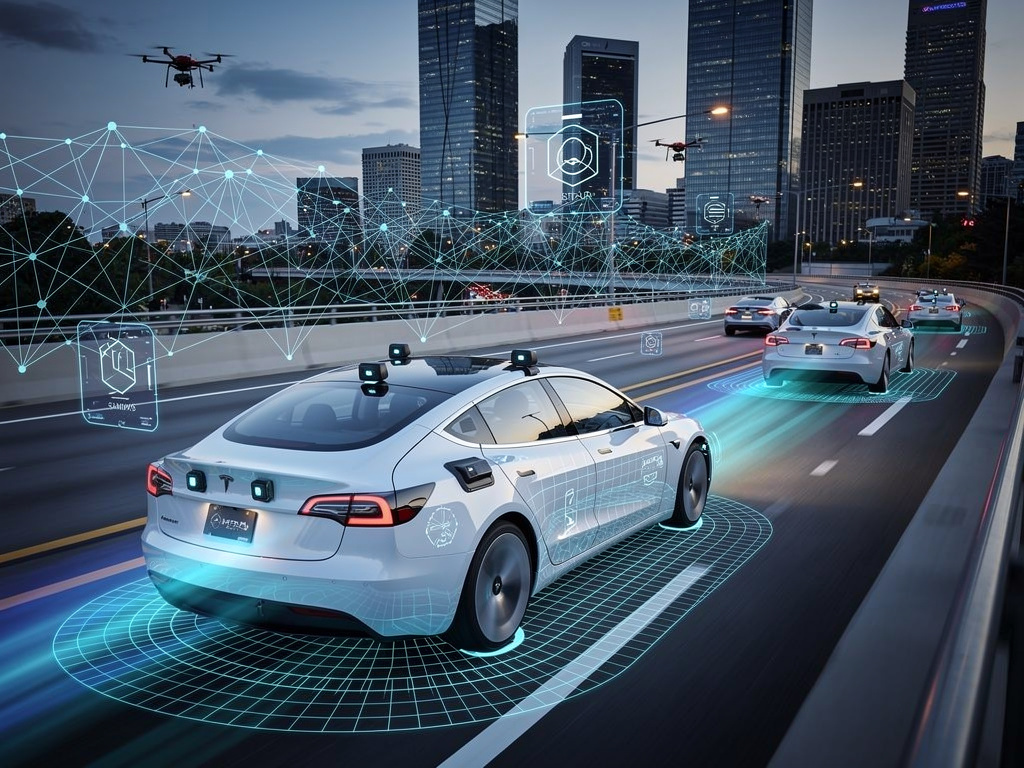
Tesla’s FSD Gambit: Forbes’ Vote of Confidence in Autonomy’s Next Frontier
Tesla’s Full Self-Driving (FSD) technology has long been a lightning rod for debate in the automotive and tech sectors, blending ambitious promises with real-world challenges. Recently, a wave of endorsements and analyses has spotlighted its potential to reshape autonomous driving. According to a detailed examination by Forbes, Tesla’s approach to FSD positions the company as a frontrunner in the race toward true vehicle autonomy, outpacing competitors through innovative software and data-driven strategies. This backing comes at a pivotal moment, as regulatory scrutiny intensifies and rivals like Waymo and Cruise push their own systems.
The Forbes piece highlights how Tesla’s reliance on vision-based systems, powered by neural networks, could lead to scalable, cost-effective autonomy. Unlike competitors that integrate expensive lidar and radar hardware, Tesla bets on cameras and AI to interpret the world, a method that has drawn both praise and skepticism. Industry insiders note that this pure-vision strategy allows for rapid iterations via over-the-air updates, enabling Tesla vehicles to learn from billions of miles of collective driving data.
Elon Musk, Tesla’s CEO, has repeatedly touted FSD as the key to unlocking robotaxi fleets and new revenue streams. Recent updates, such as FSD version 14, have shown marked improvements in handling complex urban environments, as detailed in hands-on reviews. These advancements suggest Tesla is closing the gap on full autonomy, even as it operates under supervised conditions that require driver attention.
Advancements in Neural Network Training
Drawing from web sources, Tesla’s FSD Supervised system can navigate errands, commutes, and road trips with minimal intervention, according to the company’s official site. This capability stems from end-to-end neural networks that process raw camera inputs directly into driving decisions, bypassing traditional rule-based programming. Such innovation is crucial for adapting to unpredictable real-world scenarios, from erratic pedestrians to sudden weather changes.
Critics, however, point to ongoing safety concerns. Wikipedia’s entry on Tesla Autopilot chronicles a history of collisions linked to the system, often attributed to driver inattention or software limitations. Regulators have scrutinized these incidents, prompting Tesla to emphasize that FSD remains a Level 2 system under SAE standards, necessitating constant supervision.
Despite these hurdles, positive momentum is building. A recent Electrek review of FSD v14 described it as “mind-blowing,” with the system handling over 200 kilometers of varied driving conditions impressively. The tester noted smoother decision-making and fewer disengagements, signaling progress toward reliability that could rival human drivers.
Competitive Edges and Market Projections
Forbes’ analysis underscores Tesla’s data advantage, amassed from its vast fleet of vehicles equipped with cameras. This real-time data loop allows for continuous improvement, potentially giving Tesla an edge over rivals with smaller datasets. Projections from financial analysts, echoed in posts on X, forecast the autonomous driving market reaching $200 billion by 2030, with Tesla positioned as a major player due to its full-stack integration.
In contrast, companies like Waymo rely on multi-sensor fusion, incorporating lidar for precise mapping. Yet, a Bloomberg Intelligence analysis shared on X suggests Tesla’s per-vehicle cost is 85% lower, thanks to its camera-only approach. This cost efficiency could democratize autonomy, making it accessible beyond premium segments.
Moreover, Tesla’s hints at hardware upgrades, such as new camera sensors reported by Electrek, indicate ongoing refinements. While some see this as casting doubt on prior promises, it reflects a pragmatic evolution in pursuit of safer, more capable systems.
Regulatory Hurdles and Legal Battles
Legal challenges continue to shadow Tesla’s FSD ambitions. A TechCrunch report details a judge’s ruling that Tesla engaged in deceptive marketing regarding Autopilot and FSD, leading to a temporary suspension of sales in California. The decision, stayed for 90 days, underscores the tension between bold claims and actual capabilities.
Elon Musk’s history of optimistic timelines, cataloged in Wikipedia’s list of predictions, shows a pattern of delays. From early promises of Level 5 autonomy by 2020 to current estimates pushing into the late 2020s, these timelines have fueled investor lawsuits alleging securities fraud.
Nevertheless, recent admissions and adjustments signal maturity. An Indian Defence Review article notes Musk’s acknowledgment of FSD’s limitations after years of hype, potentially paving the way for more grounded expectations and regulatory approvals.
Innovation in AI and Hardware Integration
Tesla’s patent filings reveal efforts to address common issues like sun glare, which can impair camera performance. As reported by Teslarati, these innovations aim to enhance reliability in diverse conditions, crucial for widespread adoption.
Rivals are not standing still. Rivian’s pivot to AI-driven autonomy, covered by The Verge and Yahoo Finance, positions it as a challenger to Tesla, emphasizing custom chips and software. Yet, Rivian’s CEO acknowledges the need for competition to spur innovation, implicitly recognizing Tesla’s lead.
Posts on X from influencers like Mario Nawfal highlight Tesla’s pure vision AI as a game-changer, potentially achieving full self-driving without traditional sensors. This sentiment aligns with Forbes’ endorsement, suggesting Tesla’s approach could disrupt established paradigms in the industry.
Safety Data and Public Perception
Emerging data supports autonomy’s safety benefits. A New York Times opinion piece cites Waymo’s lower crash rates compared to human drivers, with 91% fewer serious injury incidents. While focused on Waymo, this bolsters the case for self-driving tech overall, including Tesla’s contributions.
Tesla’s own metrics, shared through official support pages, emphasize Autopilot’s role in enhancing safety via features like automatic emergency braking and lane keeping. However, public perception remains mixed, with Reddit discussions on r/TeslaFSD criticizing the “Full Self-Driving” moniker as misleading since it requires supervision.
To counter this, Tesla is testing fully autonomous robotaxis in Austin, as noted in X posts. These driverless trials mark a milestone, heating up competition with Waymo and signaling confidence in the technology’s maturity.
Economic Implications and Future Outlook
Financial forecasts paint a rosy picture. A Goldman Sachs report, referenced in an X post by Herbert Ong, values Tesla’s FSD at $1-3 billion currently, with potential upside to $75 billion by 2030. Similarly, Morgan Stanley’s outlook sees self-driving cars as a $200 billion opportunity, with Tesla and Google as frontrunners.
The shift toward end-to-end neural nets, as described in X updates, allows FSD to “think for itself,” handling complex maneuvers without hand-coded rules. This evolution could enable robotaxi services, transforming urban mobility and generating subscription revenue.
Industry experts like Sebastian Thrun, mentioned in X discussions, predict pure vision will eclipse multi-sensor methods due to cost advantages, aligning with Tesla’s strategy.
Strategic Positioning Amid Challenges
Tesla’s journey reflects broader trends in autonomous tech, where software prowess increasingly trumps hardware. Forbes’ backing emphasizes this, arguing Tesla’s data moat and AI focus position it to dominate.
Yet, achieving unsupervised autonomy remains elusive. Tesla acknowledges that full reliability demands billions more miles of experience and regulatory nods, which vary by jurisdiction.
As 2025 draws to a close, with the current date marking late December, Tesla’s FSD v14 and upcoming iterations promise further leaps. Electrek’s coverage of camera upgrades suggests hardware will complement software gains, addressing persistent doubts.
Vision for Widespread Adoption
Looking ahead, Tesla’s model could influence global standards. By prioritizing scalable, affordable tech, it challenges the high-cost paradigms of competitors, potentially accelerating adoption in emerging markets.
Collaborations and expansions, such as potential integrations with ride-sharing platforms like Uber, could amplify impact. X posts from Stock Talk highlight Tesla’s mileage advantage over Waymo, reinforcing its data-driven lead.
Ultimately, Forbes’ endorsement serves as a bellwether, signaling that despite setbacks, Tesla’s FSD is on a trajectory to redefine autonomy, blending innovation with the grit needed to navigate regulatory and technical obstacles. As the sector evolves, Tesla’s bold bets may well pay off, steering the future of transportation toward a driverless horizon.


 WebProNews is an iEntry Publication