
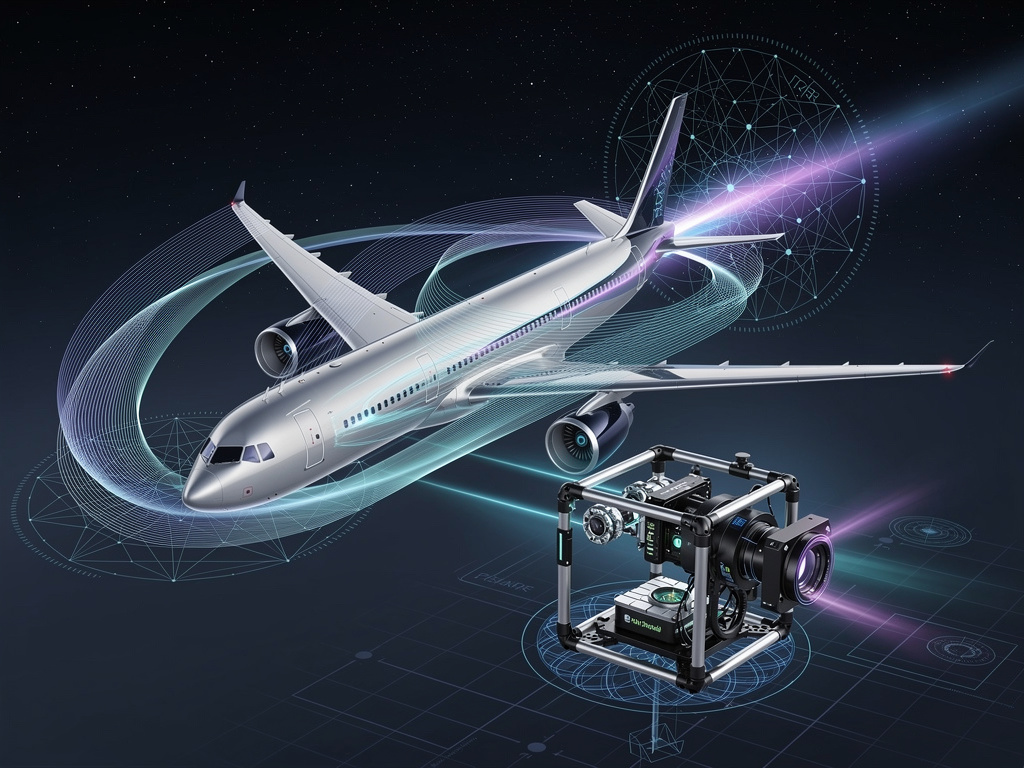
Soaring Through Light: Unveiling the Frontier of Photon-Driven Aviation Tech
In the realm of cutting-edge technology, a revolutionary approach is reshaping how we visualize and interact with light itself. Researchers have developed a method called “Flying with Photons,” which allows for the rendering of novel views of propagating light, capturing its journey through space at ultrafast speeds. This innovation stems from a blend of advanced imaging hardware and neural rendering techniques, enabling videos of light in motion from perspectives never before possible. At its core, the technology relies on ultrafast cameras that record light with picosecond precision, far beyond what traditional sensors can achieve.
The project, detailed in a paper presented at the European Conference on Computer Vision in 2024, introduces a neural volume rendering framework based on transient fields. These fields map 3D points and directions to high-dimensional signals representing radiance over time. This setup accounts for the finite speed of light, producing effects like scattering, reflection, and refraction in rendered videos. By training on multi-viewpoint datasets captured with single-photon avalanche diodes (SPADs), the system synthesizes dynamic scenes where light pulses appear to “fly” through environments.
What makes this particularly intriguing for aviation enthusiasts and engineers is the potential crossover into photon-based systems for flight. Imagine aircraft navigation aided by real-time light propagation models, enhancing safety in low-visibility conditions. The underlying tech draws from computational imaging advancements, where single-photon detection pushes boundaries in remote sensing and bioimaging, as explored in a comprehensive review by Artificial Intelligence Review.
Bridging Imaging and Quantum Realms
Extending beyond mere visualization, this photon-flying concept ties into quantum communication developments that could transform aviation communications. Recent breakthroughs, such as entangling photons between drones a kilometer apart, hint at secure, hack-proof networks for airborne systems. In 2021, experiments reported by New Scientist demonstrated entangled photons transmitted between hovering drones, laying groundwork for a quantum internet that might one day guide autonomous aircraft fleets.
Fast-forward to 2025, and we’re seeing quantum teleportation between distant quantum dots, a feat achieved by an international team including Paderborn University. As detailed in Phys.org, this involves transferring the polarization state of a photon from one quantum dot to another, separated physically. Such advancements are crucial for building scalable quantum networks, potentially integrating with photon-based aviation tech to enable ultra-secure data links during flights.
Moreover, Stanford researchers have made strides in quantum signaling at room temperature, entangling light and electrons without extreme cooling. According to a December 2025 report in Stanford Report, this tiny device could revolutionize cryptography and computing in aviation contexts, where reliable quantum tech must withstand varying environmental conditions.
Hardware Innovations Fueling Flight
Diving deeper into the hardware, the “Flying with Photons” setup uses a scanned single-pixel SPAD for picosecond resolution, as outlined in the arXiv preprint arXiv. This is more accessible than bulky streak cameras, offering a balance of cost and performance. The system’s ability to reconstruct transient videos opens doors to simulating light behavior in complex scenarios, like atmospheric turbulence affecting aircraft sensors.
In parallel, integrated preparation of high-dimensional flying structured photons, as described in eLight, combines spatial modes and polarization for qudit encoding. This synergy enhances noise resilience, vital for aviation applications where signals must traverse vast distances without degradation. Researchers are encoding information in four-dimensional Hilbert spaces, promising higher data rates for in-flight communications.
Posts on X from tech enthusiasts highlight speculative yet inspiring ideas, such as laser-equipped orbs ionizing air around planes for propulsion or stabilization. While not yet mainstream, these discussions reflect growing interest in photonics for aviation, echoing real research into quantum sensors for enhanced navigation.
From Labs to Skies: Practical Applications
The transition from lab prototypes to aviation-ready tech is accelerating. For instance, Airbus is collaborating with PsiQuantum on fault-tolerant quantum algorithms, as noted in X posts and industry updates. This partnership focuses on deploying quantum computing for aerospace design, potentially optimizing photon-based systems for fuel efficiency or autonomous flight paths.
Another angle comes from telecom-wavelength quantum teleportation using frequency-converted photons, detailed in Nature Communications. By enabling long-distance quantum links, this could secure communications between ground control and aircraft, mitigating cyber threats that plague modern aviation.
Furthermore, Indian scientists’ ‘PhotonSync’ tech, mentioned in recent X buzz, turns optical fibers into stable quantum channels. This innovation supports long-haul quantum communication, which might integrate with satellite systems for global aviation monitoring.
Challenges in Scaling Photon Tech
Despite these advances, scaling remains a hurdle. Single-photon detectors must improve in array size and efficiency for widespread use, as discussed in the Springer review on computational imaging. Current systems are promising but require enhancements to handle the rigors of aviation environments, like vibrations and temperature fluctuations.
Quantum computers shifting to photonic designs, using fiber optics for entangled photon packets, represent a paradigm shift. An X post from 2025 describes this evolution, where copper wires give way to light-based data resonance, potentially powering onboard AI for real-time decision-making in aircraft.
Rochester Institute of Technology’s work on quantum frontiers, as covered in a PRWeb release PRWeb, underscores navigation challenges and solutions, blending photonics with quantum mechanics for precise positioning.
Industry Impacts and Future Trajectories
The implications for the aviation sector are profound. Photonic quantum computers, explored in a Journal of Supercomputing article The Journal of Supercomputing, promise fault-tolerant architectures from players like ORCA Computing and Photonic Inc. These could simulate aerodynamic models with unprecedented accuracy, reducing development costs for new aircraft.
In quantum sensing, near-visible photon sources with 98.4% efficiency, as tweeted recently, establish foundations for daylight quantum communications in satellites, directly benefiting aviation’s reliance on orbital tech.
A peer-reviewed breakthrough creating a photon in 37 quantum dimensions, shared on X, illustrates the multidimensional potential of light particles for information processing, which could enhance aviation data systems.
Interdisciplinary Synergies and Ethical Considerations
Interdisciplinary efforts are key, merging computer vision with quantum physics. The GitHub repository for “Flying with Photons” GitHub provides open-source code, fostering collaboration among developers and aerospace engineers to adapt rendering techniques for flight simulations.
Ethical aspects arise, particularly in quantum-secured communications preventing unauthorized access. As aviation adopts these, ensuring equitable access and preventing misuse becomes paramount, especially with AI-driven threats on the rise.
Looking ahead, the fusion of photon rendering and quantum teleportation could enable virtual reality training for pilots, visualizing light paths in fog or storms with lifelike accuracy.
Pushing Boundaries with Global Collaborations
Global collaborations are accelerating progress. The European Pilot ‘Photonics For Quantum’ with 50 million euros in funding, as per recent X updates, targets quantum communications, aligning with aviation’s need for robust sensors.
ScienceDaily’s coverage of photon teleportation ScienceDaily emphasizes frequency conversion for identical sources, crucial for a quantum internet supporting air traffic control.
In essence, these developments are not isolated; they form a cohesive push toward photon-empowered aviation, where light becomes the medium for safer, smarter skies.
Real-World Deployments and Case Studies
Real-world deployments are emerging. For example, quantum teleportation between photons from distant sources, reported in Phys.org in November 2025 Phys.org, counters eavesdropping, ideal for secure pilot-ground exchanges.
Case studies from arXiv’s HTML version arXiv HTML highlight SPADs’ role in capturing light transport phenomena, applicable to modeling laser-based landing systems.
X sentiment reflects excitement, with users discussing photon packets in supercomputers, hinting at onboard quantum processors for aircraft.
Vision for Tomorrow’s Aviation
Envisioning the future, photon-based tech could lead to “light sails” for atmospheric maneuvering or enhanced LIDAR for collision avoidance. The SpringerLink chapter on “Flying with Photons” SpringerLink details the multi-viewpoint video capture, inspiring aviation simulations.
With ongoing research, such as RIT’s quantum navigation, the sector stands on the brink of transformation.
Ultimately, as photons “fly” through our innovations, they illuminate paths to more efficient, secure, and imaginative aviation solutions, blending the ethereal with the engineered.


 WebProNews is an iEntry Publication