
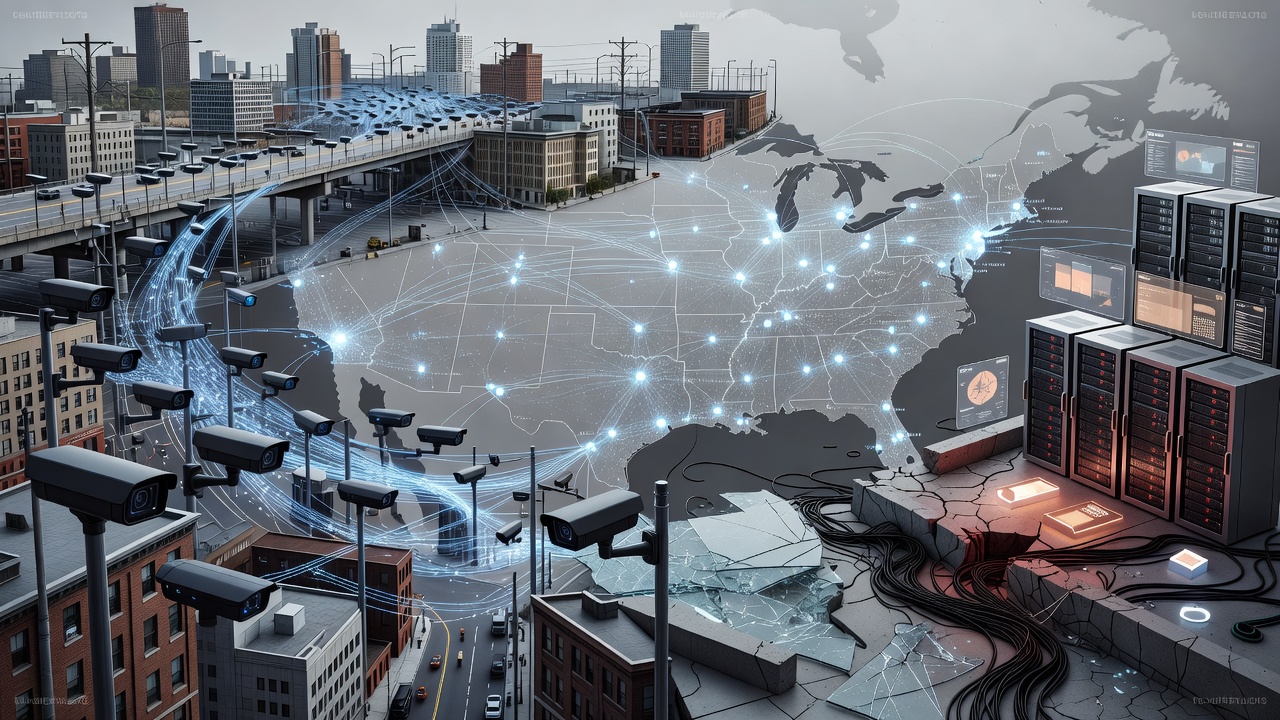
Atlanta-based Flock Safety started with a straightforward pitch. Install solar-powered cameras that read license plates, feed the data into a cloud system, and give police a powerful new tool to solve crimes. What began as automated license plate readers has grown into something far larger. Today the company claims more than 100,000 AI-powered units deployed across the country, scanning billions of plates each month and expanding into video feeds, natural-language searches, and even drones.
Police departments love the results. Tulsa achieved 100 percent homicide clearance in 2024 with help from the system, according to the company’s own materials. Flock executives point to involvement in solving hundreds of thousands of cases annually. Yet critics see a creeping infrastructure of mass surveillance. The data doesn’t stay local. It flows into a national network that even small-town chiefs can query. And federal agencies have tapped into it.
The Next Web reported in June 2026 that Flock dominates the market for these devices. Its cameras do more than capture plates. They stream footage, apply AI tags to vehicles and sometimes people, and allow searches such as “green sedan with an American flag bumper sticker.” Officers in one state pull records gathered in another. The network effect is what makes the system unique. And what worries privacy advocates.
But expansion has come with problems. Security researcher Benn Jordan discovered at least 70 Flock cameras exposed directly to the open internet in late 2025. No passwords blocked access to live feeds showing children in parks or private moments on streets. Researchers even gained root access with physical proximity and installed malware. Flock responded by labeling some of these independent testers as activists bent on defunding police. The company’s defensive posture only fueled distrust.
Police misuse has surfaced too. Officers have run searches on ex-partners, personal acquaintances, and political targets. The American Civil Liberties Union documented how the technology reaches beyond drivers to capture video of bystanders and occupants. Natural language queries now let users hunt for specific objects or descriptions in footage. One example the company itself gave: “landscaping trailer with a ladder.” Activists worry the same tools could target protest descriptions or personal traits.
Data sharing with immigration authorities added fuel. In Denver local officers conducted more than 1,400 searches on behalf of ICE, the ACLU found. Records obtained by 404 Media showed similar patterns elsewhere. Some cities reacted sharply. At least 30 localities have canceled or deactivated Flock contracts since the start of 2025, according to NPR. Flagstaff, Cambridge, Eugene, and Santa Cruz led the way, driven by fears that local data fed federal deportation efforts.
Mountain View, California, discovered through an audit that federal agencies had accessed its camera data without explicit permission. The city shut everything down. Terms-of-service changes at Flock heightened anxiety. The company removed language promising it would not sell customer data, calling the clause redundant. Residents saw an opening for broader commercial use or AI training on their footage. Joe Hirsh, a Dunwoody, Georgia, resident, told his city council the police seemed too trusting. “You and I both know the next time Flock is misused in our city, you will turn a blind eye because none of you are trustworthy with our records,” he said, as reported by The Guardian.
Flock CEO Garrett Langley has pushed back. He described opposition as a “coordinated attack” from groups wanting to defund the police and called some activists “terroristic.” The company stresses that data belongs to customers, not Flock. It points to audit logs, sharing controls, and recent policy tweaks that separate federal users and limit nationwide access. New contracts outpace cancellations by a wide margin, Langley has said. The firm now operates in over 5,000 communities across 49 states and performs more than 20 billion scans monthly, per its Wikipedia entry drawing on company statements.
Errors create their own harm. Misread plates have led to wrongful stops and even a $1.9 million settlement in Aurora, Colorado, after a family faced guns drawn over a bad match. One driver complained he could not escape the system’s alerts. Cameras flagged his car every time it passed. “You can’t get a breath of fresh air in or out of that place without us knowing,” an officer remarked in one documented exchange.
Installations sometimes arrive without warning. In Roanoke, Virginia, Kat Vaughn returned home to find a Flock Raven sensor pole on the strip in front of her house. The device, meant for audio gunshot detection, was not on the approved list and was not scheduled to activate for weeks. City officials scrambled to explain. Similar surprises have occurred in neighborhoods where residents never received notice or a chance to object.
Removing the technology proves difficult. Dayton, Ohio, and Evanston, Illinois, tried to exit contracts only to discover potential penalties. Some departments resorted to covering lenses with trash bags while they negotiated. Denver’s city council voted unanimously to end its Flock deal after heated public meetings. Mayor Mike Johnston overruled them and extended the contract anyway, citing its value for public safety. Later the city switched to Axon.
The Electronic Frontier Foundation noted in June 2026 that grassroots campaigns are gaining ground. Activists maintain maps like DeFlock.me that crowdsource locations of more than 76,000 readers. Will Freeman, who runs the project, expects more cities to drop the system as awareness spreads. States have begun passing laws. Washington enacted restrictions on automated license plate reader use and data retention in 2026. Other legislatures are watching.
Flock has not stood still. It added video capabilities that let departments request live feeds or short clips. Artificial intelligence now powers descriptive searches across stored footage. The company rolled out a business network that lets private entities share hotlists and patterns with police. Drones and mobile units expand coverage into areas without fixed poles. All of it feeds the same searchable cloud.
Supporters argue the benefits outweigh the risks. Fewer officers and tighter budgets make efficient tools essential. Flock’s website highlights measurable results, from faster homicide clearances to recovery of stolen vehicles. Private customers, including homeowners associations, buy units to protect property. The system connects public and private cameras in ways that amplify reach.
Yet the scale creates a surveillance net unlike anything seen before. Billions of scans produce detailed movement histories for millions of drivers. Retention policies vary by contract, but many keep data for weeks or months. Queries require no warrant in most jurisdictions. Audit logs exist, but they only catch the abuses that get reported. At least 20 documented cases of officers stalking individuals with the technology have surfaced in recent years, according to the Institute for Justice.
Concerns extend beyond crime fighting. Data has appeared in immigration enforcement, abortion-related investigations, and monitoring of protests. Women in certain states expressed fear of being tracked after medical procedures. Immigrant communities worry about routine drives triggering federal attention. The ACLU warned that such systems always expand beyond their original justification. What starts as a tool for stolen cars evolves into something that catalogs daily life.
Flock insists safeguards are in place. It introduced keyword filters to block sensitive searches and created a transparency portal for agencies. Federal pilot programs with Customs and Border Protection were halted after audits revealed unauthorized access. The company designates federal users separately and prevents automatic addition to statewide or nationwide lookup functions. These changes came after public pressure and investigations by lawmakers including Sen. Ron Wyden.
Still, trust remains fractured. A change in terms of service, even if intended to remove redundant language, signaled to many that protections could shift without notice. Hacking demonstrations showed how a compromised camera could stream or delete evidence. One researcher called the network a potential “Netflix for stalkers.” Flock countered that vulnerabilities were fixed quickly and that independent penetration tests passed.
The debate plays out in city halls and statehouses. Some communities vote to keep the cameras after weighing crime data. Others see an unacceptable trade-off. In Dunwoody, officials had spent $360,000 on a command center and half a million dollars annually on Flock services before resident revolt forced a pause. Similar battles repeat across the map.
No comprehensive national study proves the cameras reduce overall crime rates. Localized success stories abound, but causation is hard to isolate. Clearance rates improve in some departments. Response times drop when vehicles linked to crimes are identified quickly. Yet the constant recording of innocent travel creates a digital shadow that follows Americans from one town to the next.
Activists aren’t waiting for federal legislation. They crowdsource maps, attend council meetings, and pressure vendors. Tools like HaveIBeenFlocked let individuals check whether their plates appear in leaked or public datasets. The pushback has slowed expansion in progressive cities while red-state and suburban departments sign on rapidly.
Flock’s valuation once reached $7.5 billion after raising nearly $1 billion in venture funding. Its growth reflects broader demand for data-driven policing amid strained budgets. But that growth also highlights the tension between security and liberty in an era of cheap sensors and powerful artificial intelligence. The cameras keep appearing on poles and rooftops. The questions about who watches the watchers only grow louder.
And for now, the network expands. One scan at a time.


 WebProNews is an iEntry Publication