
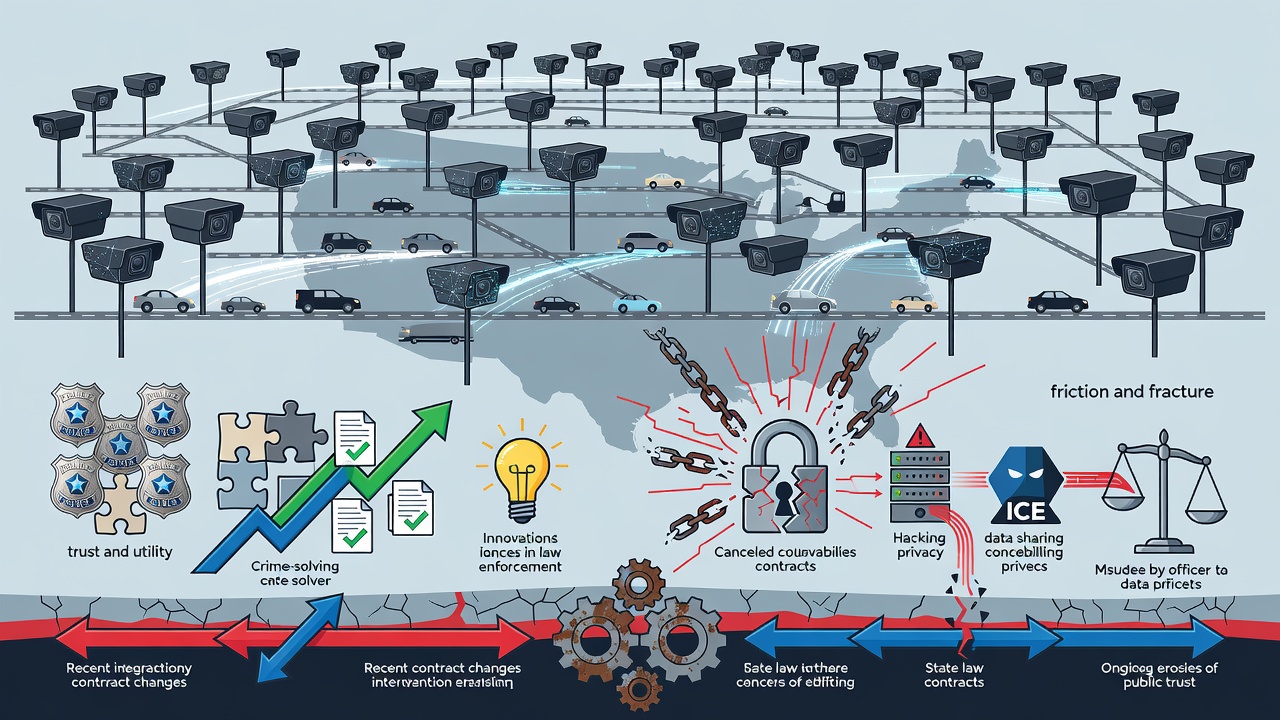
More than 100,000 automated license plate reader cameras now dot roadsides, neighborhoods and business districts across the United States. The vast majority come from one company: Flock Safety. Police praise the Atlanta-based firm for helping recover stolen vehicles, clear homicides and track suspects. Yet a growing number of cities have yanked the devices amid fears of mass tracking, data breaches and federal overreach. The backlash has intensified in recent months.
Short answer? These aren’t simple traffic cameras. Flock’s systems capture license plates, vehicle color, make, model, bumper stickers, scratches and even occupants in some cases. AI then catalogs everything into a searchable database. Officers query it with plain language. “Green sedan with American flag bumper sticker.” Results appear instantly. No warrant needed in most places.
The Spread and the Promise
Flock cameras transmit data wirelessly to cloud servers. Departments sign contracts that often link them into a national network. A cop in Texas can search footage from Massachusetts under certain setups, according to reporting by Engadget. The company claims its technology aids in solving 700,000 crimes annually. Gwinnett County, Georgia, credited the cameras with a 53% drop in commercial burglaries one year and recovery of vehicles worth $1.47 million.
Cobb County police pointed to the system as part of achieving a 100% homicide clearance rate over two years. But success stories mask deeper tensions. Once installed, the cameras prove sticky. Cities that try to exit face contract hurdles. Some have resorted to covering units with garbage bags while sorting legal details.
But the technology’s reach has sparked revolt. At least 30 localities canceled or deactivated Flock systems since early 2025. Flagstaff, Arizona. Cambridge, Massachusetts. Eugene, Oregon. Santa Cruz, California. Activity surged in late 2025 and early 2026. Many cited worries that local data fed into federal immigration enforcement under the Trump administration’s crackdown. “We do not support AI mass surveillance,” one Flagstaff resident told NPR. The town’s mayor said trust in Flock had evaporated.
In Santa Cruz, a council member grew alarmed after learning how broadly data might travel. The city ended its contract less than two years after starting. Hillsborough, North Carolina, walked away in October 2025 over contract language that appeared to let Flock share data with third parties on a “good faith” basis. Flock insists each customer retains sole authority over sharing decisions. “Each Flock customer has sole authority over if, when, and with whom information is shared,” the company wrote in an email to NPR.
Yet audits tell different stories. Illinois Secretary of State Alexi Giannoulias discovered in 2025 that Flock allowed U.S. Customs and Border Protection access to state data, violating local law. The company paused federal pilots nationwide afterward. Denver’s police conducted more than 1,400 searches on behalf of ICE since mid-2024, according to logs obtained by the ACLU of Colorado. The city council voted unanimously to drop Flock. Mayor Mike Johnston extended the deal anyway, citing investigative value. Denver later switched to Axon.
Privacy advocates argue the systems create permanent records of ordinary travel. Drive past enough cameras and your daily routes, routines and associations become visible to authorities. And not just police. Security researchers and journalists have shown how easily the network can be abused.
One musician and YouTuber, Benn Jordan, exposed dozens of vulnerabilities with rudimentary methods. In late 2025 he located over 70 Flock cameras accessible online without passwords. Live feeds showed children at parks and private moments. Jordan even recorded Flock’s dismissive response to his earlier work and played it back through one of the company’s own devices. Physical access proved worse. Researchers gained root control on outdoor units using basic Android tools and a reset button. USB ports invited malware. Flock fixed some issues but criticized researchers as activists seeking to “defund the police.”
Hacking demonstrations fueled public anger. In Dunwoody, Georgia, residents revolted after terms-of-service updates and videos of compromised feeds circulated. One local, Joe Hirsh, accused police of laziness. “When you hear from our police department saying they trust Flock, it’s clear that our police are too lazy to verify what a vendor such as Flock says,” he told the council, per The Guardian. The city deferred renewal despite heavy investment in a real-time crime center. Another resident discovered a camera feed from a Jewish community center marked “do not share” had been accessible anyway.
Terms Shift, Trust Erodes
Flock updated its contracts multiple times in late 2025 and early 2026. The company removed language stating it “does not own and shall not sell customer data.” New terms grant Flock the exclusive right to decide how, when and in what format customers access their own information. Data arrives in degraded, low-resolution form without timestamps in some cases. The license Flock receives appears perpetual. Arbitration clauses favor Georgia law. Termination grows harder. The American Civil Liberties Union flagged these shifts in April 2026, advising municipalities to consult lawyers and consider avoiding the systems altogether. Reports from IPVM and the site HaveIBeenFlocked.com amplified the concerns and influenced local debates.
Misuse cases pile up. Officers have queried plates belonging to ex-partners, current romantic interests and journalists hundreds of times. One Milwaukee officer faced charges after tracking his partner and her ex 55 times using Flock data. Victims often learn of the surveillance only through tools like HaveIBeenFlocked that reveal search history. Flock told one outlet that 15 abuse incidents came to light thanks to its own audit features. The true number likely exceeds that since many cases stay hidden.
Even without malice, errors create harm. AI misreads plates. A “7” becomes a “2.” Innocent drivers land on hot lists, face repeated stops and feel watched. In one Colorado case a woman received a theft summons based on flawed camera evidence. Her own vehicle camera cleared her. Others report officers admitting the town lives under total observation. “You can’t get a breath of fresh air in or out of that place without us knowing,” a Columbine sergeant said in doorbell footage captured by Engadget.
Company employees once used footage of children at a community center pool and gymnastics classes as sales demos to police. Flock defended the actions as authorized and well-intentioned. The episode drew sharp criticism. Ring, owned by Amazon, ended a partnership with Flock in early 2026 after a Super Bowl ad drew backlash over the surveillance ties.
States have begun pushing back with legislation. Washington enacted limits on automated license plate readers in March 2026, restricting federal access and data retention. Other proposals aim to require warrants for certain queries or shorten storage periods. Yet adoption continues. Some communities renew contracts with tighter guardrails. Renton, Washington, reactivated cameras after policy updates. Alameda County, California, extended coverage while stressing blocks on immigration data sharing. Flock highlights these examples on its site, arguing safety and privacy can align when rules are followed.
The company maintains it does not work directly with ICE and has disabled certain capabilities in sanctuary areas. Still, local officers can initiate searches that benefit federal agents. Transparency portals show query logs in some jurisdictions. But critics say oversight lags the technology’s power. One Business Insider investigation detailed how misreads unraveled lives and how the firm’s rise outpaced safeguards.
So the debate fractures along familiar lines. Police departments facing staffing shortages view Flock as a force multiplier. Residents in progressive enclaves see an always-on surveillance grid that chills movement and association. Hackers, researchers and journalists keep exposing weaknesses. Cities split between renewal and rejection. And the cameras keep multiplying. Over 20 billion plate reads per month, Flock has said. Billions of data points on where Americans drive, when and with what adornments on their vehicles.
Recent weeks show no slowdown in tension. A June 2026 TechCrunch report noted Americans physically destroying Flock units in some areas, linking the vandalism to immigration enforcement fears. An ACLU video from days ago warned that the systems let police track movements without warrants. Washington Post coverage highlighted towns torn apart by the technology, including one that declared a state of emergency over the dispute.
Whether Flock’s network ultimately makes communities safer or simply more observed remains unsettled. Evidence of crime reduction exists in some deployments. Persistent questions about errors, abuse, security and mission creep remain in others. Cities will keep choosing sides. The cameras, solar-powered and wireless, install faster than regulations can catch up. Drivers passing beneath them have little say in the matter. Their plates, patterns and presence feed the database all the same.


 WebProNews is an iEntry Publication