
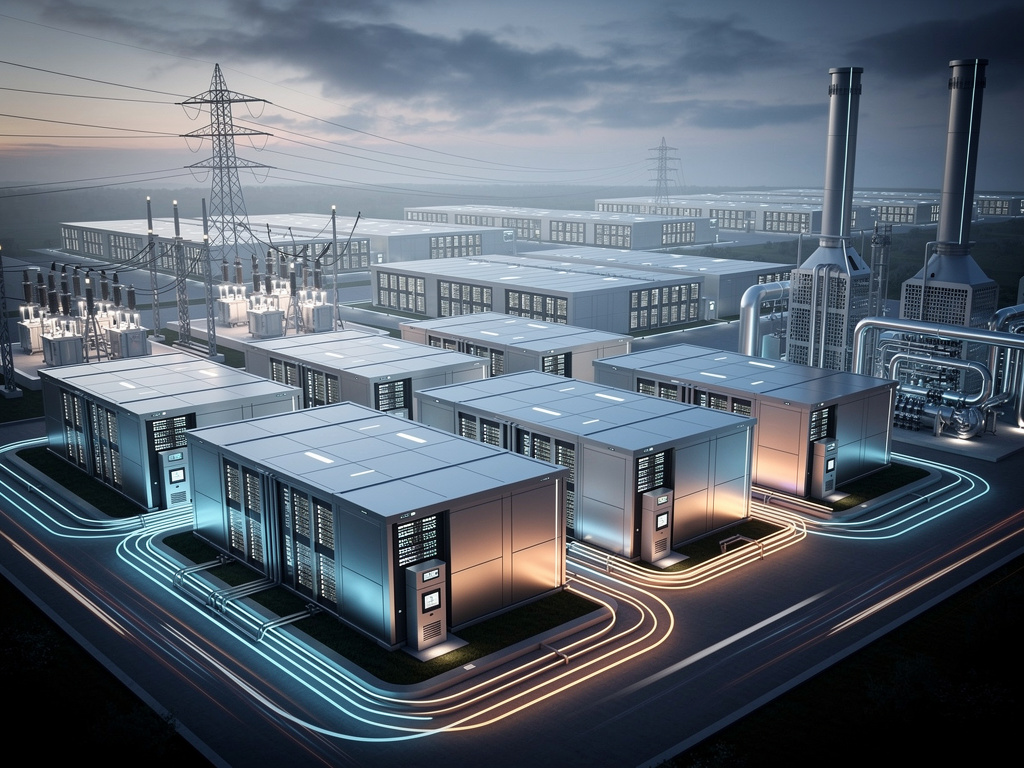
Power shortages grip new data center projects. Construction timelines stretch past two years. Heat from dense AI racks threatens to overwhelm traditional cooling. Contract manufacturer Flex sees an opening in this strain.
The company, long known for assembling electronics, now pitches itself as a key supplier of integrated power, cooling and compute systems built specifically for the surge in artificial intelligence workloads. Executives outline ambitious plans. They include a tax-free spin-off of the cloud and power infrastructure unit into a standalone public company by early 2027. The move aims to give the high-growth segment its own capital structure and market valuation.
From Contract Assembler to AI Infrastructure Player
Flex began positioning for this shift years before the latest AI boom took hold. It acquired a power business from Ericsson. It combined that with existing compute integration expertise. The result is a portfolio that now spans much of the data center stack. Yahoo Finance detailed how CEO Revathi Advaithi described the strategy during a J.P. Morgan fireside chat. “We know how to do spins. We’ve done it well,” she said, pointing to the earlier Nextracker separation that reached a $17 billion market capitalization.
The remaining Flex business after the spin would still generate more than $22 billion in revenue. The separated entity, internally called SpinCo, would focus on data center thermal architecture, electrical infrastructure and cooling. Advaithi is expected to lead the new company while current President Michael Hartung steps into the CEO role at the core manufacturing operation, Reuters reported in May.
Growth projections for the spun-off unit stand out. Management forecasts 65% to 75% revenue increase in fiscal 2027 and more than 80% the following year. Much of that expansion sits on already awarded programs with strong customer visibility. Capital spending for the combined company is set to peak between $1.4 billion and $1.6 billion in fiscal 2027. Yet the spin structure should keep debt levels manageable.
But Flex doesn’t stop at financial engineering. It has rolled out concrete technical answers to the three biggest headaches facing data center operators: power, heat and deployment speed. In October 2025 the company unveiled highly integrated reference designs for next-generation facilities. These pre-engineered, modular blueprints bundle megawatt-scale liquid-cooled racks, capacitive energy storage systems, modular rack-level coolant distribution units capable of 1.8 MW, and prefabricated power pods and skids.
The designs promise to shorten construction from roughly one year to six months. They cut onsite labor needs, reduce the number of interconnects, and support an open architecture that works with preferred servers from partners including those powered by Nvidia and AMD chips. Deployment can accelerate by up to 30%. Michael Hartung captured the pitch. “Flex delivers the industry’s deepest hardware stack by integrating power, cooling and compute with vertically integrated manufacturing at scale,” he said. “Its open architecture provides the flexibility required for faster, more predictable deployments, enabling data center operators to keep up with AI demand.” That comment appeared in SiliconANGLE.
These systems target the transition to higher-voltage 800VDC power architectures. They address electrical disturbances common in dense AI clusters through advanced energy storage. And they ease the move to liquid cooling at rack level without forcing operators into full-facility overhauls. Flex’s own site highlights an AI infrastructure platform that integrates these elements into modular designs. The goal is clear. Speed deployment while lowering complexity and risk.
Such offerings arrive at a moment when demand forecasts keep rising. Goldman Sachs Research projects U.S. data center power consumption will climb from 31 gigawatts in 2025 to 41 GW in 2026 and then 66 GW in 2027. Analysts Hongcen Wei, Daan Struyven and Samantha Dart note that only 50% to 60% of scheduled capacity typically comes online on time. Regional power constraints grow acute in the Mid-Atlantic, Mid-Continent and Northwest. The share of U.S. peak summer electricity demand attributed to data centers could more than double to 8.5% by 2027. Their analysis sits in the Goldman Sachs report published days ago.
Broader studies paint an even steeper curve. Deloitte estimates U.S. AI data center power demand could reach 123 GW by 2035, a more than thirtyfold jump from 2024 levels. The International Energy Agency sees global data center electricity use more than doubling to around 945 terawatt-hours by 2030. AI accounts for the largest share of that acceleration. These figures come from reports that underscore the same bottlenecks Flex claims to tackle.
Operators already plan years ahead. Flexential’s 2025 State of AI Infrastructure Report found 79% of enterprises map data center capacity more than a year out, with many looking three to five years forward. Power availability now dictates location decisions for nine in ten organizations. Vacancy rates in prime markets have dropped to 1.9%. Most new builds are pre-leased. The report is available via Flexential.
Flex positions its platform as one way to compress those timelines. Modular construction happens offsite in parallel. Validation of full megawatt blocks can occur in factories before shipment. Lifecycle software adds monitoring, predictive maintenance and optimization. The combination promises not just faster builds but more reliable long-term operation.
Challenges remain. Grid interconnection queues stretch for years in many regions. Supply chains for certain high-voltage components stay tight. Skilled labor for complex cooling installations is scarce. Yet Flex’s vertically integrated manufacturing scale and history in power electronics give it advantages over pure-play startups. The spin-off itself could unlock higher valuations for the infrastructure business, which investors may price more like a specialized industrial growth story than a diversified contract manufacturer.
Advaithi has steered Flex through multiple portfolio resets. Exits from consumer markets. The Nextracker transaction. Heavy reinvestment in compute and power. The latest move fits the pattern. It isolates a segment growing far faster than the low-to-mid single-digit pace expected for the remaining operations.
Whether the spin delivers the projected acceleration depends on execution. Customer uptake of the new reference designs. Ability to scale liquid cooling at gigawatt levels. Success in winning larger shares of hyperscaler and cloud provider budgets. Early signals suggest demand exists. Awarded programs already underpin much of the near-term growth outlook.
Data centers once expanded in steady increments. AI has changed the math. Racks now push toward one megawatt each. Power density climbs. Cooling requirements shift from air to liquid almost overnight. In this environment, suppliers who can deliver pre-integrated, factory-tested blocks hold an edge. Flex clearly intends to be one of them. The spin-off and the technical platform both serve that ambition.
So the company’s bet is straightforward. Power and thermal management will determine who scales AI infrastructure fastest. Integrated modular solutions, backed by deep manufacturing expertise, can shorten the gap between ambition and operational reality. If the forecasts hold, the market for such capabilities will only expand in the years ahead.


 WebProNews is an iEntry Publication