
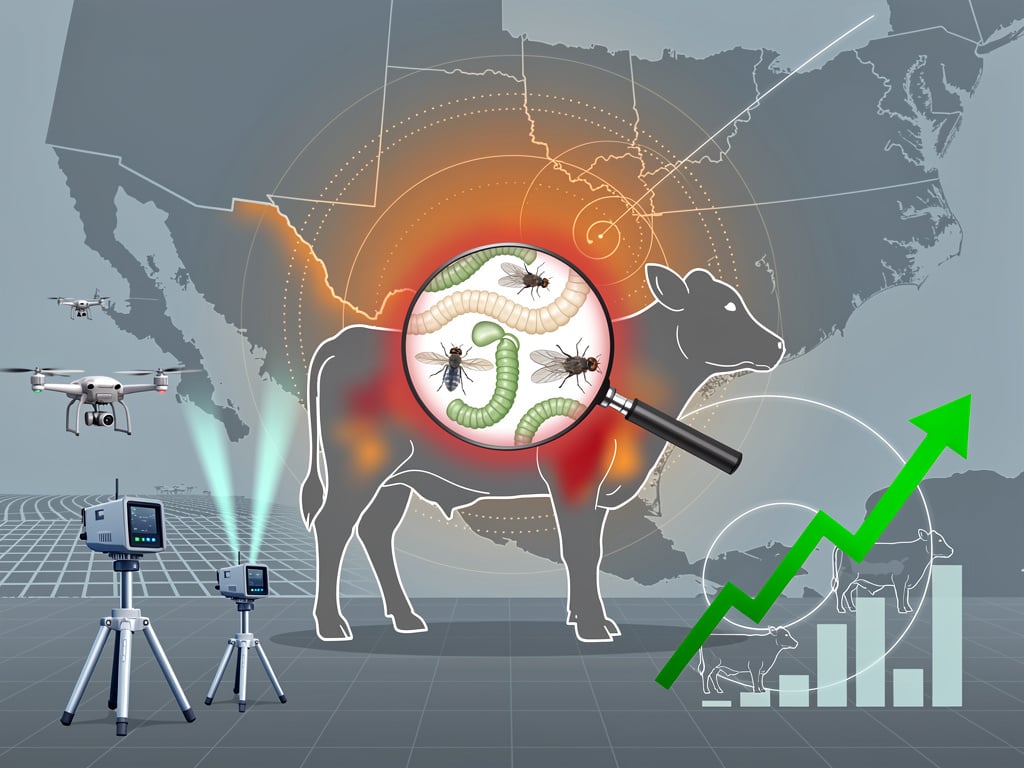
The U.S. Department of Agriculture has confirmed the detection of New World screwworm larvae in a calf in South Texas. This marks the first known case inside the United States in decades. The parasitic fly, long eradicated from American soil, now poses an immediate threat to livestock operations across the southern states.
Confirmation came after samples from the animal tested positive. Officials acted swiftly. They quarantined the premises. Yet the news sent ripples through cattle markets already strained by low herd numbers. Beef prices, which have climbed in recent months, could face fresh pressure if the infestation spreads.
Ars Technica first reported the USDA announcement. The agency described the find as a significant development. Sterile insect releases, a technique that helped wipe out the pest in the 1960s, are now being ramped up along the border. But this time the fly has a foothold north of the Rio Grande.
The screwworm fly lays eggs in open wounds. Larvae hatch and burrow into living flesh. They feed aggressively. The result is painful, foul-smelling infestations that can kill untreated animals within days. Cattle, sheep, goats, wildlife, even pets and humans in rare instances face risk. Texas ranchers know the signs all too well from training sessions. A wound that doesn’t heal. A smell like rotting meat. Maggots visible in tissue.
Just days earlier, detections in Mexico had drawn closer. Reuters reported a case in a young sheep in Coahuila state, within 31 miles of the border. Then came an even nearer find. A goat in the same region, 25 miles from Texas soil. U.S. Agriculture Secretary Brooke Rollins addressed the escalation in early June briefings.
“One detected 25 miles from the U.S.-Mexico border with the goat in Coahuila, our closest detection to date,” Rollins said, according to accounts in USA Today. She stressed that while no widespread U.S. outbreak exists, the South Texas case changes the equation. Federal and state teams moved immediately to trace contacts and expand surveillance.
Texas Agriculture Commissioner Sid Miller has sounded alarms for months. He called the parasite an imminent threat. In statements to local media, Miller highlighted potential losses. One USDA analysis estimates $1.8 billion in damage to Texas alone from a full outbreak. Others project higher figures when wildlife and broader supply chain effects factor in. The state’s $15 billion cattle sector stands squarely in the crosshairs.
History offers a cautionary tale. The U.S. declared screwworm eradicated in 1966. Scientists deployed billions of sterilized male flies. These mated with wild females, producing no offspring. The population collapsed. A small outbreak hit Texas in 1972. Costs reached around $330 million in today’s dollars. Today’s cattle inventory sits at historic lows. Any added mortality or treatment expense hits harder.
But the fly’s return didn’t happen overnight. Cases reappeared in Central America years ago. They moved steadily north through Mexico. By late 2025, detections reached northern states. Mexico opened a new sterile fly production facility. The U.S. shifted release zones into South Texas as a buffer. Governor Greg Abbott issued a statewide disaster declaration in January 2026. The move unlocked resources for monitoring and response.
Recent detections accelerated preparations. Federal officials suspended certain livestock imports from Mexico last year. They trained more veterinarians. They distributed Swormlure traps to ranchers. These chemical lures help detect adult flies. Early reporting remains key. The Texas Animal Health Commission urges producers to inspect animals daily, treat all wounds promptly, and call immediately if larvae appear.
Markets reacted with typical speed. Cattle futures dipped on the news. Traders cited fears of movement restrictions and higher veterinary costs. One unconfirmed report in South Texas, later verified, rattled commodity desks. Reuters noted the impact on trader sentiment. Ground beef prices already hover near record levels. Further supply tightening could push them higher still.
Response efforts draw on proven methods. The USDA plans to increase sterile fly production. A new facility in Edinburg, Texas, aims to release hundreds of millions weekly once fully operational. In the meantime, flies from existing plants cover expanded zones. Teams conduct ground and aerial surveillance. They test samples from suspicious wounds across multiple counties.
Yet challenges remain. Warmer weather favors fly reproduction. Climate shifts may expand suitable habitat. International cooperation with Mexico continues but faces logistical hurdles. Some ranchers worry about quarantine rules that could limit animal movements for weeks. Continuity of business plans exist to minimize disruption. They require strict inspections and documentation.
Human cases stay rare. A travel-related instance surfaced in 2025. Health authorities treated it successfully. Still, the parasite doesn’t discriminate. Any open sore invites risk. Public health messaging now accompanies agricultural alerts.
The South Texas detection forces a reckoning. Decades without the pest left some producers unfamiliar. Extension services from Texas A&M and state agencies have held clinics. They teach identification. They demonstrate wound treatment with approved insecticides. Prevention beats cure. But cure, when applied early, saves animals.
Officials insist the situation remains containable. “We are treating this with the urgency it deserves,” one USDA spokesman told reporters. Expanded sterile releases. Heightened producer vigilance. Rapid diagnostics. These form the core strategy. Success in the 1950s and 60s proves the approach works. This time officials hope to stop the fly before it gains a permanent foothold.
Ranchers in affected areas face immediate practical questions. How long will testing take? Will compensation cover lost animals? Can they ship cattle to feedlots under protocol? Answers evolve daily as incident command teams gather data. One thing holds clear. Reporting suspicions quickly protects neighbors and the wider industry.
The episode underscores vulnerabilities in the livestock supply chain. A single insect. Billions in potential economic damage. Low herd sizes amplify every shock. As summer heats up, so does the battle against an old enemy returned. Federal, state, and private efforts converge on one goal. Contain it here. Keep it from spreading north or east. The coming weeks will test those preparations.


 WebProNews is an iEntry Publication