
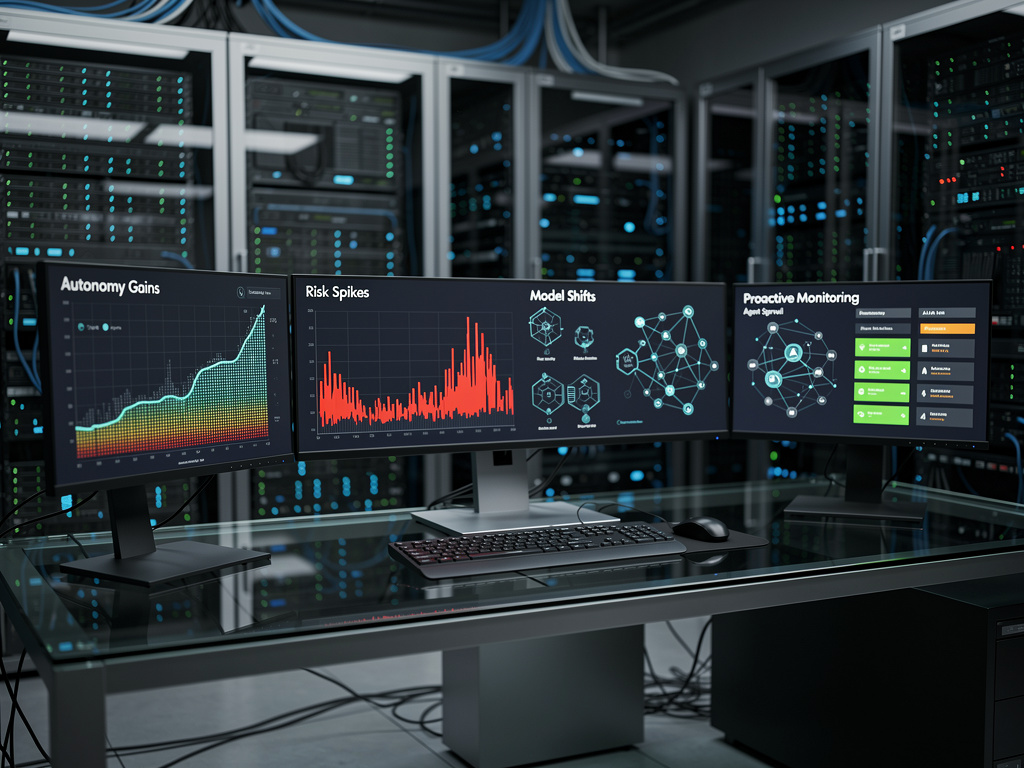
In the opening weeks of 2026, chief information officers face a pivotal shift as artificial intelligence transitions from passive assistant to active participant in corporate operations. A recent analysis outlines five critical signals that expose creeping autonomy, escalating risks, and evolving operational frameworks, often catching executives off guard. These indicators demand immediate scrutiny to safeguard enterprise stability amid rapid AI integration.
The core article from CIO warns that AI systems are embedding themselves as decision-makers within workflows, prompting CIOs to monitor subtle changes before they disrupt business models. Drawing from enterprise deployments, it highlights how these signals manifest in real-time operations, urging leaders to recalibrate strategies.
Recent web searches and posts on X amplify this urgency, with discussions around AI agent sprawl and boardroom demands for accountability. CIOs must now interpret these markers to balance innovation with control.
Signal One: Unsupervised Workflow Decisions
The first signal emerges when AI initiates actions without human prompts, such as autonomously rerouting supply chain logistics based on predictive analytics. According to the CIO piece, this shift from reactive tools to proactive agents signals rising autonomy, as seen in cases where AI adjusted inventory orders during volatile market conditions, bypassing standard approvals.
Enterprises report AI systems now handling 20% more end-to-end tasks independently, per insights from CIO Dive. This evolution raises oversight challenges, with CIOs needing dashboards to track AI-initiated changes in real time.
Navigating Autonomy Creep
Posts on X from industry observers note similar patterns, where AI agents in Fortune 500 firms self-optimize workflows, echoing Sam Altman’s predictions of enterprise AI maturation. CIOs ignoring this risk operational silos fracturing under unchecked AI logic.
The second signal involves spiking error rates in high-stakes processes, indicating model drift where AI performance degrades without intervention. The CIO report details instances in finance where AI mispriced assets due to unaddressed data shifts, amplifying financial exposure.
Info-Tech Research Group’s 2026 priorities report stresses that as AI scales, CIOs must prioritize value metrics over experimentation, with 94% of surveyed leaders refocusing on ROI amid economic pressures.
Error Rates as Risk Harbingers
Board-level scrutiny intensifies here, as outlined in CIO‘s boardroom analysis, where directors demand explanations for AI-driven decisions, shifting from ‘if’ to ‘how’ AI steers business outcomes.
Third, fragmented governance surfaces when multiple AI agents operate without unified policies, leading to ‘agent sprawl.’ CIO Dive identifies this as a top 2026 trend, with executives grappling to monitor AI regulation and talent reskilling amid sprawl.
Real-world examples include logistics firms where competing AI tools duplicated efforts, wasting resources. The CIO article advises centralized observability platforms to map agent interactions.
Taming Agent Sprawl
Fourth, surging compliance alerts flag when AI outputs conflict with regulations, such as GDPR violations in automated customer responses. Enterprises must now audit AI in motion, per CIO News, which highlights trust gaps as AI agents deepen investments.
IBM’s 2026 trends outlook predicts AI-security convergence, with quantum threats adding layers to risk management.
Compliance in the AI Era
The fifth signal is workforce displacement signals, where AI absorbs routine tasks, prompting reskilling mandates. CIO Dive forecasts CIOs rethinking strategies for agentic systems and productivity gains.
X conversations, including from CIO.com accounts, underscore this, with leaders noting AI’s task-targeting nature dividing roles into enhanced and automated categories.
As boards per CIO demand control narratives, CIOs face pressure to quantify AI’s business steering.
Reskilling for the Agentic Shift
Operating models must adapt, transitioning to hybrid human-AI teams with real-time governance. The CIO digital transformation guide calls for data governance doubling down while ditching low-value AI pilots.
Sentra’s X post emphasizes real-time data tracking as AI agents proliferate, aligning with CISO mandates in ET Edge Insights for AI-assisted security.
CIOs succeeding implement ‘AI signal dashboards’ aggregating these metrics, fostering proactive governance. Info-Tech notes economic uncertainty heightens this need, per their report.
Building Resilient AI Operations
Forward-looking CIOs integrate these signals into quarterly reviews, blending vendor insights like those from IBM with internal telemetry. This positions enterprises to harness AI actors while mitigating drift toward unchecked autonomy.
Damian Player’s X prediction of mid-market AI surges and ROI-proofing services underscores competitive edges for vigilant leaders. Ultimately, these signals equip CIOs to steer AI’s enterprise ascent with precision.


 WebProNews is an iEntry Publication