
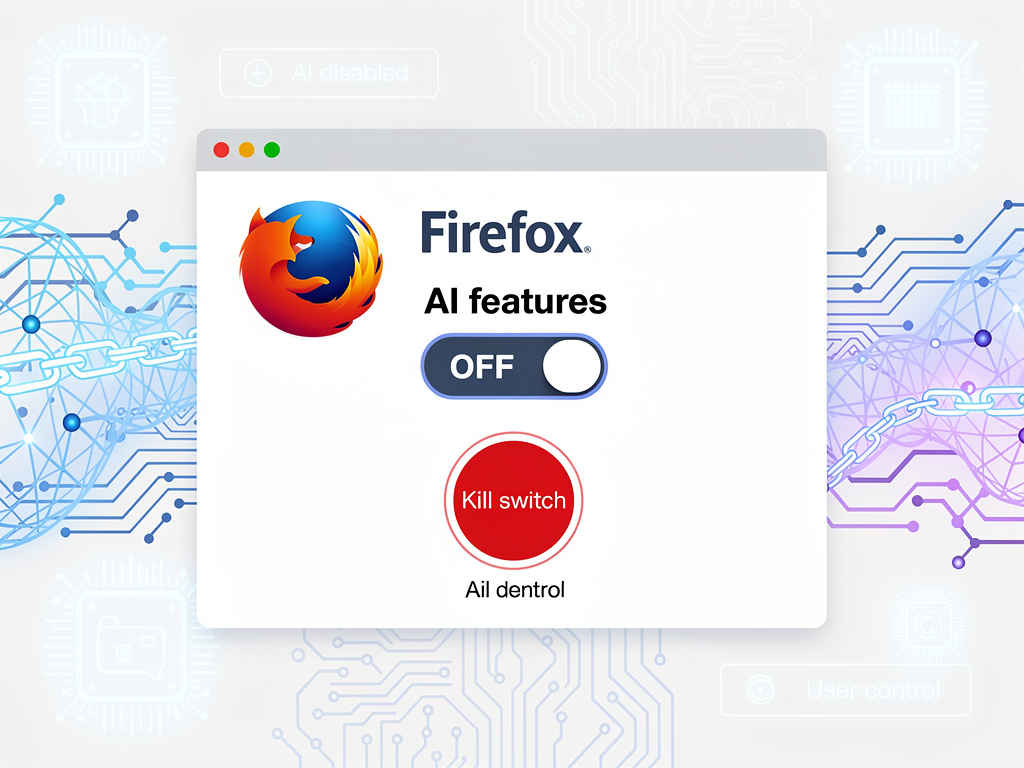
Mozilla Firefox has introduced a feature that represents a watershed moment in the ongoing debate over artificial intelligence integration in consumer software: a comprehensive AI kill switch that allows users to completely disable all AI-powered features with a single toggle. This move positions Firefox as the first major browser to acknowledge growing user fatigue with mandatory AI implementations, potentially reshaping how technology companies approach feature deployment in an increasingly skeptical market.
According to TechRadar, the new setting enables users to opt out of all AI-related functionality within Firefox, including chatbot integrations, AI-powered search suggestions, and automated content generation tools. The feature arrives at a critical juncture when major technology companies are racing to embed AI capabilities into every conceivable product, often without providing meaningful opt-out mechanisms for users who prefer traditional interfaces.
The decision reflects Mozilla’s long-standing commitment to user autonomy and privacy-first design principles, values that have defined the organization since its inception. Unlike competitors who have positioned AI integration as an inevitable evolution of their platforms, Mozilla is betting that a significant segment of users will appreciate the ability to maintain a purely human-curated browsing experience. This philosophical approach stands in stark contrast to the strategies employed by Google Chrome, Microsoft Edge, and Apple Safari, all of which have increasingly embedded AI features as default, non-negotiable components of their user experience.
Market Dynamics Driving the Anti-AI Backlash
The introduction of Firefox’s AI kill switch comes amid mounting evidence that consumer enthusiasm for AI features may be significantly overstated by technology companies. Industry surveys conducted throughout 2024 have revealed a complex relationship between users and AI-powered tools, with many expressing concerns about privacy, accuracy, and the erosion of human agency in digital interactions. While AI proponents tout efficiency gains and enhanced capabilities, critics point to issues ranging from hallucinations and misinformation to the environmental costs of running large language models.
Mozilla’s decision appears informed by this growing skepticism. The organization has historically positioned itself as a counterweight to Big Tech’s data collection practices, and this latest move reinforces that identity. By offering users the choice to completely disable AI features, Firefox is making a calculated bet that privacy-conscious users, developers, and enterprise customers will view this optionality as a competitive advantage. The timing is particularly notable given the recent controversies surrounding AI training data, copyright infringement claims, and the energy consumption associated with running AI models at scale.
The browser market has long been characterized by fierce competition over features, performance, and user experience. However, Firefox’s market share has declined significantly over the past decade, dropping from over 30% in 2009 to approximately 3% today, according to various web analytics platforms. This diminished position may actually provide Mozilla with strategic flexibility that larger players lack. With less to lose in terms of market dominance, Firefox can afford to take principled stands that might alienate some users while attracting others who feel underserved by mainstream alternatives.
Technical Implementation and User Control
The AI kill switch functions as a master control that disables all artificial intelligence features across the browser. This includes Mozilla’s recently introduced AI chatbot sidebar, automated alt-text generation for images, AI-powered translation services, and predictive text features. Users can access the toggle through Firefox’s settings menu, where it is prominently displayed in the privacy and security section. The implementation is designed to be irreversible until manually re-enabled, ensuring that AI features cannot reactivate through updates or background processes.
From a technical standpoint, the feature represents more than a simple preference toggle. Mozilla’s engineers have structured the kill switch to prevent any AI-related network requests, local processing, or data collection when disabled. This comprehensive approach addresses concerns that even when AI features appear dormant, they may continue to collect telemetry or prepare data for processing. By implementing a hard cutoff at the architectural level, Mozilla is demonstrating that genuine user control requires more than surface-level interface changes.
The granularity of control extends beyond the binary on-off switch. Advanced users can access additional settings that allow selective disabling of specific AI features while maintaining others. This tiered approach acknowledges that user preferences exist on a spectrum, with some individuals comfortable with certain AI applications while rejecting others. The flexibility represents a middle ground between the all-or-nothing approaches that have characterized much of the AI debate in consumer technology.
Industry Implications and Competitive Response
Mozilla’s move places pressure on competing browsers to justify their AI integration strategies. Google Chrome has embedded AI features deeply into its search and browsing experience, with Gemini AI increasingly prominent in search results and browser interfaces. Microsoft Edge has similarly integrated Copilot throughout its user experience, making AI assistance a central pillar of its value proposition. Apple, while typically more conservative in feature deployment, has announced extensive AI capabilities coming to Safari as part of its Apple Intelligence initiative.
These companies now face a strategic dilemma. If they follow Mozilla’s lead and offer comprehensive AI opt-outs, they risk undermining the business cases that justify massive investments in AI infrastructure and development. However, failing to provide meaningful user choice could alienate privacy-conscious users and potentially attract regulatory scrutiny in jurisdictions with strong consumer protection frameworks. The European Union’s Digital Markets Act and similar legislation in other regions increasingly emphasize user autonomy and the right to refuse automated decision-making systems.
Industry analysts suggest that Mozilla’s approach could influence regulatory thinking about AI opt-out requirements. If a browser with limited resources can implement comprehensive AI controls, regulators may question why larger companies claim such features are technically infeasible or would compromise user experience. This dynamic could accelerate the development of regulatory frameworks requiring meaningful consent mechanisms for AI features, particularly those that process personal data or influence content curation.
Privacy Advocates and Developer Community Reaction
The privacy advocacy community has largely welcomed Mozilla’s AI kill switch as a validation of long-standing concerns about consent and user autonomy. Organizations focused on digital rights have consistently argued that AI integration should be opt-in rather than opt-out, particularly when such systems process personal information or influence what content users see. Firefox’s implementation goes further than opt-out by providing a comprehensive disable mechanism, addressing concerns that traditional opt-out systems often leave residual data collection or processing active.
The developer community’s response has been more nuanced. While many developers appreciate having control over their browsing environment, some have noted that AI features can provide legitimate productivity benefits when implemented thoughtfully. The debate within developer circles reflects broader tensions about AI’s role in professional workflows, with some viewing it as an indispensable tool and others seeing it as a distraction from fundamental skills and problem-solving approaches.
Enterprise customers represent another constituency with strong opinions about AI integration. Many organizations have policies restricting the use of AI tools due to concerns about intellectual property leakage, compliance with industry regulations, or simply maintaining control over their technology stack. For these customers, Firefox’s AI kill switch provides a clear mechanism for ensuring compliance with internal policies, potentially making the browser more attractive for corporate deployments where AI usage must be carefully controlled or prohibited entirely.
The Broader Context of AI Skepticism
Mozilla’s decision reflects a broader cultural moment in which initial enthusiasm for generative AI is giving way to more critical assessment of its costs and benefits. The past two years have seen explosive growth in AI capabilities and deployment, but also mounting concerns about accuracy, bias, environmental impact, and the concentration of power in companies controlling large language models. High-profile incidents of AI systems producing false information, exhibiting bias, or being manipulated by malicious actors have contributed to growing skepticism about uncritical AI adoption.
The environmental costs of AI have emerged as a particular concern. Training and running large language models requires enormous computational resources, translating to significant energy consumption and carbon emissions. As climate concerns intensify, some users are questioning whether the benefits of AI features justify their environmental footprint, particularly for applications that provide marginal improvements over traditional functionality. Mozilla’s AI kill switch allows environmentally conscious users to reduce their digital carbon footprint by eliminating unnecessary AI processing.
The economic context also matters. Technology companies have invested billions of dollars in AI capabilities, creating pressure to demonstrate return on investment through widespread adoption. However, forcing AI features on reluctant users may backfire if it drives them to alternative platforms or generates negative sentiment. Mozilla’s approach suggests a different path: building trust through transparency and user control, even if it means some users reject features the company has invested in developing.
Future Trajectories and Strategic Positioning
Looking ahead, Mozilla’s AI kill switch may represent the opening salvo in a broader rethinking of how AI features are deployed in consumer software. If the feature proves popular and attracts users back to Firefox, other browsers may feel compelled to offer similar controls. This could trigger a shift from the current paradigm of mandatory AI integration toward a more flexible model where users can choose their level of AI engagement based on personal preferences and values.
The success or failure of this strategy will likely depend on whether Mozilla can effectively communicate the availability and benefits of the AI kill switch to potential users. With limited marketing resources compared to Google, Microsoft, and Apple, Firefox faces challenges in reaching users who might appreciate this feature but remain unaware of it. The company will need to leverage its existing community of privacy advocates, developers, and power users to spread awareness through word-of-mouth and social media channels.
Mozilla’s move also raises questions about the future of AI development more broadly. If significant numbers of users choose to disable AI features when given the option, it may signal that the current approach to AI integration is misaligned with user needs and preferences. Technology companies may need to reconsider not just how they deploy AI, but what problems they are trying to solve and whether AI is genuinely the best solution. The AI kill switch thus functions as a form of market research, providing clear data about user preferences that can inform future development priorities.
The introduction of Firefox’s AI kill switch represents more than a single feature addition; it embodies a philosophical stance about user autonomy, corporate responsibility, and the appropriate role of artificial intelligence in everyday computing. As AI continues to permeate every aspect of digital life, Mozilla’s willingness to let users say no may prove either prescient or quixotic. Regardless of the outcome, the company has staked out distinctive territory in an increasingly homogeneous browser market, offering users a choice that reflects fundamentally different values about technology’s purpose and limits. Whether other developers follow this lead will reveal much about the technology industry’s commitment to user agency in an age of algorithmic ubiquity.


 WebProNews is an iEntry Publication