
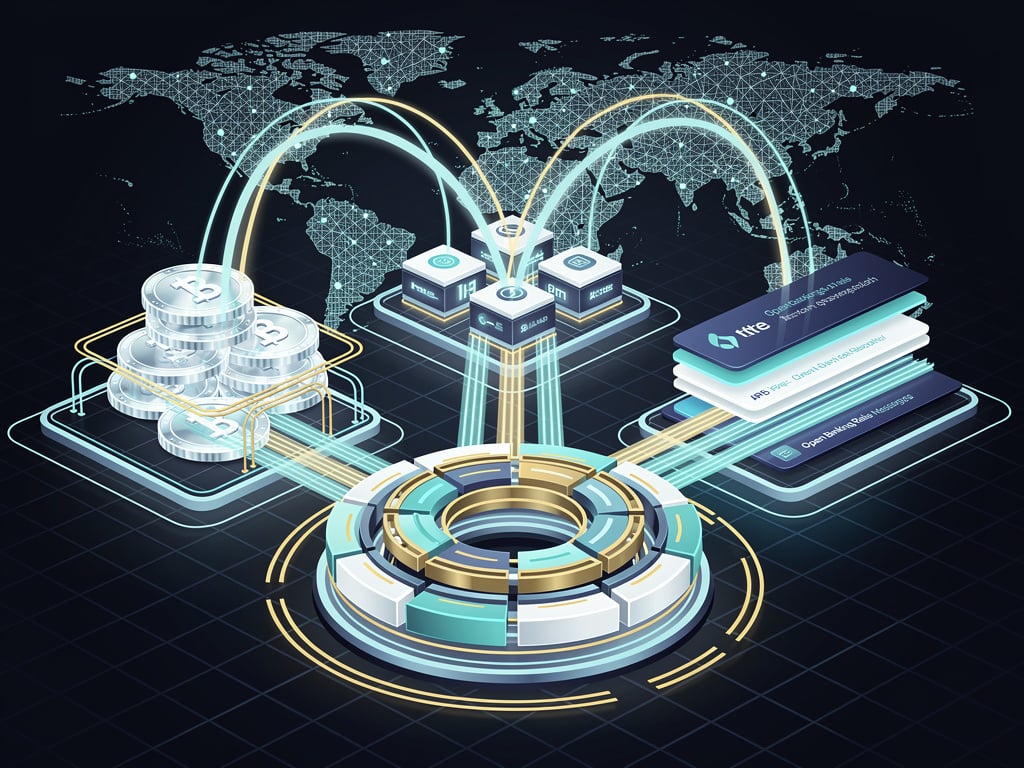
Fintech companies once chased speed above all else. They built flashy apps and quick transfers. Yet when those systems met the real world of banks, networks and regulations, they often stalled. Interoperability, the ability for distinct platforms to exchange data and value without constant custom fixes, emerged as the stubborn obstacle.
Stablecoins offered one answer. Their circulating supply hit $300 billion. B2B payments on these rails reached roughly $226 billion in 2025 after filtering out trading and internal transfers. Growth hit 733% year over year. Platforms took notice. TechRadar reported how Stripe acquired Bridge and rolled out stablecoin-powered accounts for businesses in 101 countries. Deel began letting clients settle invoices in USDC or USDT at a guaranteed 1:1 rate to USD. Grab and StraitsX tested stablecoin settlement layers across Asia.
These moves weren’t about hype. They responded to operating pressure. Nkiru Uwaje, COO and co-founder of MANSA, wrote in that TechRadar piece, “A scalable system has to absorb volume, coordinate cleanly with others, and keep its internal state clear when pressure builds.” Real infrastructure behaves differently under volume. Pilots survive manual fixes. Production does not.
Payment gateways illustrate the point. They must handle high transaction counts, variable demand and time-sensitive operations. When they slow, payroll delays follow. Merchant settlements fail. Liquidity gets trapped. Reporting breaks. Operational risk climbs. Uber’s engineering teams described systems like Docstore and Schemaless that support tens of millions of requests per second across rides, deliveries, maps and payments. The company shifted overload management closer to the storage layer. It replaced static quotas with signals based on concurrency and tenant behavior. Under stress a system needs clear limits. It needs priority rules operators can trust.
But volume alone doesn’t explain the challenge. Every new partner brings its own reporting format. Local payment methods differ. Compliance vendors demand unique data models. Wallets, card networks, liquidity providers and accounting platforms describe the same transaction in conflicting ways. Growth quickly turns into operational debt. Standard interfaces counter that. They create predictable contracts. Teams and partners know what to expect. Adding markets or rails no longer requires full rebuilds.
Networked APIs succeed when they follow consistent resource models and conventions. In payments one vague field can trigger weeks of reconciliation headaches. The strongest designs treat the account as a shared operational layer. Fiat balances, stablecoin holdings, transfers, card connectivity, payment access and asset control all route through the same interface. Coordination costs drop.
Multi-party systems still fail in odd ways. One platform accepts a payment. Another delays it. A third applies extra screening. Without predictable state, teams argue later about what occurred. Good design removes ambiguity. Transactions land in known statuses: completed, failed, reversed or pending. Operators see exactly what checks ran and what comes next.
Idempotency became central. It lets clients retry requests after network glitches without creating duplicate objects or double payouts. Idempotency tokens prevent side effects from repeated calls. A temporary outage shouldn’t force finance teams into manual investigations. Small errors stay contained.
Reliability isn’t a product feature. It forms the operating model. Companies scaling across networks perform diligence before onboarding partners. They maintain audit trails, compliance logic, monitoring, exception handling and clear recoverability paths. They classify failures. Some can retry. Others must stop. A few require human review.
Settlement infrastructure shows this clearly. Payment firms don’t ask only whether a rail is fast. They examine whether liquidity stays predictable, counterparties prove reliable and settlement records stay clean. Speed matters only when paired with control. Interoperability helps only when it cuts coordination costs. Money moves expose weak infrastructure fast.
Recent developments reinforce these lessons. Open banking has shifted from initiative to infrastructure. By 2026 more jurisdictions will require financial institutions and fintechs to provide secure, standardized API access to consumer financial data. Data control tilts toward users. Privacy and interoperability expectations tighten. InnReg noted in its December 2025 analysis that this change “will begin shifting data control to the user and tightening expectations around privacy and interoperability.” In the United States the CFPB’s Section 1033 rule advances toward final form. It will mandate data access standards, set boundaries on use, retention and third-party sharing, and require clear consent management. Fintech products that aggregate or analyze user data must now embed controls for access, transparency and deletion from the start.
Real-time payments add another layer. Settlement in seconds rather than days makes old fraud models obsolete. Behavioral analytics and machine learning must judge risk in milliseconds. J.P. Morgan’s insights on fintech infrastructure highlight six fronts for payment leaders. The firm explained that “funds moving in seconds rather than days render traditional fraud detection models inadequate.” Multi-network strategies demand fraud defenses that operate consistently across real-time payment systems, FedNow and card networks. Intelligent routing, powered by AI, selects optimal paths based on cost, speed and reliability. Modular architecture separates business logic from network-specific code so new rails can be added without core rebuilds.
Nacha’s 2026 account verification rule acts as a catalyst. It requires stronger checks on bank account details before ACH processing. Compliance avoids penalties and reduces returns. Yet its value stretches further. The same validation infrastructure supports real-time flows. AI-powered systems assess risk beyond ownership confirmation. J.P. Morgan advised payment leaders to “use Nacha 2026 as the trigger for broader infrastructure assessment.” Companies that treat it as isolated compliance miss gains in fraud prevention, routing and future AI applications.
Global standards gain traction too. ISO 20022 adoption accelerates. The SWIFT coexistence period for legacy MT messages ended in late 2025. Nearly 200 market infrastructure projects now implement or consider the standard for payments and securities. Richer, structured data improves automation, reconciliation and analytics. Cross-border flows benefit from reduced translation errors. Finastra and other industry voices stressed that native ISO 20022 systems prevent data loss and operational friction. Banks, fintechs and processors must align APIs, internal platforms and partner integrations.
Trust remains the foundation. Mastercard’s Tucker Foote wrote in May 2026 that “a fragmented digital economy is less secure, less competitive and less useful.” He argued digital sovereignty and interoperability can reinforce each other when built on common standards for payments, identity and data. Security becomes a shared responsibility through information exchange and coordinated incident response. Clear, technology-neutral rules on protection and consumer safeguards earn trust. Foote’s vision calls for public-private partnerships that produce systems “resilient for countries, safe for people and open to opportunity.”
Embedded finance providers illustrate the shift. Companies like ConnectPay offer regulated infrastructure so non-banks can integrate payments and banking without building from scratch. The embedded finance market is projected to grow sharply. Success depends on APIs that connect cleanly to multiple rails while meeting compliance demands. Latin American examples show orchestration layers that unify Pix, QR codes and local wallets for merchants. One integration replaces juggling separate providers.
These examples share common traits. They design for pressure before it arrives. They favor standard interfaces over custom work. They maintain predictable state and treat reliability as operational discipline. The next wave of systems will show composure under load. They will communicate status clearly. They will connect trusted parties without introducing new risks.
Fintech has moved past the era of isolated disruption. Banks, payment networks, regulators and technology providers now build together. Open finance, real-time rails, stablecoin bridges and global messaging standards converge. The winners won’t be those who move fastest in isolation. They will be those who make their systems work reliably with everyone else’s.
And the pressure keeps building. Volumes rise. Regulations tighten. Expectations for instant, secure and transparent movement grow. The architectures that survive won’t simply scale. They will coordinate without drama. They will fail gracefully and recover cleanly. In payments, that difference decides who keeps the lights on.


 WebProNews is an iEntry Publication