
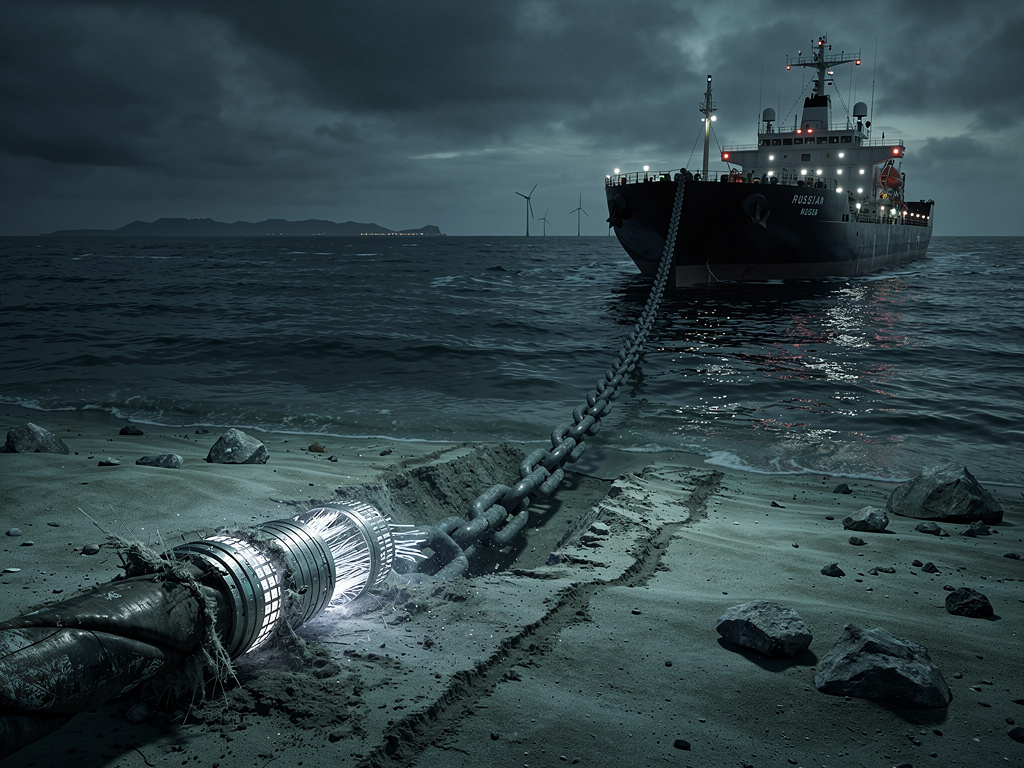
Shadows Beneath the Waves: The Fitburg Incident and the Fragile Threads of Baltic Connectivity
In the chilly expanse of the Baltic Sea, where geopolitical tensions simmer just below the surface, a new chapter unfolded on December 31, 2025, when Finnish authorities detained the cargo ship Fitburg amid suspicions of deliberate sabotage to a vital undersea telecommunications cable linking Finland and Estonia. This incident, occurring in the Gulf of Finland, has reignited concerns over the vulnerability of critical infrastructure in a region already scarred by similar disruptions. The Fitburg, en route from St. Petersburg, Russia, to Haifa, Israel, was seized after border guards discovered its anchor suspiciously lowered into the sea, coinciding with the detection of a fault in the Helsinki-Tallinn telecom link.
Finnish police, acting swiftly, boarded the vessel with special forces and arrested all 14 crew members, launching an investigation into potential aggravated criminal damage and interference with telecommunications. According to reports from CNN, the damage was reported early that morning, prompting an immediate response from authorities who traced the ship’s path to the affected area. This event echoes a pattern of disturbances in the Baltic, where undersea cables and pipelines have faced repeated threats, raising alarms about hybrid warfare tactics employed by state actors.
The seizure of the Fitburg marks the fourth such incident in the Gulf of Finland within less than 18 months, as highlighted in coverage by Tom’s Hardware. Previous cases, including the 2024 damage to the Estlink 2 power cable attributed to the tanker Eagle S, have fueled suspicions of orchestrated attacks, often linked to vessels originating from Russia. In this latest case, investigators found drag marks on the seabed, suggesting the anchor was deliberately deployed to snag and sever the cable, a method that has become a hallmark of these disruptions.
Escalating Tensions in Submarine Infrastructure
Estonian officials, collaborating closely with their Finnish counterparts, expressed grave concerns over the implications for regional security and economic stability. The affected cable, operated by telecom company Elisa, is crucial for data transmission between the two Nordic nations, supporting everything from financial transactions to everyday internet services. Disruptions like this not only cause immediate outages but also underscore the broader risks to Europe’s digital backbone, which relies heavily on a network of undersea cables carrying over 95% of international data traffic.
Drawing from insights in Reuters, Finnish President Alexander Stubb addressed the nation, emphasizing that while no definitive proof of state involvement has emerged, the pattern of incidents points to a deliberate strategy to test Western resolve. The Gulf of Finland, a strategic chokepoint, has seen heightened naval activity since Russia’s invasion of Ukraine, with NATO allies ramping up patrols to safeguard these vital arteries. The Fitburg’s Russian origin and its cargo—reportedly innocuous goods—have not quelled suspicions, especially given the ship’s deviation from standard shipping lanes.
On social media platform X, formerly Twitter, posts from defense analysts and OSINT accounts have amplified the narrative of sabotage. Users have shared satellite imagery and tracking data showing the Fitburg’s anomalous movements, with one prominent account noting dozens of kilometers of drag marks near the cable’s path. These online discussions, while not official, reflect a growing public awareness and speculation about hybrid threats, blending cyber and physical attacks to undermine adversaries without direct confrontation.
The Anatomy of Undersea Vulnerabilities
Delving deeper into the technical aspects, undersea cables like the one damaged are engineered with multiple layers of protection, including steel armoring and burial in the seabed to depths of up to several meters in shallow waters. However, in areas like the Gulf of Finland, where depths average around 50 meters, they remain susceptible to anchor drags, fishing gear, or intentional interference. Experts cited in The Guardian explain that a ship’s anchor, if deployed at speed, can create furrows that easily ensnare and rupture these lines, leading to signal loss that can take weeks to repair.
The economic fallout from such incidents is substantial. For Finland and Estonia, both heavily digitized economies, a severed cable disrupts cross-border commerce, with potential losses in the millions of euros per day. In the case of the Fitburg, telecom operators quickly rerouted traffic through redundant lines, minimizing immediate impact, but the long-term costs of repairs and heightened security measures add up. Industry insiders point to the need for advanced monitoring systems, such as distributed acoustic sensing, which uses fiber optics to detect vibrations along the cable route, potentially alerting to threats in real time.
Comparisons to past events reveal a troubling trend. The 2024 Eagle S incident, as detailed in posts on X from accounts like OSINTdefender, involved similar anchor-dragging tactics that severed the Estlink 2 power cable and several data lines. Finnish authorities, learning from that episode, have since enhanced their response protocols, including closer coordination with NATO’s maritime command. The Eagle S was also seized, and investigations uncovered links to shadowy shipping firms, though no direct ties to the Kremlin were publicly confirmed.
Geopolitical Ripples and International Responses
The international community has responded with a mix of condemnation and calls for vigilance. NATO Secretary-General Jens Stoltenberg, in statements echoed across media, urged member states to bolster protections for critical infrastructure, potentially expanding the alliance’s role in monitoring subsea assets. Estonia, a vocal critic of Russian aggression, has pushed for EU sanctions on vessels suspected of involvement, arguing that these acts constitute economic warfare.
From a legal standpoint, prosecuting such cases is complex. Under international maritime law, as outlined in analyses from BBC News, proving intent is key, especially when ships claim accidental damage. The Fitburg’s crew, now detained, face interrogations that could reveal whether orders came from higher up the chain. Finnish police, per Euronews, are examining the vessel’s black box data and crew communications for evidence of premeditation.
Broader implications extend to global supply chains and energy security. The Baltic region’s pipelines, such as the now-defunct Nord Stream, have been previous targets, with explosions in 2022 still under investigation. As noted in The New York Times, these incidents highlight how non-state actors or proxies can be used to inflict damage without escalating to open conflict, a tactic increasingly employed in gray-zone operations.
Technological Defenses and Future Safeguards
To counter these threats, innovations in cable technology are accelerating. Companies are developing self-healing cables with built-in redundancies and AI-driven anomaly detection. In the Baltic, joint Finnish-Estonian initiatives, supported by EU funding, aim to deploy underwater drones for regular inspections, reducing response times to potential sabotage.
Industry experts, drawing from discussions on X where users like Navy Lookout share naval insights, emphasize the role of allied navies in deterrence. Finland’s recent NATO accession has integrated its forces more deeply with the alliance, enabling rapid deployments like the one that intercepted the Fitburg. This integration not only enhances surveillance but also sends a strong signal to potential aggressors.
Looking ahead, the Fitburg case could catalyze international agreements on undersea infrastructure protection, similar to those governing airspace. Proposals include designating certain sea routes as protected zones, with mandatory tracking for vessels over a certain tonnage. Such measures, while challenging to implement, could mitigate risks in hotspots like the Baltic.
Human Elements and Ongoing Investigations
At the heart of the incident are the 14 crew members, hailing from various nationalities, now under scrutiny in Finnish custody. Interviews, as reported in recent updates, seek to uncover motivations—were they unwitting pawns or complicit in a larger scheme? Psychological profiles and polygraph tests may come into play, adding layers to the investigative process.
Public sentiment, gauged from X posts, shows a mix of outrage and calls for accountability. Accounts like Visegrád 24 have amplified the story, framing it as part of Russia’s hybrid warfare arsenal, though official sources urge caution against premature conclusions.
As repairs commence on the damaged cable, with divers assessing the breakage, the incident serves as a stark reminder of the interconnected world’s fragility. Finnish authorities, committed to transparency, promise regular updates, ensuring that this shadowy episode does not fade into obscurity without lessons learned.
Echoes of Past Incidents and Strategic Implications
Reflecting on the 2024 Eagle S case, where Finnish special forces conducted a similar boarding operation, patterns emerge. That vessel, flagged under the Cook Islands, left drag marks spanning kilometers, severing power and data lines. Investigations, as per DW, pointed to sanctions evasion, blending economic motives with potential sabotage.
Strategically, these disruptions test NATO’s cohesion, particularly in the Nordic-Baltic corridor. Estonia’s defense ministry has advocated for enhanced cyber-physical defenses, integrating satellite monitoring with seabed sensors to create a comprehensive shield.
Ultimately, the Fitburg incident underscores the need for resilient infrastructure in an era of asymmetric threats. As nations grapple with these challenges, the Baltic Sea remains a frontline in the battle for secure connectivity, where every cable cut ripples through global networks. With ongoing probes, the full story may yet unfold, revealing the depths of this underwater intrigue.


 WebProNews is an iEntry Publication