
If you’re asking “How long does it take to film the voice?” you’re usually trying to plan time for recording + fixes + final audio. In real film/TV work, voice isn’t just “press record.” It’s a chain: capture the performance, clean it up, match it to picture, get approvals, and deliver mix-ready audio.
If you’re considering a movie voice generator, the timeline can become shorter and easier, because you reduce the number of studio sessions and last-minute re-recordings (ADR). That often means faster turnaround and lower costs – especially when schedules are tight.
Below is the simplest, most practical breakdown.
What “filming the voice” includes (in plain English)
Most projects need three things:
- Recording
Actors record lines (on set or in studio). - Fixing
You replace or repair lines that are unusable (noise, wrong wording, performance issues). This is where ADR happens. - Finalizing
Editors sync the voice to picture, clean it, and the sound team mixes it to match the scene.
So time depends on how much you record and how many fixes you need.
The short answer: typical timelines
1. Small amount of voice (trailer / short VO / a few scenes)
- Recording: a few hours to 1 day
- Fixes + edit: 1–3 days
- Final mix integration: 1–3 days
Total: usually 3–7 days
2. One episode (TV) or a big chunk of dialogue
- Recording: 1–3 days
- ADR / pickups: 1–5 days
- Edit + sync + mix handoff: 3–10 days
Total: typically 1–3 weeks
3. Feature film (especially if there’s a lot of ADR)
- Recording spread out: days across weeks
- ADR + pickups: 1–3+ weeks (depending on problems)
- Final post integration: 2–6+ weeks (parallel with sound design)
Total: often 4–10+ weeks for voice work across the full schedule
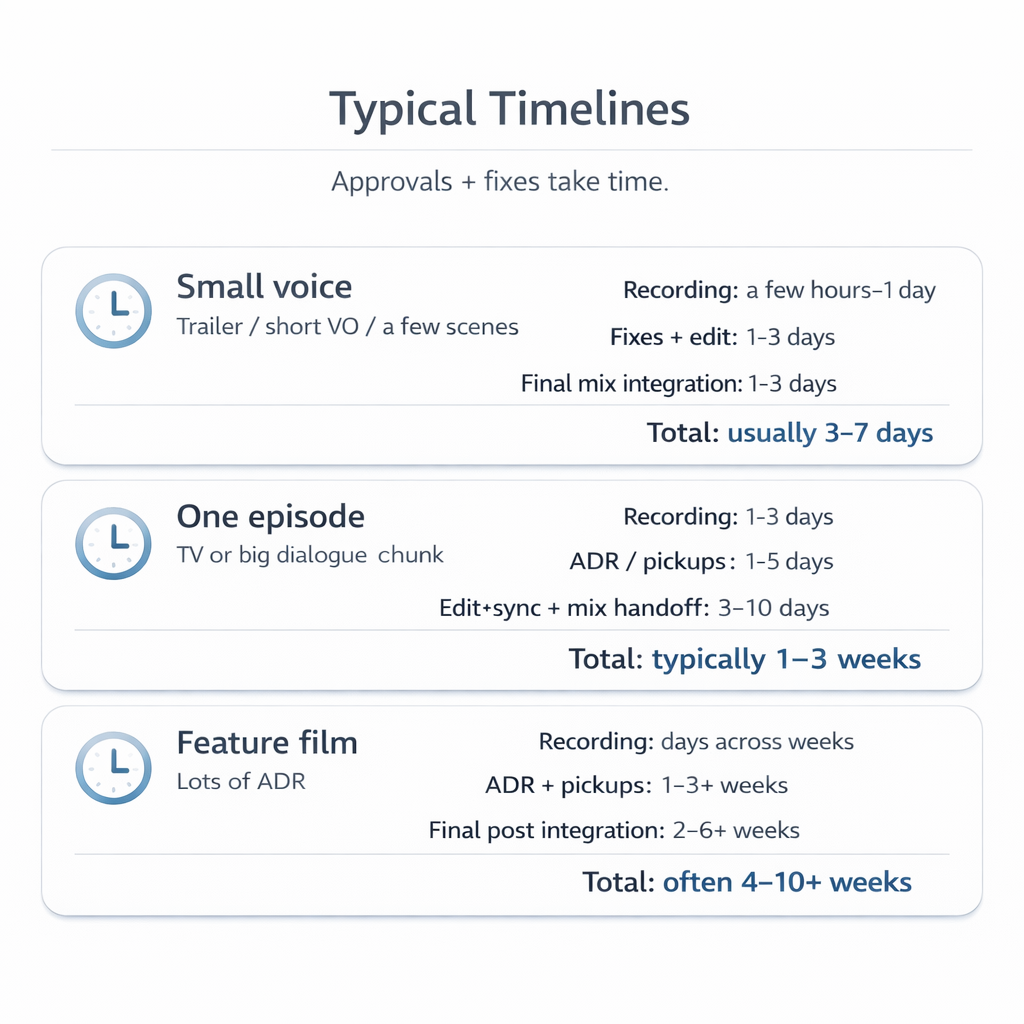
These are normal ranges – because approvals and fixes take time.
What makes voice take longer (the 5 biggest reasons)
1. Script changes
Every rewrite creates new lines. New lines = new recording or fixes.
2. Noisy locations
If you filmed in places with wind, crowds, traffic, or echo, you’ll need more ADR.
3. Actor availability
Even if ADR takes “one day,” getting the actor back into a studio can take weeks.
4. Performance matching (harder than people think)
ADR is slow because the actor has to match:
- timing
- emotion
- mouth movement (lip sync)
5. Too many approval rounds
If “final” means 6 rounds of notes from 6 people, schedule stretches.
Where Respeecher makes it easier, faster, cheaper
In traditional workflows, the main pain is re-recording:
- you need to book the actor again
- book a studio
- direct the session
- edit, sync, and approve again
That’s expensive and slow.
With Respeecher’s film/TV workflow (the movie voice generator approach), you can reduce the amount of ADR and pickups by handling certain changes and continuity fixes in post – without repeating the whole studio process every time.
What this changes in practice
Easier:
Fewer moving parts. Less coordination with talent, studios, travel, and schedules.
Faster:
Instead of waiting for the next available studio slot, you can move quicker through revisions and continuity work.
Cheaper:
Fewer recording days + fewer last-minute sessions usually means lower cost – especially when a project has lots of pickups.
Important: this isn’t about replacing actors. It’s about making post-production smoother when real projects inevitably change.
A simple way to estimate your timeline (use this as a template)
Answer these 4 questions:
- How much voice do we have?
Trailer (minutes) / Episode / Feature - How stable is the script?
Mostly locked / still changing - How messy is the production audio?
Clean / mixed / noisy - How many fixes do we expect?
Small / medium / heavy ADR
Then choose a range:
- Small / clean / locked: 3–7 days
- Medium / some changes / some noise: 1–3 weeks
- Heavy ADR / many changes / messy audio: 4–10+ weeks
If you’re in the “medium” or “heavy” bucket, that’s where Respeecher typically saves the most time and cost, because it reduces re-recording pressure.
Quick examples (so it’s crystal clear)
Example A: Trailer VO
You need a 60-second narration. Script changes twice.
Traditional: call the actor back, record again, re-edit.
With Respeecher: revisions can be easier to push through post → fewer repeat sessions.
Example B: Series episode with ADR
A location scene is noisy. Several lines are unusable.
Traditional: ADR session + editing + approval loop.
With Respeecher: continuity and fixes can be handled more efficiently, keeping the episode on schedule.
Example C: Feature film pickups
You need 40 pickup lines after a test screening.
Traditional: booking the actor becomes the bottleneck.
Respeecher can reduce how often you need a full pickup session, making the workflow less dependent on availability.
Simple close: what you should tell your team
If your project is small and clean, voice can be done in days.
If you have script changes, noise, or lots of pickups, voice turns into weeks.
And if you want to make it easier, faster, and cheaper, it’s worth using a film-ready AI voice workflow like Respeecher’s – because it reduces the biggest schedule and budget killer: re-recording.
Explore Respeecher for film & TV here: movie voice generator.
HTML
<h1 dir=”ltr”>How Long Does It Take to Film the Voice?</h1>
<p dir=”ltr”>If you’re asking “How long does it take to film the voice?” you’re usually trying to plan time for recording + fixes + final audio. In real film/TV work, voice isn’t just “press record.” It’s a chain: capture the performance, clean it up, match it to picture, get approvals, and deliver mix-ready audio.</p>
<p dir=”ltr”>If you’re considering a <a href=”https://www.respeecher.com/film-tv-production”>movie voice generator</a>, the timeline can become shorter and easier, because you reduce the number of studio sessions and last-minute re-recordings (ADR). That often means faster turnaround and lower costs – especially when schedules are tight.</p>
<p dir=”ltr”>Below is the simplest, most practical breakdown.</p>
<h2 dir=”ltr”>What “filming the voice” includes (in plain English)</h2>
<p dir=”ltr”>Most projects need three things:</p>
<ol>
<li dir=”ltr” aria-level=”1″>
<p dir=”ltr” role=”presentation”>Recording<br>Actors record lines (on set or in studio).</p>
</li>
<li dir=”ltr” aria-level=”1″>
<p dir=”ltr” role=”presentation”>Fixing<br>You replace or repair lines that are unusable (noise, wrong wording, performance issues). This is where ADR happens.</p>
</li>
<li dir=”ltr” aria-level=”1″>
<p dir=”ltr” role=”presentation”>Finalizing<br>Editors sync the voice to picture, clean it, and the sound team mixes it to match the scene.</p>
</li>
</ol>
<p dir=”ltr”>So time depends on how much you record and how many fixes you need.</p>
<h2 dir=”ltr”>The short answer: typical timelines</h2>
<h3 dir=”ltr”>1. Small amount of voice (trailer / short VO / a few scenes)</h3>
<ul>
<li dir=”ltr” aria-level=”1″>
<p dir=”ltr” role=”presentation”>Recording: a few hours to 1 day</p>
</li>
<li dir=”ltr” aria-level=”1″>
<p dir=”ltr” role=”presentation”>Fixes + edit: 1–3 days</p>
</li>
<li dir=”ltr” aria-level=”1″>
<p dir=”ltr” role=”presentation”>Final mix integration: 1–3 days<br>Total: usually 3–7 days</p>
</li>
</ul>
<h3 dir=”ltr”>2. One episode (TV) or a big chunk of dialogue</h3>
<ul>
<li dir=”ltr” aria-level=”1″>
<p dir=”ltr” role=”presentation”>Recording: 1–3 days</p>
</li>
<li dir=”ltr” aria-level=”1″>
<p dir=”ltr” role=”presentation”>ADR / pickups: 1–5 days</p>
</li>
<li dir=”ltr” aria-level=”1″>
<p dir=”ltr” role=”presentation”>Edit + sync + mix handoff: 3–10 days<br>Total: typically 1–3 weeks</p>
</li>
</ul>
<h3 dir=”ltr”>3. Feature film (especially if there’s a lot of ADR)</h3>
<ul>
<li dir=”ltr” aria-level=”1″>
<p dir=”ltr” role=”presentation”>Recording spread out: days across weeks</p>
</li>
<li dir=”ltr” aria-level=”1″>
<p dir=”ltr” role=”presentation”>ADR + pickups: 1–3+ weeks (depending on problems)</p>
</li>
<li dir=”ltr” aria-level=”1″>
<p dir=”ltr” role=”presentation”>Final post integration: 2–6+ weeks (parallel with sound design)<br>Total: often 4–10+ weeks for voice work across the full schedule</p>
</li>
</ul>
<p dir=”ltr”><img src=”../../../upload/images/2026/01/26/image_697761293ec04.png”></p>
<p dir=”ltr”>These are normal ranges – because approvals and fixes take time.</p>
<h2 dir=”ltr”>What makes voice take longer (the 5 biggest reasons)</h2>
<h3 dir=”ltr”>1. Script changes</h3>
<p dir=”ltr”>Every rewrite creates new lines. New lines = new recording or fixes.</p>
<h3 dir=”ltr”>2. Noisy locations</h3>
<p dir=”ltr”>If you filmed in places with wind, crowds, traffic, or echo, you’ll need more ADR.</p>
<h3 dir=”ltr”>3. Actor availability</h3>
<p dir=”ltr”>Even if ADR takes “one day,” getting the actor back into a studio can take weeks.</p>
<h3 dir=”ltr”>4. Performance matching (harder than people think)</h3>
<p dir=”ltr”>ADR is slow because the actor has to match:</p>
<ul>
<li dir=”ltr” aria-level=”1″>
<p dir=”ltr” role=”presentation”>timing</p>
</li>
<li dir=”ltr” aria-level=”1″>
<p dir=”ltr” role=”presentation”>emotion</p>
</li>
<li dir=”ltr” aria-level=”1″>
<p dir=”ltr” role=”presentation”>mouth movement (lip sync)</p>
</li>
</ul>
<h3 dir=”ltr”>5. Too many approval rounds</h3>
<p dir=”ltr”>If “final” means 6 rounds of notes from 6 people, schedule stretches.</p>
<h2 dir=”ltr”>Where Respeecher makes it easier, faster, cheaper</h2>
<p dir=”ltr”>In traditional workflows, the main pain is re-recording:</p>
<ul>
<li dir=”ltr” aria-level=”1″>
<p dir=”ltr” role=”presentation”>you need to book the actor again</p>
</li>
<li dir=”ltr” aria-level=”1″>
<p dir=”ltr” role=”presentation”>book a studio</p>
</li>
<li dir=”ltr” aria-level=”1″>
<p dir=”ltr” role=”presentation”>direct the session</p>
</li>
<li dir=”ltr” aria-level=”1″>
<p dir=”ltr” role=”presentation”>edit, sync, and approve again</p>
</li>
</ul>
<p dir=”ltr”>That’s expensive and slow.</p>
<p dir=”ltr”>With Respeecher’s film/TV workflow (the movie voice generator approach), you can reduce the amount of ADR and pickups by handling certain changes and continuity fixes in post – without repeating the whole studio process every time.</p>
<h3 dir=”ltr”>What this changes in practice</h3>
<p dir=”ltr”>Easier:<br>Fewer moving parts. Less coordination with talent, studios, travel, and schedules.</p>
<p dir=”ltr”>Faster:<br>Instead of waiting for the next available studio slot, you can move quicker through revisions and continuity work.</p>
<p dir=”ltr”>Cheaper:<br>Fewer recording days + fewer last-minute sessions usually means lower cost – especially when a project has lots of pickups.</p>
<p dir=”ltr”>Important: this isn’t about replacing actors. It’s about making post-production smoother when real projects inevitably change.</p>
<h2 dir=”ltr”>A simple way to estimate your timeline (use this as a template)</h2>
<p dir=”ltr”>Answer these 4 questions:</p>
<ol>
<li dir=”ltr” aria-level=”1″>
<p dir=”ltr” role=”presentation”>How much voice do we have?<br>Trailer (minutes) / Episode / Feature</p>
</li>
<li dir=”ltr” aria-level=”1″>
<p dir=”ltr” role=”presentation”>How stable is the script?<br>Mostly locked / still changing</p>
</li>
<li dir=”ltr” aria-level=”1″>
<p dir=”ltr” role=”presentation”>How messy is the production audio?<br>Clean / mixed / noisy</p>
</li>
<li dir=”ltr” aria-level=”1″>
<p dir=”ltr” role=”presentation”>How many fixes do we expect?<br>Small / medium / heavy ADR</p>
</li>
</ol>
<p dir=”ltr”>Then choose a range:</p>
<ul>
<li dir=”ltr” aria-level=”1″>
<p dir=”ltr” role=”presentation”>Small / clean / locked: 3–7 days</p>
</li>
<li dir=”ltr” aria-level=”1″>
<p dir=”ltr” role=”presentation”>Medium / some changes / some noise: 1–3 weeks</p>
</li>
<li dir=”ltr” aria-level=”1″>
<p dir=”ltr” role=”presentation”>Heavy ADR / many changes / messy audio: 4–10+ weeks</p>
</li>
</ul>
<p dir=”ltr”>If you’re in the “medium” or “heavy” bucket, that’s where Respeecher typically saves the most time and cost, because it reduces re-recording pressure.</p>
<h2 dir=”ltr”>Quick examples (so it’s crystal clear)</h2>
<h3 dir=”ltr”>Example A: Trailer VO</h3>
<p dir=”ltr”>You need a 60-second narration. Script changes twice.<br>Traditional: call the actor back, record again, re-edit.<br>With Respeecher: revisions can be easier to push through post → fewer repeat sessions.</p>
<h3 dir=”ltr”>Example B: Series episode with ADR</h3>
<p dir=”ltr”>A location scene is noisy. Several lines are unusable.<br>Traditional: ADR session + editing + approval loop.<br>With Respeecher: continuity and fixes can be handled more efficiently, keeping the episode on schedule.</p>
<h3 dir=”ltr”>Example C: Feature film pickups</h3>
<p dir=”ltr”>You need 40 pickup lines after a test screening.<br>Traditional: booking the actor becomes the bottleneck.<br>Respeecher can reduce how often you need a full pickup session, making the workflow less dependent on availability.</p>
<h2 dir=”ltr”>Simple close: what you should tell your team</h2>
<p dir=”ltr”>If your project is small and clean, voice can be done in days.<br>If you have script changes, noise, or lots of pickups, voice turns into weeks.</p>
<p dir=”ltr”>And if you want to make it easier, faster, and cheaper, it’s worth using a film-ready AI voice workflow like Respeecher’s – because it reduces the biggest schedule and budget killer: re-recording.</p>
<p dir=”ltr”>Explore Respeecher for film & TV here: movie voice generator.</p>
<p> </p>


 WebProNews is an iEntry Publication