
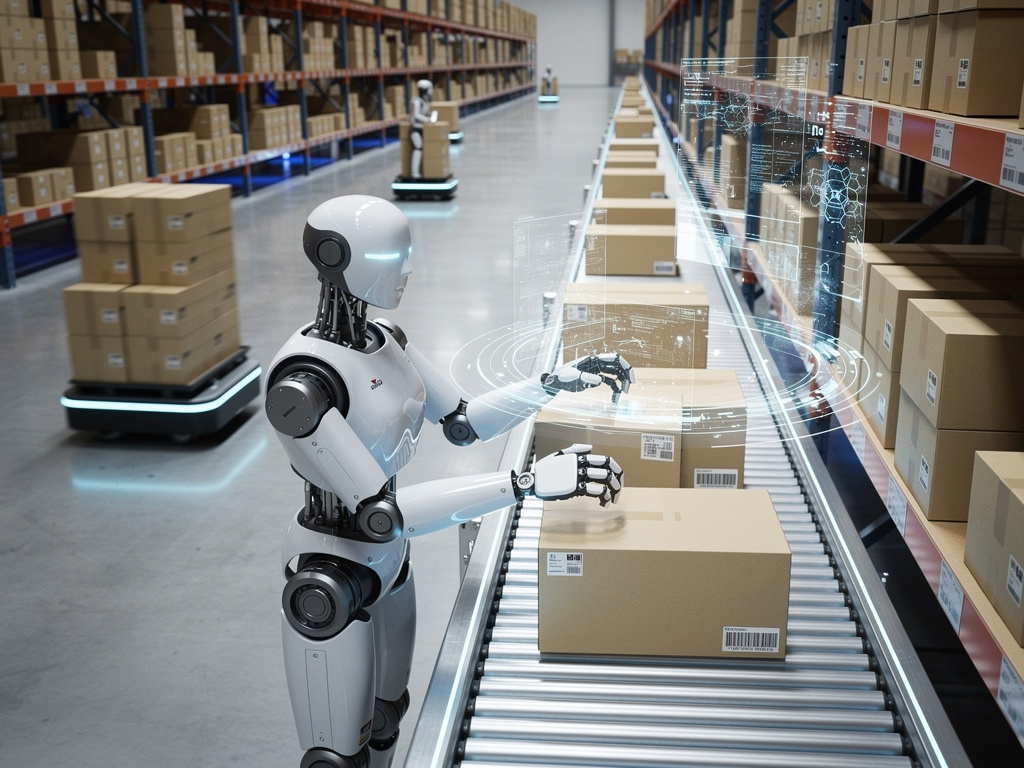
In the bustling warehouses of modern logistics, where millions of packages zip through conveyor belts daily, a new breed of humanoid robots is emerging as a game-changer. Figure AI, a California-based startup, recently captivated the tech world with a video demonstration of its Figure 02 robot sorting packages for a full hour without interruption. This isn’t just a parlor trick; it’s a glimpse into how automation could reshape labor-intensive tasks in supply chains. The robot, standing at human height with dexterous hands, methodically picks, scans, and places boxes of varying sizes, showcasing endurance that rivals human workers but with tireless precision.
The demonstration, shared by Figure AI’s founder and CEO Brett Adcock on social media, highlights the robot’s ability to handle real-world variability—different package shapes, weights, and orientations—without faltering. This comes at a time when e-commerce giants like Amazon and DHL are pouring billions into robotics to cope with surging demand. Industry experts note that such advancements could address chronic labor shortages, especially during peak seasons when shipment volumes spike by double digits. For instance, DHL Express reported a 17.3% year-on-year increase in shipments during the 2020 peak, a trend that has only accelerated.
What sets Figure AI’s approach apart is its integration of advanced AI models that allow the robot to learn from vast datasets, adapting to unpredictable environments. Unlike traditional robotic arms fixed to assembly lines, this humanoid design mimics human movements, enabling it to navigate dynamic warehouse floors. The hour-long video isn’t edited for flair; it’s a raw display of sustained performance, complete with occasional pauses for recalibration, underscoring the technology’s maturity.
Humanoids Step Into the Sorting Arena
Beyond the spectacle, this development ties into broader innovations in parcel handling. Companies like Amazon have been piloting systems such as the Visual AI Sorting System (VASS), which uses computer vision to sort packages more flexibly, decoupling employee pacing from machine rhythms. As detailed in a report from Amazon’s official blog, VASS is set for wider rollout in Europe and the U.S. by 2027, promising safer workplaces and faster deliveries. This echoes Figure AI’s demo, where the robot’s AI processes visual data in real-time to identify and manipulate items.
Meanwhile, startups like Unbox Robotics are deploying mobile sorting robots that traverse warehouse floors, using sensors to detect package attributes and route them efficiently. These systems, as explored in a guide from Unbox Robotics, can classify robots into elevated or ground-based models, minimizing space needs while boosting throughput. In one pilot with DHL in Asia Pacific, such robots enhanced productivity amid growing shipment volumes, aligning with Deutsche Post DHL Group’s €2 billion investment in automation under its Strategy 2025.
The economic implications are profound. With the global packaging robotics market projected to hit $35.1 billion by 2033, growing at a compound annual rate of 11.1%, as per analysis from Future Data Stats, investments in humanoid tech like Figure AI’s could accelerate this trajectory. Warehouses that adopt these robots stand to reduce labor costs significantly, much like STO Express in China, where robotic systems sort 200,000 packages daily while halving workforce expenses.
AI-Driven Precision Meets Real-World Challenges
Delving deeper, the Figure 02 robot’s performance draws on foundation models trained on millions of images and extensive operational hours. This mirrors advancements from Ambi Robotics, whose PRIME-1 model processes mixed packages without relying on uniform bins, as highlighted in posts on X from industry observers. Such AI enables robots to grasp irregular items, read labels, and stack them intelligently, tackling a key bottleneck in logistics where human error rates can reach 1-2% in manual sorting.
Comparisons to other humanoid efforts, such as those from Tesla’s Optimus or Boston Dynamics’ Atlas, reveal Figure AI’s edge in endurance tasks. While Optimus has demonstrated basic folding, Figure’s hour-long sorting session, reported in Digital Trends, pushes boundaries by simulating a full shift’s worth of work. This isn’t hype; it’s backed by real metrics, with the robot maintaining accuracy over prolonged periods, a feat that could integrate seamlessly into facilities like Amazon’s, where autonomous mobile robots already handle transport.
Regulatory and ethical considerations loom large here. As robots take on more roles, questions arise about job displacement. Yet, proponents argue that these machines augment human workers, freeing them for higher-value tasks like route planning. A pilot by PostNord in Sweden, using AI robotic arms for parcel sorting, showed improved safety and efficiency, reducing physical strain on employees during high-volume periods.
Market Forces Propel Robotic Adoption
The parcel sortation system market, valued at $2.2 billion in 2023, is forecasted to reach $3.1 billion by 2034, driven by e-commerce booms and automated sorting tech, according to a press release from OpenPR. Figure AI’s demo fits this narrative, illustrating how humanoid robots could scale to meet demands in sectors beyond logistics, including manufacturing and retail fulfillment.
Innovations extend to hybrid models, like DOBOT’s Nova on wheeled platforms for inbound-outbound handling, as shared in recent X updates from robotics firms. These systems combine mobility with AI sorting, enabling warehouses to process orders at rates unattainable by humans alone. For example, robots at adidas warehouses in India, deployed by DHL Supply Chain, automate marketplace sorting and manifest generation, replacing manual processes and enhancing accuracy.
Cost-benefit analyses further bolster the case. Robots-as-a-service models, discussed in an article from Robotics & Automation News, lower entry barriers for smaller operators, allowing them to test automation without massive upfront investments. This democratizes access, potentially transforming mid-sized warehouses that previously relied on labor-intensive methods.
Overcoming Technical Hurdles in Deployment
Challenges persist, of course. Battery life, sensor reliability, and integration with existing infrastructure remain hurdles. Figure AI’s robot, in its demo, operated in a controlled setting, but scaling to chaotic warehouse environments requires robust fail-safes. Insights from Tech Times emphasize the robot’s precision and speed, yet note the need for advancements in real-time adaptability to handle damaged or mislabeled packages.
Collaborations are key to progress. Amazon’s last-mile delivery team is enhancing VASS with advanced computer vision, building on pilots that improve employee experiences. Similarly, Figure AI’s partnerships with investors like OpenAI suggest a future where language models enable robots to respond to verbal commands, further blurring lines between human and machine collaboration.
Sustainability adds another layer. Robotic sorting reduces waste from errors and optimizes energy use in warehouses. Brazil Potash’s AI ore-sorting trials, while not directly related, illustrate how similar tech cuts costs and environmental impact, a principle applicable to package handling where efficient sorting minimizes unnecessary transport emissions.
Future Trajectories in Warehouse Automation
Looking ahead, the convergence of AI, robotics, and data analytics promises even greater efficiencies. Projections from WINSSolutions question whether 2025-2026 humanoid robots are reality or hype, but Figure AI’s demonstration leans toward the former, with tangible industrial potential. Warehouses could see fleets of such robots working alongside humans, sorting at scales that support global supply chains.
Economic ripple effects extend to job markets. While automation might displace routine roles, it creates demand for technicians, programmers, and overseers. Training programs, like those embedded in DHL’s strategy, prepare workforces for this shift, ensuring that technological leaps don’t leave workers behind.
Ultimately, as e-commerce continues its ascent—projected to drive the automated packaging market to $162.2 billion by 2035, per Focal Robot—innovations like Figure AI’s will be pivotal. They not only enhance speed and accuracy but also redefine what’s possible in logistics, turning once-tedious tasks into seamless operations that keep the world’s goods flowing efficiently.
Industry-Wide Implications and Strategic Shifts
For executives in logistics, the strategic imperative is clear: invest now or risk obsolescence. Companies adopting humanoid sorters could see throughput increases of 50% or more, based on pilots like PostNord’s. This isn’t isolated; X posts from supply chain automation accounts highlight Amazon’s reveals of sorting robots and fully autonomous mobiles, signaling a wave of deployments.
Integration challenges, such as software compatibility, are being addressed through open standards and AI interoperability. Figure AI’s model, trained on diverse datasets, exemplifies this, potentially setting benchmarks for competitors.
In the end, these advancements herald a new era where robots don’t just assist but lead in efficiency-driven environments, promising a future where warehouses operate with unprecedented reliability and scale.


 WebProNews is an iEntry Publication