
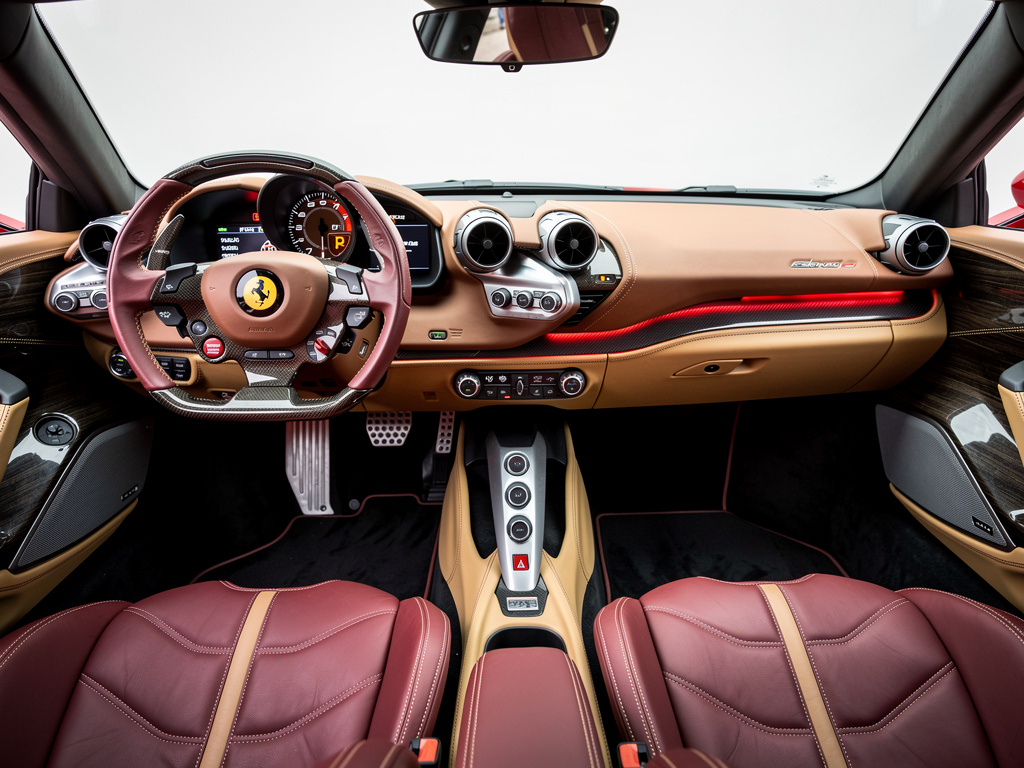
When Ferrari finally pulled back the curtain on the interior of its first-ever electric vehicle, the automotive world expected a radical departure — a cockpit dripping with screens, touch surfaces, and the kind of minimalist tech aesthetic that has come to define the modern EV cabin. Instead, what emerged from the Maranello design studios was something far more provocative: a deliberate, almost defiant embrace of analog craftsmanship, orchestrated by none other than Sir Jony Ive and Marc Newson, two of the most influential industrial designers of the past three decades.
The collaboration between Ferrari and Ive’s design firm, LoveFrom, represents one of the most closely watched partnerships in both the automotive and technology design worlds. Ive, who spent decades shaping Apple’s iconic product lines, and Newson, the Australian-born polymath whose work spans furniture, aircraft interiors, and watches, have brought a philosophy to the Ferrari EV interior that stands in stark contrast to the prevailing trends in electric vehicle design. As Ars Technica reported, the duo has infused the cabin with “old-school charm,” prioritizing tactile materials, physical controls, and a sense of warmth that feels almost anachronistic in an age of capacitive touch panels and sprawling digital displays.
A Rejection of Silicon Valley’s Dashboard Doctrine
The design philosophy underpinning the Ferrari EV interior is, in many ways, a direct rebuke of the approach championed by Tesla and subsequently adopted by nearly every major automaker entering the electric space. Where Tesla stripped the Model 3’s dashboard down to a single central screen, and where competitors like Rivian, Lucid, and even legacy brands like Mercedes-Benz have followed suit with ever-larger digital surfaces, Ive and Newson have gone in the opposite direction. Physical switches, knobs, and buttons feature prominently. The materials palette emphasizes hand-finished leather, machined aluminum, and bespoke textiles rather than glossy piano black plastic or acres of glass.
According to the reporting by Ars Technica, the interior design reflects a conviction that the act of driving a Ferrari — even an electric one — should remain a fundamentally sensory experience. Ive and Newson appear to have been guided by the belief that luxury is not about the absence of complexity, but about the presence of intention in every surface, switch, and stitch. The result is a cabin that feels less like a consumer electronics device and more like a finely crafted instrument, a design ethos that echoes the hand-built engine bays of Ferrari’s storied V12 grand tourers.
The LoveFrom Partnership and Ferrari’s Strategic Calculus
Ferrari’s decision to engage LoveFrom was announced in 2021, and the partnership has been the subject of intense speculation ever since. Ive departed Apple in 2019 after nearly three decades, during which he oversaw the design of the iMac, iPod, iPhone, and Apple Watch — products that collectively redefined consumer expectations around industrial design. His post-Apple venture, LoveFrom, was conceived as a boutique consultancy that would work with a small number of clients on deeply integrated, long-term design projects. Ferrari was among the first and most prominent of those clients.
Marc Newson, who has been a close collaborator of Ive’s for years and joined LoveFrom as a partner, brings his own formidable reputation. His work on the Qantas A380 first-class suite, the Ikepod watch brand, and a dizzying array of furniture and product designs has established him as one of the most versatile designers alive. Together, Ive and Newson represent an unusual concentration of design talent being brought to bear on a single car interior — a fact that Ferrari has clearly calculated will generate enormous attention and differentiate its EV offering in a crowded and rapidly evolving market.
Materiality Over Digitality: The Core Design Principles
What makes the Ferrari EV interior particularly noteworthy is its emphasis on what designers call “materiality” — the quality, texture, and feel of physical materials. In an era when many automakers have sought to reduce costs and increase perceived modernity by replacing physical components with software-driven interfaces, Ive and Newson have doubled down on the opposite approach. The cabin reportedly features extensive use of natural materials, including leathers treated and finished using traditional Italian techniques, metals that have been precision-machined rather than stamped, and fabrics that have been developed specifically for the project.
This approach is not merely aesthetic; it is philosophical. Ive has spoken extensively throughout his career about the importance of how objects feel in the hand, about the emotional resonance of well-chosen materials, and about the way that physical design can communicate care and intentionality. In the context of a Ferrari, these principles take on added significance. The brand’s identity has always been rooted in the idea of the car as a total work of art — a Gesamtkunstwerk in which engine note, driving dynamics, exterior sculpture, and interior environment all contribute to a unified emotional experience. The challenge of the EV transition, for Ferrari, is preserving that holistic sensory identity even as the visceral soundtrack of a naturally aspirated engine disappears.
The Broader Industry Implications of Ferrari’s Approach
Ferrari’s interior strategy arrives at a moment of significant introspection within the automotive industry. Several major automakers have begun to walk back their most aggressive moves toward all-digital interiors, responding to consumer feedback and safety research indicating that the elimination of physical controls can be distracting and frustrating. Volkswagen, for example, has publicly acknowledged that its move to touch-sensitive controls on the steering wheel and climate system in recent models was a mistake, and has pledged to reintroduce physical buttons. Euro NCAP, the European safety assessment body, has also begun penalizing vehicles that bury essential functions in touchscreen menus.
In this context, the Ive-Newson Ferrari interior can be seen not just as a luxury statement but as a leading indicator of a broader industry correction. If even the most forward-looking electric vehicle from one of the world’s most prestigious brands is choosing physical controls and analog craftsmanship over digital minimalism, it sends a powerful signal to the rest of the industry. It suggests that the pendulum may be swinging back — that the future of car interiors may not be defined by ever-larger screens, but by a more thoughtful integration of digital and physical elements.
Ferrari’s EV Ambitions in a Competitive Arena
The Ferrari EV, which is expected to arrive with a price tag that will place it firmly in the ultra-luxury segment, enters a market that is becoming increasingly competitive at the top end. Porsche’s Taycan has established a strong foothold among performance-oriented EV buyers. Rimac’s Nevera has set extraordinary performance benchmarks. Lotus, with its Evija hypercar, and Pininfarina, with the Battista, have both staked claims in the electric supercar space. And Lamborghini, Ferrari’s most direct rival, is pursuing its own electrification strategy under the Volkswagen Group umbrella.
What sets Ferrari apart — and what the Ive-Newson interior is designed to reinforce — is the brand’s unparalleled ability to command both emotional loyalty and extraordinary pricing power. Ferrari has historically operated on margins that are the envy of the automotive industry, and its ability to maintain those margins in the EV era will depend in large part on whether it can convince its clientele that an electric Ferrari is still, unmistakably, a Ferrari. The interior is arguably the most critical battleground in that effort, because it is where the driver spends the most time and where the absence of an internal combustion engine will be most keenly felt.
What the Cabin Tells Us About Ferrari’s Future Identity
The decision to foreground craftsmanship and tactile richness in the EV interior also speaks to a deeper strategic question facing Ferrari: how to define its brand identity in a post-combustion world. For decades, Ferrari’s identity has been inseparable from the sound, the heat, and the mechanical drama of its engines. The shift to electric propulsion threatens to strip away those defining characteristics, leaving the brand to find new pillars of differentiation. The interior, with its emphasis on materials, touch, and artisanal quality, appears to be one of those new pillars.
Ive and Newson, for their part, seem ideally suited to this task. Both designers have built careers on the premise that great design is not about novelty for its own sake, but about creating objects that feel inevitable — that seem, in retrospect, as though they could not have been designed any other way. If they can bring that sensibility to the Ferrari EV cabin, they may succeed in doing something that many thought impossible: making an electric Ferrari feel not like a compromise or a concession to regulation, but like a natural and exciting evolution of one of the most storied marques in automotive history.
The stakes are enormous — not just for Ferrari, but for the broader luxury automotive sector. The choices made in Maranello, under the guidance of two of the world’s most celebrated designers, will reverberate across the industry for years to come. In a world racing toward electrification, Ferrari’s bet on analog soul may prove to be the most radical move of all.


 WebProNews is an iEntry Publication