
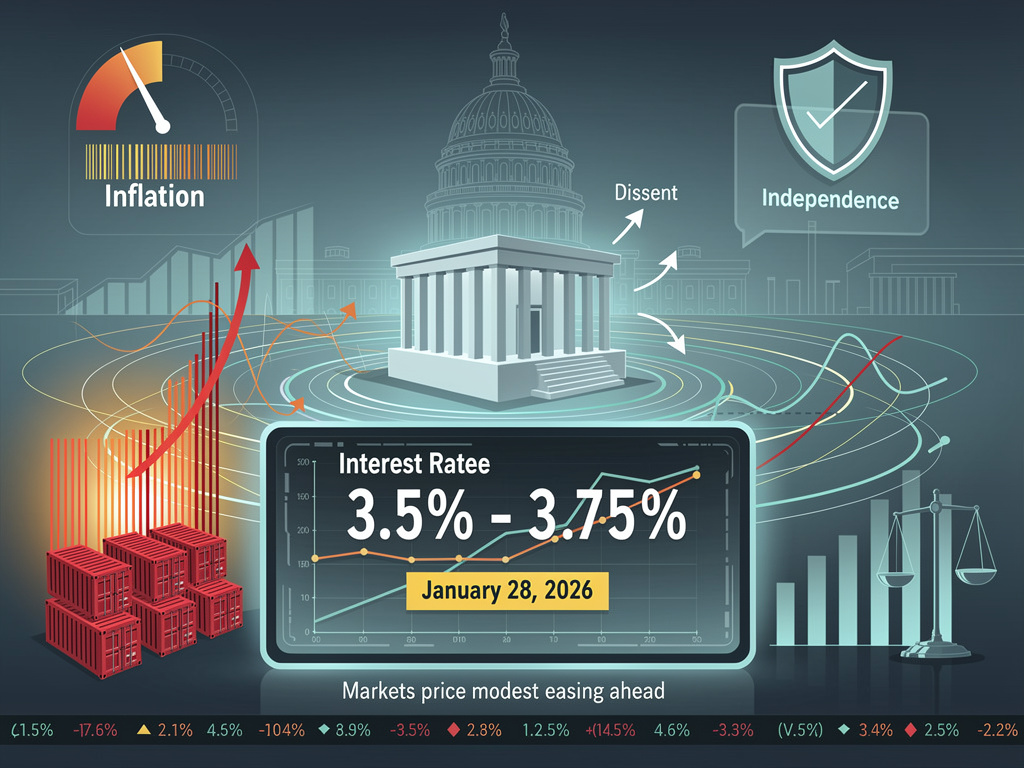
In a move that underscored the Federal Reserve’s resolve amid mounting political headwinds, the Federal Open Market Committee on January 28, 2026, held its benchmark federal funds rate steady at 3.5%-3.75%, pausing after three consecutive quarter-point cuts in late 2025. Chair Jerome Powell, facing scrutiny over his impending successor and a Justice Department probe, emphasized data-driven decisions during his post-meeting press conference. “The economy has once again surprised us with its strength, not for the first time,” Powell remarked, as reported by The New York Times.
The decision aligned with market expectations but revealed deepening divisions within the FOMC. Governors Stephen Miran and Christopher Waller dissented, advocating for another 25 basis-point reduction, marking the sixth straight meeting with dissents. For Miran, this represented a shift from prior calls for half-point cuts. Powell noted broad support for the hold, stating there was “broad support on the committee” for maintaining rates, according to CNBC.
Persistent Inflation and Tariff Shadows
FOMC projections highlighted inflation’s stubborn persistence, described as “somewhat elevated” after moving up since earlier in the year. Policymakers attributed much of the overshoot to tariffs, with Powell clarifying, “It’s really tariffs that are causing most of the inflation overshoot,” expecting a one-time price increase to fade by mid-2026, per LiveMint. The statement reflected solid growth forecasts, a stabilizing labor market constrained by lower immigration and steady participation rates, and muted layoffs.
The Fed’s outlook pointed to 2026 GDP growth at 2.3%, unemployment steady at 4.4%, and core PCE inflation easing to 2.5%, upgrades from prior estimates that justified the pause. “We’re well positioned to wait and see how the economy evolves from here,” Powell had signaled in December, a stance reinforced Wednesday, as covered by The Guardian.
Political Crosswinds Test Independence
Powell’s press conference dodged queries on White House tensions five times with variations of “I have nothing for you on that.” Pressed on advice for his May successor—amid President Trump’s search narrowing to candidates like Kevin Hassett or Kevin Warsh—Powell advised, “Stay out of elected politics.” This came days after he labeled a criminal probe into Fed renovations a “pretext” for pressuring rates lower, declaring, “The threat of criminal charges is a consequence of the Federal Reserve setting interest rates based on our best assessment of what will serve the public,” via the Federal Reserve.
The Supreme Court’s recent arguments on Trump’s bid to remove Governor Lisa Cook amplified independence concerns. Yet Powell affirmed, “Monetary policy is not on a preset course. We will make our decisions on a meeting-by-meeting basis,” per CNBC. Economists noted the Fed’s firm footing: “The hurdle to additional cuts has been raised under Chair Powell’s watch,” as Investopedia quoted analysts.
Market Reactions Signal Cautious Optimism
Major stock indexes ended little changed, with traders pricing a 60% chance of two more quarter-point cuts in 2026, per CNBC. Gold surged to record highs near $5,300 as a hedge against uncertainty, while futures eyed a potential June cut. “The Fed delivered a rate cut, but it arrived in a somewhat hawkish package,” said Ellen Zentner of Morgan Stanley Wealth Management.
Charlie Ripley of Allianz Investment Management viewed it as affirmation: “Labor conditions are not worsening, growth has accelerated and inflation has steadied for now. Policy rates are much closer to neutral.” On X, users echoed the pause’s significance, with posts highlighting the 10-2 vote and tariff impacts.
Projections Point to Measured Path Ahead
Though no new dot plot emerged this meeting, December’s median envisioned one 2026 cut to 3.25%-3.5%, aligning with neutral estimates. Powell stressed, “We haven’t made any decisions about future meetings, but the economy is growing at a solid pace,” as in Yahoo Finance. Risks balanced upside for inflation and unemployment, complicating further easing.
Wall Street anticipates a prolonged hold unless labor data softens markedly. Heather Long of Navy Federal Credit Union called it “détente at the Fed for now. But a shakeup is coming with the new Fed Chair in May.” The FOMC’s balance sheet expansion via short-term Treasury purchases aims to maintain ample reserves, signaling no reversal on normalization.
Dissenters and Data Dependency
Miran’s dissent evolved from aggressive easing calls, while Waller’s push reflected dovish concerns over job gains averaging just 40,000 monthly—potentially revised lower. Powell cautioned on revisions: “That figure could be revised lower by as much as 60,000,” implying net job losses, from PBS News.
“What you see is some people feel we should stop here and that we’re at the right place and just wait,” Powell described internal debates. Upcoming jobs reports will test this stance, with markets watching for cracks in the labor stasis amid tariff-driven price pressures.


 WebProNews is an iEntry Publication