
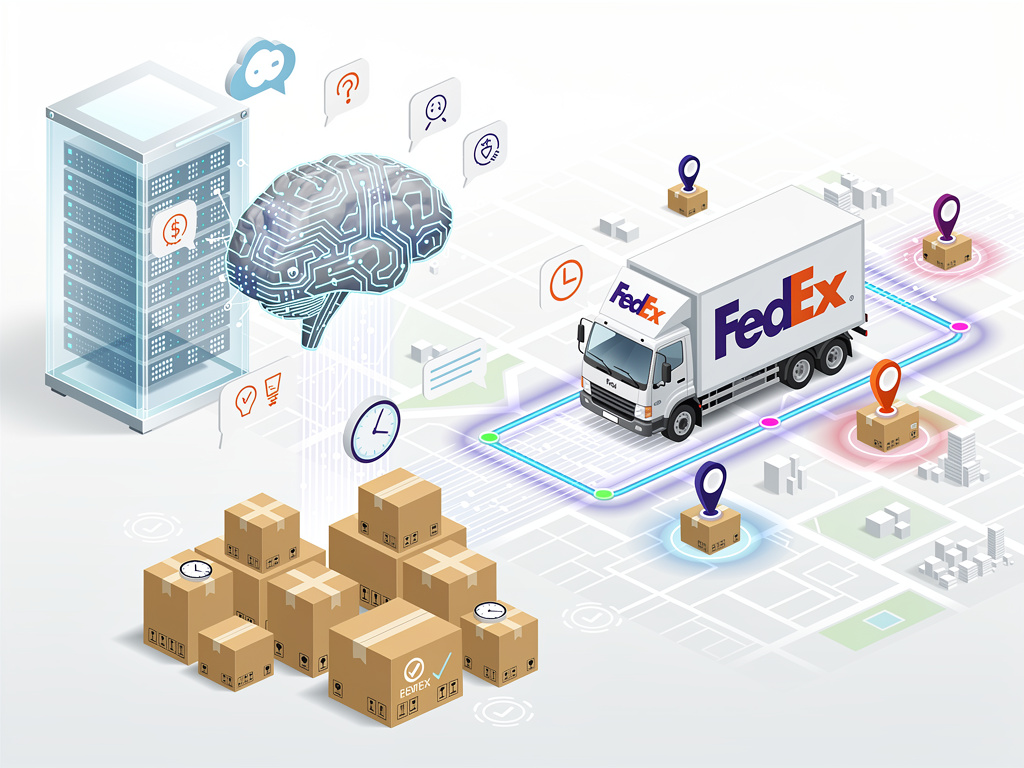
FedEx Corp. is rolling out a suite of artificial intelligence tools designed to transform how customers navigate the complexities of last-mile delivery, marking the logistics giant’s most significant investment yet in generative AI technology to address the industry’s most persistent operational challenge. The initiative, announced in early 2025, positions FedEx at the forefront of a broader industry shift toward AI-powered customer service solutions that promise to reduce costs while improving delivery precision during the critical final leg of package journeys.
According to Customer Experience Dive, the new AI-powered tools will enable customers to receive instant, intelligent responses to queries about delivery times, package locations, and potential delays without human intervention. The system leverages large language models trained on FedEx’s decades of logistics data, customer interaction patterns, and real-time operational information to provide contextually relevant answers that previously required customer service representatives to manually research and respond.
The timing of FedEx’s AI deployment reflects mounting pressure across the logistics sector to optimize last-mile operations, which typically account for 53% of total shipping costs according to industry analyses. By automating customer inquiries related to this expensive final delivery stage, FedEx aims to simultaneously reduce call center expenses and improve customer satisfaction scores that have become increasingly important differentiators in the competitive parcel delivery market.
The Technology Behind FedEx’s AI Customer Service Revolution
FedEx’s new AI infrastructure integrates natural language processing capabilities with the company’s existing operational systems, creating what executives describe as a “digital delivery assistant” capable of understanding complex customer questions and providing actionable information. The system can interpret queries ranging from simple tracking requests to nuanced questions about delivery exceptions, address changes, and special handling requirements that have traditionally required human expertise to resolve.
The AI tools represent a significant evolution from FedEx’s earlier chatbot implementations, which relied on predetermined response trees and keyword matching. The new generative AI system can understand context, anticipate follow-up questions, and even proactively alert customers to potential delivery issues before they escalate into service failures. This predictive capability draws on machine learning algorithms that analyze historical delivery patterns, weather data, traffic conditions, and facility capacity constraints to forecast potential disruptions.
Industry Context: The Last-Mile Delivery Challenge
Last-mile delivery has emerged as the logistics industry’s most vexing challenge, combining high costs with elevated customer expectations for speed, flexibility, and communication. The proliferation of e-commerce has exponentially increased package volumes while simultaneously fragmenting delivery destinations across residential areas where route density is lower and delivery attempts are more likely to fail due to customer unavailability.
FedEx’s AI initiative addresses a fundamental tension in modern logistics: customers demand Amazon-like visibility and responsiveness, but achieving that level of service traditionally requires substantial human capital investment in customer service operations. By deploying AI to handle routine inquiries and provide real-time delivery intelligence, FedEx is attempting to scale its customer service capabilities without proportionally increasing headcount—a strategy that could yield significant margin improvements if successfully executed.
Competitive Implications and Market Positioning
FedEx’s move into AI-powered customer service follows similar investments by competitors seeking technological advantages in an industry where service differentiation is increasingly difficult to achieve. United Parcel Service has deployed machine learning algorithms to optimize route planning and predict package flow, while Amazon has invested heavily in AI across its logistics network, from warehouse robotics to delivery route optimization and customer communication systems.
The strategic importance of AI in logistics extends beyond operational efficiency to customer retention and market share defense. In an era where shippers can easily compare service levels and costs across carriers, the ability to provide superior delivery visibility and proactive communication creates tangible competitive advantages. FedEx’s AI tools are designed to reduce the friction points that drive customers to competitors, particularly around delivery exceptions and the need to contact customer service for basic information.
Implementation Strategy and Rollout Timeline
FedEx is taking a phased approach to deploying its AI customer service tools, initially focusing on high-volume inquiry categories where automation can deliver immediate value. The company is prioritizing queries related to delivery status updates, estimated arrival times, and address corrections—categories that currently consume significant customer service resources while offering relatively straightforward resolution paths that AI can reliably handle.
The implementation strategy includes substantial guardrails to ensure AI responses maintain accuracy and avoid the hallucination problems that have plagued some generative AI deployments in customer-facing roles. FedEx has built verification layers that cross-reference AI-generated responses against authoritative data sources within its operational systems, and the company maintains human oversight for complex scenarios where AI confidence levels fall below predetermined thresholds.
Operational Impact on Customer Service Infrastructure
The introduction of AI tools is reshaping FedEx’s customer service organization, though company officials emphasize the technology is designed to augment rather than replace human agents. Customer service representatives are being repositioned to handle escalated issues, complex problem-solving scenarios, and situations requiring empathy and judgment that AI systems cannot yet replicate. This workforce transition reflects broader patterns across industries deploying generative AI, where automation handles routine tasks while humans focus on higher-value interactions.
Early internal metrics suggest the AI tools are successfully deflecting a significant percentage of routine inquiries from human agents, though FedEx has not publicly disclosed specific volume reductions or cost savings. Industry analysts estimate that successful AI deployment in customer service operations could reduce per-contact costs by 30-50% for routine inquiries while simultaneously improving response times and availability, since AI systems can handle unlimited concurrent conversations without wait times.
Data Privacy and Security Considerations
FedEx’s AI implementation raises important questions about data handling and privacy, particularly given the sensitive nature of delivery information and customer communication. The company has stated that its AI systems operate within existing data governance frameworks and comply with privacy regulations including GDPR and CCPA, but the use of customer interaction data to train and improve AI models represents a new dimension of data utilization that some privacy advocates view with concern.
The AI tools process substantial amounts of customer data, including delivery addresses, contact information, communication preferences, and historical interaction patterns. FedEx has implemented data minimization principles that limit AI access to information necessary for responding to specific queries, and the company maintains that customer data used in AI training is anonymized and aggregated to prevent individual identification. However, the effectiveness of these protections and the potential for data breaches or misuse remain ongoing concerns as AI systems become more deeply integrated into customer-facing operations.
Financial Implications and Investor Perspective
From an investor standpoint, FedEx’s AI investments represent both opportunity and risk. Successfully automating customer service operations could generate substantial margin expansion at a time when the company faces pressure to improve profitability amid moderating e-commerce growth rates and intense competitive pressure. Analysts view AI deployment as essential for FedEx to maintain cost competitiveness against rivals who are making similar technology investments.
However, the financial benefits of AI deployment will take time to materialize and require sustained investment in technology infrastructure, data systems, and organizational change management. FedEx has not disclosed specific capital expenditure figures for its AI initiatives, but industry observers estimate that comprehensive AI deployment across customer service operations could require investments in the hundreds of millions of dollars when accounting for technology licensing, system integration, training data development, and workforce transition costs.
Future Directions and Technology Evolution
FedEx’s current AI deployment represents an initial phase in what company executives envision as a multi-year transformation of customer interaction and operational intelligence. Future iterations of the technology are expected to incorporate more sophisticated predictive capabilities, including AI systems that can anticipate customer needs based on shipping patterns, proactively suggest delivery alternatives before problems arise, and integrate with customers’ own systems to automate shipping decisions and exception handling.
The evolution of FedEx’s AI capabilities will likely expand beyond customer service into adjacent areas including pricing optimization, capacity planning, and network design. Machine learning algorithms are increasingly capable of identifying patterns and optimization opportunities that human analysts might miss, potentially unlocking efficiency gains across FedEx’s vast operational network. The company’s ability to leverage AI across multiple business functions will significantly influence its competitive position and financial performance in coming years, making the current customer service deployment an important proof point for broader AI strategy execution.


 WebProNews is an iEntry Publication