
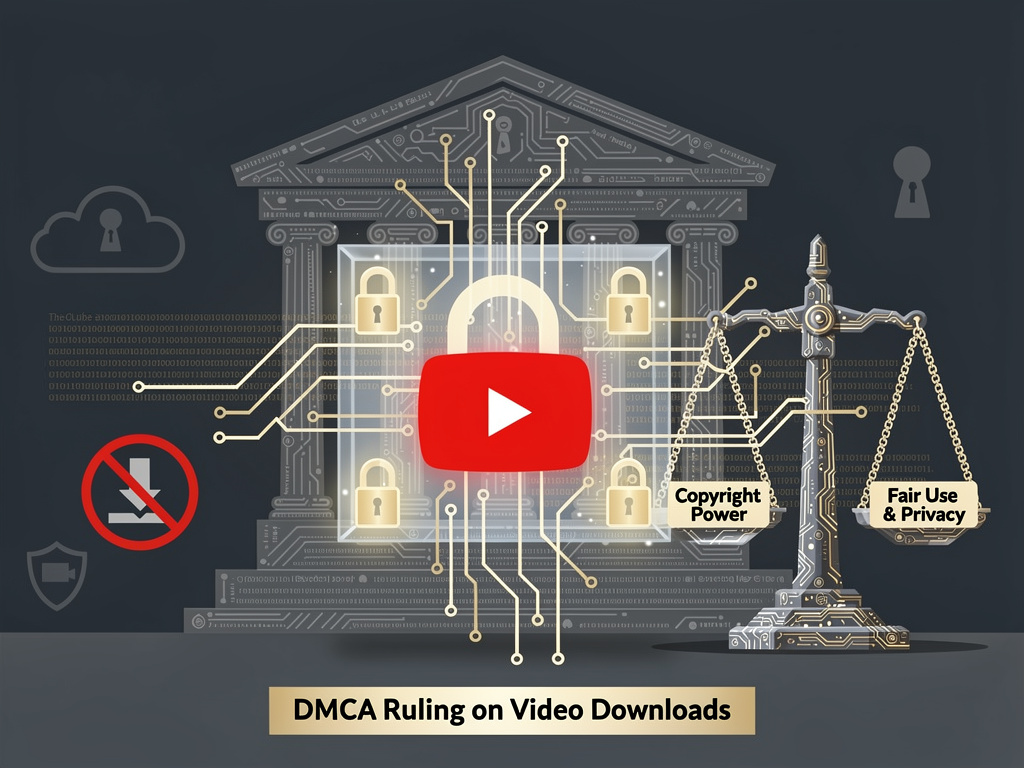
A recent federal court decision has sent ripples through the technology industry, establishing new precedent for how copyright law applies to tools that download and convert YouTube videos. The ruling, which determined that circumventing YouTube’s technological protections can constitute a violation of the Digital Millennium Copyright Act (DMCA), marks a significant expansion of copyright holders’ power to control how their content is accessed and used online.
According to Slashdot, the court’s interpretation hinges on Section 1201 of the DMCA, which prohibits the circumvention of technological measures that control access to copyrighted works. The decision represents a departure from how many technology advocates and legal scholars have traditionally understood the scope of this provision, particularly as it applies to content that is freely accessible on streaming platforms.
The case centers on software tools commonly known as YouTube rippers or downloaders, which allow users to save videos from YouTube’s platform to their local devices, often converting them to different formats such as MP3 audio files. While these tools have existed for years and are widely used by millions of people worldwide, copyright holders have increasingly sought legal remedies to shut them down, arguing that they facilitate piracy and undermine legitimate streaming revenue.
The Technical Mechanisms at the Heart of the Dispute
YouTube employs various technological measures designed to control how users access and interact with content on its platform. These include encryption protocols, dynamic URL generation, and rolling cipher systems that make it difficult for third-party tools to reliably extract video files. The court’s ruling suggests that bypassing these technical barriers, even for content that appears publicly available, constitutes unlawful circumvention under the DMCA.
This interpretation has significant implications for how we understand the concept of access control in the digital age. Unlike traditional forms of copy protection that might encrypt a DVD or require a password to unlock content, YouTube’s measures don’t prevent initial viewing—they simply restrict the ability to download and retain copies. The court’s decision effectively expands the definition of access control to include mechanisms that govern how content can be consumed, not just whether it can be accessed at all.
Technology industry observers note that this reasoning could have far-reaching consequences beyond YouTube downloaders. If courts broadly interpret technological measures to include any system that shapes user interaction with digital content, a wide range of tools and services could potentially fall under DMCA scrutiny. This includes browser extensions, archival tools, accessibility software, and research applications that interact with online platforms in ways their operators might not have intended.
The Historical Context of DMCA Section 1201
When Congress passed the DMCA in 1998, the primary concern was preventing piracy of physical media like DVDs and software CDs. Section 1201’s anti-circumvention provisions were designed to protect the encryption and access control systems on these products. However, the law’s language was written broadly enough to adapt to future technologies, which has led to ongoing debates about its proper scope and application.
Over the past two decades, copyright holders have increasingly invoked Section 1201 in contexts far removed from the traditional piracy concerns that motivated the law’s passage. These cases have involved everything from printer cartridges and garage door openers to video game consoles and agricultural equipment. Critics argue that this expansion has transformed the DMCA from an anti-piracy tool into a mechanism for controlling competition and consumer behavior.
The YouTube ripper case fits into this broader pattern of DMCA expansion, but with unique characteristics that make it particularly significant. Unlike cases involving physical products or software applications, this ruling addresses content that is intentionally made available for free streaming to the general public. The copyright holders aren’t arguing that the ripping tools enable access to content that users couldn’t otherwise view—they’re arguing that these tools enable a form of access that violates the platform’s intended usage model.
Fair Use and Personal Archiving in the Digital Era
One of the most contentious aspects of the ruling involves its implications for fair use rights and personal archiving. Many users of YouTube downloading tools argue that they’re simply exercising their legal right to make personal copies of content for legitimate purposes such as offline viewing, educational use, or preservation of publicly available material that might later be deleted.
The DMCA includes exemptions for certain activities, and the Library of Congress periodically reviews and updates the list of permissible circumvention activities. However, these exemptions are narrow and subject to a complex rulemaking process that occurs only once every three years. The current exemptions don’t clearly cover downloading YouTube videos for personal use, leaving users in a legal gray area.
Legal scholars have long debated whether the DMCA’s anti-circumvention provisions improperly restrict fair use rights. The Copyright Act grants users certain privileges to use copyrighted material without permission for purposes such as criticism, commentary, education, and research. However, if accessing that material requires circumventing a technological protection measure, users may be liable under the DMCA even if their ultimate use of the content would qualify as fair use.
The Business Model Implications for Content Platforms
The court’s decision reinforces YouTube’s control over how content on its platform is consumed, which has significant business implications. YouTube’s revenue model depends on serving advertisements alongside video content and collecting data about viewing habits. When users download videos to watch offline, they circumvent this advertising-based business model, potentially depriving both YouTube and content creators of revenue.
Content creators on YouTube have mixed reactions to downloading tools. Some view them as threats to their ability to monetize their work, while others see them as relatively harmless given that their primary revenue comes from views on the platform itself. Many creators also recognize that downloading tools can serve legitimate purposes, such as allowing fans to preserve content or watch videos in areas with limited internet connectivity.
The ruling may embolden other streaming platforms to pursue similar legal strategies against tools that enable downloading or circumvent their intended usage models. Services like Netflix, Spotify, and Disney+ already employ sophisticated digital rights management systems, but this precedent could provide additional legal ammunition to enforce their terms of service and protect their business models from third-party interference.
International Dimensions and Enforcement Challenges
YouTube downloading tools are often operated by entities located outside the United States, which complicates enforcement of U.S. court rulings. Many of these services are based in jurisdictions with different copyright laws and limited cooperation with U.S. legal authorities. Even when courts issue injunctions or damages awards, actually shutting down these services and collecting judgments remains challenging.
The global nature of the internet means that even if YouTube ripper sites are blocked or shut down in the United States, they often remain accessible through various technical means. Users can employ virtual private networks (VPNs), proxy servers, or simply access mirror sites hosted in other countries. This creates a whack-a-mole situation where copyright enforcement becomes an ongoing battle rather than a problem that can be definitively solved through litigation.
Different countries take varying approaches to the legality of downloading streaming content for personal use. Some European nations have private copying levies that effectively legalize certain types of personal copying, while others have stricter rules that align more closely with U.S. copyright law. This patchwork of international regulations creates confusion for both users and service providers operating in a global digital environment.
The Technical Arms Race Between Platforms and Downloaders
The legal battle over YouTube ripping tools mirrors a parallel technical arms race between platforms seeking to prevent downloading and developers creating tools to circumvent those protections. YouTube regularly updates its systems to break compatibility with downloading tools, while tool developers quickly adapt their software to work around the new protections. This cycle has been ongoing for years and shows no signs of stopping.
From a technical perspective, completely preventing downloads of streaming video is fundamentally difficult because the content must ultimately be delivered to the user’s device in a format that can be rendered and displayed. Once video data reaches a user’s computer, determined individuals with sufficient technical knowledge can always find ways to capture and save it, even if that requires screen recording or other less elegant solutions.
The court’s ruling may intensify this technical arms race by providing stronger legal backing for platforms’ technological protection measures. However, it’s unclear whether legal victories will translate into practical success in preventing downloads. The history of digital rights management suggests that determined users and developers often find ways around even the most sophisticated protection systems, and that legal threats alone are insufficient to eliminate unwanted behaviors.
Privacy and Data Collection Concerns
An often-overlooked aspect of the YouTube downloading debate involves privacy and data collection. When users stream content directly through YouTube, the platform collects extensive data about viewing habits, preferences, and behaviors. This data is valuable for targeted advertising and platform optimization, but it also raises privacy concerns for users who may prefer to minimize their digital footprint.
Some users turn to downloading tools specifically to avoid the tracking and data collection associated with streaming platforms. By downloading videos and watching them offline, these users can enjoy content without contributing to the vast data profiles that companies like Google compile. The court’s ruling effectively limits this privacy-preserving option, potentially forcing users to choose between accessing content and maintaining their privacy preferences.
The tension between copyright enforcement and privacy rights represents a broader challenge in digital policy. As platforms increasingly rely on data collection and behavioral tracking to support their business models, users have limited options for accessing content in ways that protect their privacy. Legal decisions that strengthen platforms’ control over content consumption may inadvertently reduce user privacy and autonomy in the digital sphere.
Looking Forward: Industry Response and Potential Legislative Action
The technology industry’s response to this ruling has been mixed, with some companies supporting stronger copyright enforcement while others worry about the precedent it sets for innovation and user rights. Trade associations representing technology companies have generally advocated for more balanced approaches to copyright that preserve space for legitimate innovation and fair use.
There have been periodic calls for Congress to revisit and reform the DMCA, particularly Section 1201’s anti-circumvention provisions. Critics argue that the law has been stretched far beyond its original intent and that it now impedes legitimate activities ranging from security research to accessibility accommodations. However, copyright reform remains politically challenging, with powerful entertainment industry lobbying groups defending the current framework and opposing changes that might weaken enforcement mechanisms.
In the absence of legislative action, courts will continue to shape the boundaries of digital copyright through case-by-case adjudication. This ruling on YouTube ripping tools represents one data point in an evolving body of law, but it’s unlikely to be the final word on these issues. As technology continues to advance and new forms of content delivery emerge, courts will face ongoing challenges in applying decades-old statutes to novel situations that their drafters never anticipated.


 WebProNews is an iEntry Publication