
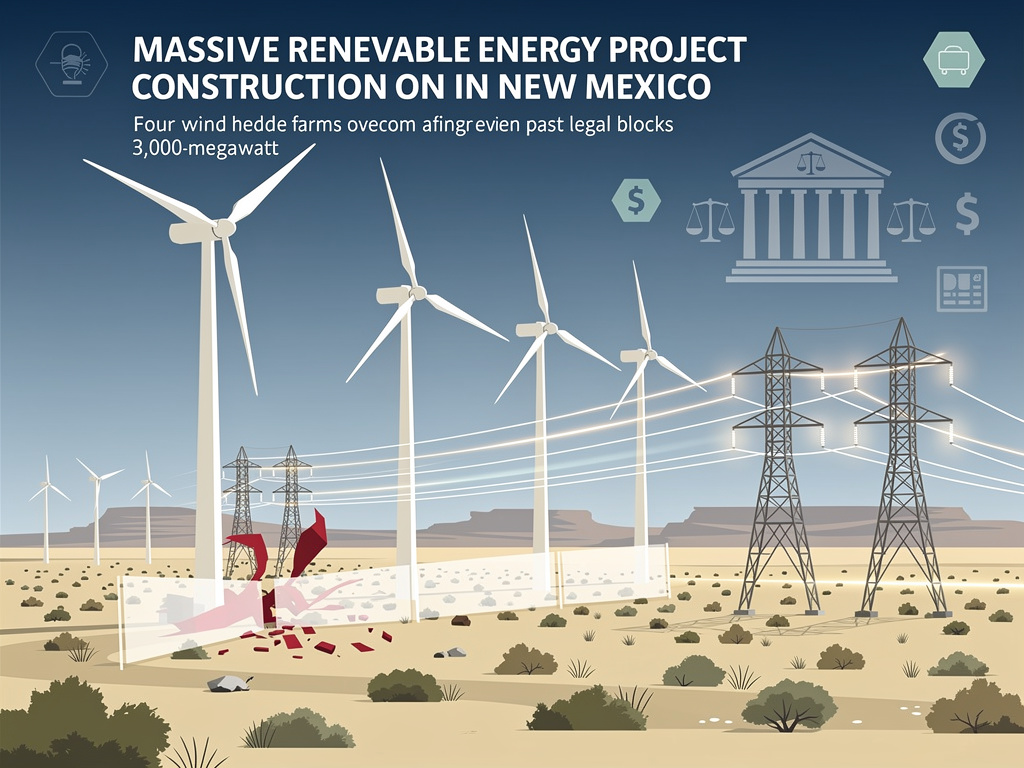
In a significant development for the renewable energy sector, a federal judge has allowed the SunZia Wind project in New Mexico to resume construction, marking the fourth wind farm initiative to overcome recent administrative obstacles imposed by the Trump administration. The decision represents a critical juncture in the ongoing tension between federal energy policy shifts and the momentum of America’s renewable infrastructure buildout, with billions of dollars in private investment and thousands of jobs hanging in the balance.
The SunZia Wind project, a massive renewable energy undertaking designed to generate 3,000 megawatts of wind power, had been halted following directives from the newly reinstated Trump administration to pause federal approvals for wind energy projects. According to Slashdot, the project joins three other wind farms that have successfully challenged administrative blocks through legal channels, underscoring the complexity of unwinding established renewable energy commitments.
The case highlights the intricate web of federal permits, private contracts, and state-level agreements that govern large-scale energy infrastructure projects. Pattern Energy, the developer behind SunZia Wind, had already invested substantial capital and secured numerous regulatory approvals before the administration change, creating a legal framework that proved difficult to simply override through executive action.
Legal Framework Protects Established Projects
Federal judges have consistently ruled that projects with completed environmental reviews and issued permits possess strong legal standing to continue operations. The SunZia Wind project had completed its Bureau of Land Management environmental impact statement and received its Record of Decision before the policy shift, establishing vested rights that courts have been reluctant to disturb retroactively.
Legal experts note that the Administrative Procedure Act requires federal agencies to follow established processes when modifying or rescinding permits, preventing arbitrary policy reversals. “The government cannot simply change its mind without following proper procedures and providing adequate justification,” explained environmental law specialists familiar with the cases, though they requested anonymity due to the politically sensitive nature of the proceedings.
Economic Implications Extend Beyond Energy Sector
The SunZia Wind project represents more than just renewable energy generation; it embodies a complex ecosystem of economic commitments spanning multiple states and involving thousands of workers. The associated SunZia Transmission project, which will carry the generated electricity across the Southwest, has already broken ground on what will become one of the longest high-voltage transmission lines in the Western United States.
Construction contractors, equipment manufacturers, and local communities have structured their operations around the project’s timeline. The temporary halt created immediate financial pressures on companies that had hired workers and ordered specialized equipment with long lead times. Supply chain experts estimate that even brief delays in projects of this magnitude can cascade into hundreds of millions of dollars in additional costs.
Pattern Energy’s Strategic Position
Pattern Energy, a major player in renewable energy development, has positioned the SunZia project as a cornerstone of its North American portfolio. The company has secured long-term power purchase agreements with utilities and corporate buyers seeking to meet renewable energy commitments, creating contractual obligations that extend far beyond the immediate political environment.
Industry analysts suggest that the legal victories for SunZia and similar projects reflect the maturation of the renewable energy sector. Unlike earlier wind projects that faced uncertain market conditions, contemporary developments operate within established regulatory frameworks and benefit from proven technologies that have achieved cost parity with conventional generation sources in many markets.
Regional Development and Grid Modernization
The SunZia project’s significance extends to regional economic development in New Mexico, where wind energy has emerged as a crucial economic driver in rural communities. The project will generate substantial property tax revenue for local governments and create permanent operations jobs in addition to the temporary construction workforce.
Grid operators have incorporated the SunZia generation capacity into long-term planning scenarios, recognizing the project’s role in diversifying the Southwest’s energy mix and enhancing grid resilience. The project’s transmission infrastructure will also provide additional capacity for future renewable energy development, creating a platform for continued clean energy expansion.
Administrative Challenges and Policy Uncertainty
The Trump administration’s attempt to halt wind projects reflects broader policy objectives to reshape federal energy priorities. However, the legal setbacks demonstrate the limitations of executive power when confronting established regulatory processes and contractual commitments. Federal agencies must navigate complex legal requirements that constrain their ability to implement rapid policy changes.
Energy policy experts note that the current situation creates uncertainty for future renewable energy investments, as developers must now factor in political risk alongside traditional project development challenges. This uncertainty could increase capital costs and slow the pace of new project announcements, even as existing projects like SunZia proceed through legal channels.
Industry Response and Adaptation
The renewable energy industry has responded to the administrative challenges by emphasizing the economic benefits of wind development and the sector’s contribution to American energy independence. Industry groups have highlighted that wind energy now supports hundreds of thousands of jobs across the manufacturing, construction, and operations sectors, with supply chains deeply integrated into the American economy.
Developers are also accelerating efforts to complete environmental reviews and secure permits for projects in the pipeline, recognizing that fully approved projects enjoy stronger legal protection against policy reversals. This rush to achieve regulatory milestones could paradoxically accelerate near-term development activity even as long-term policy uncertainty persists.
Transmission Infrastructure as Strategic Asset
The SunZia Transmission project, intrinsically linked to the wind farm, represents critical infrastructure for the Western grid’s evolution. The 550-mile transmission line will connect New Mexico’s wind resources to Arizona and California markets, addressing the geographic mismatch between renewable resource availability and electricity demand centers.
Transmission infrastructure has emerged as a critical bottleneck for renewable energy expansion, with permitting and construction timelines often exceeding those of generation projects. The SunZia Transmission line’s progress, protected by the same legal frameworks as the wind farm, demonstrates the strategic value of integrated generation and transmission development.
Market Forces and Technology Trends
Beyond the immediate legal and political dynamics, the SunZia project reflects fundamental market forces driving renewable energy adoption. Wind energy costs have declined dramatically over the past decade, making new wind projects economically competitive without subsidies in many regions. Corporate purchasers, motivated by sustainability commitments and long-term price stability, have created robust demand for renewable energy contracts.
Technological advances in turbine design have also enhanced project economics. Modern turbines capture more energy from the same wind resources, improving capacity factors and revenue potential. The SunZia project will deploy state-of-the-art turbine technology, maximizing energy production from New Mexico’s high-quality wind resources.
Looking Forward: Policy and Investment Implications
The legal outcomes for SunZia and similar projects establish important precedents for the relationship between federal energy policy and private infrastructure investment. Courts have signaled that established regulatory processes and property rights will be protected even amid significant policy shifts, providing some stability for long-term capital deployment.
However, the uncertainty surrounding new project approvals could reshape investment patterns in the renewable energy sector. Developers may prioritize projects on private land or in states with supportive policies, reducing federal land development and concentrating activity in particular regions. This geographic shift could have significant implications for rural economic development and the optimal utilization of America’s renewable energy resources. As the SunZia project moves forward, it will serve as both a test case for legal frameworks protecting infrastructure investments and a barometer for the renewable energy sector’s resilience amid political headwinds.


 WebProNews is an iEntry Publication