
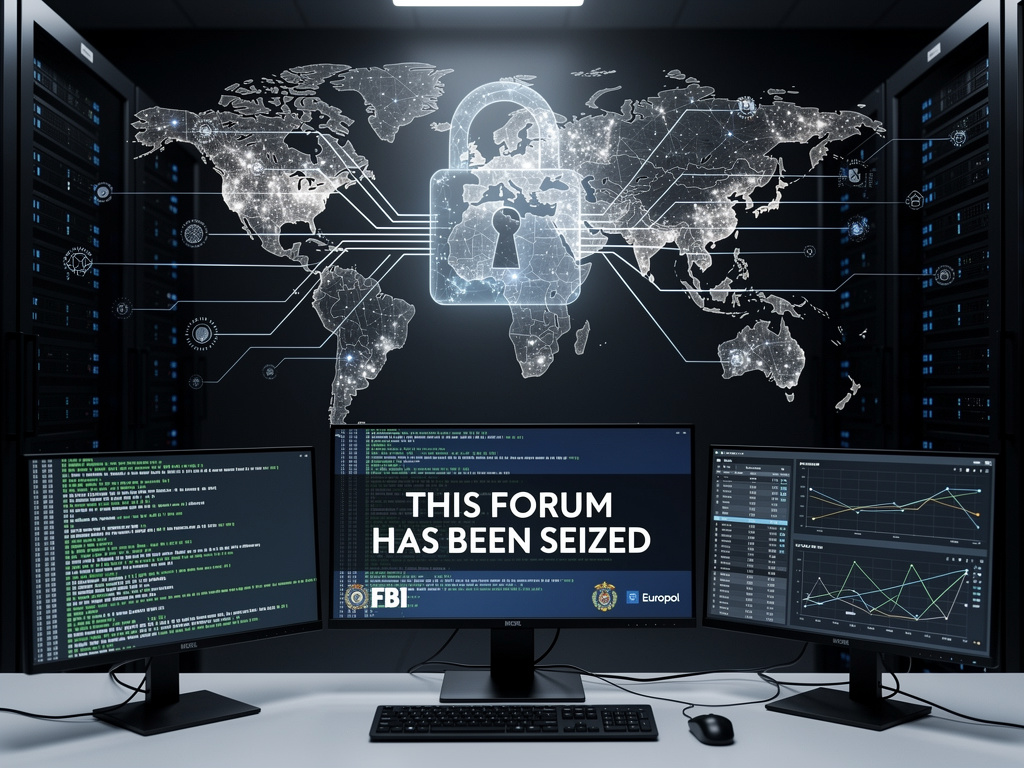
The digital notice plastered across the homepage was stark, blue, and familiar. For the second time in recent history, the Federal Bureau of Investigation, in coordination with Europol and a coalition of international law enforcement agencies, claimed control over a notorious hub of illicit data trade. While the URL in question points to the latest iteration of the underground marketplace ecosystem—often colloquially grouped with predecessors like LeakBase and RaidForums—the reality on the ground signals a significant escalation in the tactics used by the Department of Justice (DOJ) to disrupt the trade of stolen credentials.
This recent operation, which saw the seizure of backend infrastructure belonging to the resurfaced BreachForums (orchestrated by the group ShinyHunters), represents more than a domain suspension. According to reports from The Hacker News, authorities did not merely take the site offline; they successfully infiltrated the server architecture, allowing them to harvest IP addresses, private messages, and transaction logs of the site's user base. This marks a tactical pivot from simple disruption to active intelligence gathering, intended to de-anonymize the thousands of cybercriminals who flocked to the platform following the demise of its predecessors.
The Architecture of a Takedown
The mechanics of this seizure reveal a sophisticated level of international cooperation. The operation involved the FBI, the UK’s National Crime Agency (NCA), and partners across Europe, Australia, and New Zealand. Unlike previous attempts where administrators could quickly restore backups to new servers, this action targeted the operational core. As detailed by BleepingComputer, the law enforcement agencies managed to seize the Telegram channels associated with the forum, a critical communication lifeline that usually survives web-based takedowns. The seizure notice on the Telegram channel mocked the administrators, specifically the persona known as "Baphomet," suggesting that he was in custody and that his devices were under federal analysis.
This psychological warfare is now a standard component of the FBI's strategy. By taking control of the administrators' accounts and posting messages directly to the community, authorities sow distrust among the user base. The message is clear: the platform you trusted was a honeypot, and your data is now in an evidence locker in Virginia. This erodes the fundamental currency of the dark web—trust. When users cannot be certain if they are speaking to a fellow criminal or a federal agent, the liquidity of the stolen data market dries up, if only temporarily.
From LeakBase to BreachForums: A lineage of fragility
To understand the significance of this seizure, one must examine the genealogy of these marketplaces. The original LeakBase closed its doors years ago, allegedly to avoid the fate that befell its peer, Hansa Market. It was followed by RaidForums, which dominated the scene until its seizure and the arrest of its founder, Diogo Santos Coelho, in 2022. BreachForums emerged almost immediately to fill that void, run by Conor Brian Fitzpatrick (known as Pompompurin). Following Fitzpatrick’s arrest, the mantle was picked up by the ShinyHunters group. Each iteration claims to be more secure than the last, yet each eventually falls to the same law enforcement pressure.
The persistence of these forums despite repeated seizures highlights a troubling reality: the demand for stolen data is inelastic. Corporate breaches continue to feed these marketplaces with fresh inventory—social security numbers, corporate espionage documents, and consumer databases. As reported by KrebsOnSecurity, the administrators of these sites often operate with a sense of impunity until the moment the handcuffs click. The ShinyHunters group, for instance, had established a reputation for high-profile breaches, including Ticketmaster and Santander Bank, using the forum to monetize their intrusions immediately.
The Telegram Migration and Fragmentation
A critical outcome of this operation is the acceleration of market fragmentation. When a central hub like BreachForums is compromised, the community does not vanish; it disperses. The immediate reaction is a migration to encrypted messaging platforms like Telegram and Session, or to smaller, invite-only forums on the Tor network (The Onion Router). This fragmentation makes the job of law enforcement harder in the long run. Instead of monitoring a single, central bazaar, investigators must now infiltrate dozens of splintered groups, each with its own vetting processes and security protocols.
However, the seizure of the BreachForums Telegram channel suggests that the FBI has found ways to pierce even these encrypted enclaves. The agency's ability to compromise the administrator's account implies either a physical access to the device (following an arrest) or a successful exploit of the operational security (OpSec) mistakes made by the operators. It serves as a stark warning that moving to an encrypted app is no longer a guarantee of safety for cybercriminals.
The Role of International Jurisdiction
The cross-border nature of these crimes necessitates the heavy involvement of Europol. Data stolen from a French corporation might be hosted on servers in Moldova, sold by a Russian broker to a buyer in the United States. The legal frameworks allowing for the synchronized seizure of infrastructure across multiple countries have matured significantly over the last five years. The Department of Justice emphasized that this was not just a U.S. operation; the servers were located in various jurisdictions, requiring mutual legal assistance treaties (MLATs) to be invoked rapidly to prevent data destruction.
This synchronization allows agencies to execute "Operation Power Off" style maneuvers, where the infrastructure is dismantled simultaneously to prevent the admins from triggering kill switches. The timing is critical. If one server is seized hours before another, the administrators have time to wipe logs or migrate to backup domains. The success of this recent seizure indicates that the communication channels between the FBI, the NCA, and Europol have become highly efficient, operating in real-time rather than through slow bureaucratic channels.
Analyzing the data fallout
The true value of this operation lies in the backend database. While the public sees a splash page, the FBI possesses the transaction history of every user who purchased data on the site. This includes cryptocurrency wallet addresses, which can be traced on the blockchain to identify real-world identities. In previous cases, such as the Silk Road or AlphaBay takedowns, this financial trail led to waves of arrests months or even years after the initial seizure.
For cybersecurity professionals and Chief Information Security Officers (CISOs), this seizure offers a brief respite but no permanent solution. The stolen data that was hosted on the forum has likely already been downloaded by hundreds of threat actors. It remains in circulation, recycled into credential stuffing lists and phishing campaigns. The immediate benefit is the disruption of the sale of new data, forcing threat actors to find new, less established venues to monetize their breaches, which increases their risk of exposure.
The Inevitable Resurrection
History suggests that a replacement is already in development. The barrier to entry for creating a leak forum is technically low; the challenge lies in building reputation and trust. New administrators will emerge, claiming to have "bulletproof" hosting and better OpSec than their predecessors. They will likely employ decentralized hosting technologies or rely more heavily on peer-to-peer networks to avoid the single point of failure that centralized forums represent.
The cycle of seizure and rebirth is a feature, not a bug, of the cybercrime underground. Law enforcement agencies are aware that they cannot arrest their way out of this problem entirely. Instead, their strategy focuses on increasing the cost of doing business. By making it dangerous to be an administrator and risky to be a buyer, they suppress the market's growth and deter lower-level actors who might otherwise be tempted to participate in the data trade.


 WebProNews is an iEntry Publication