
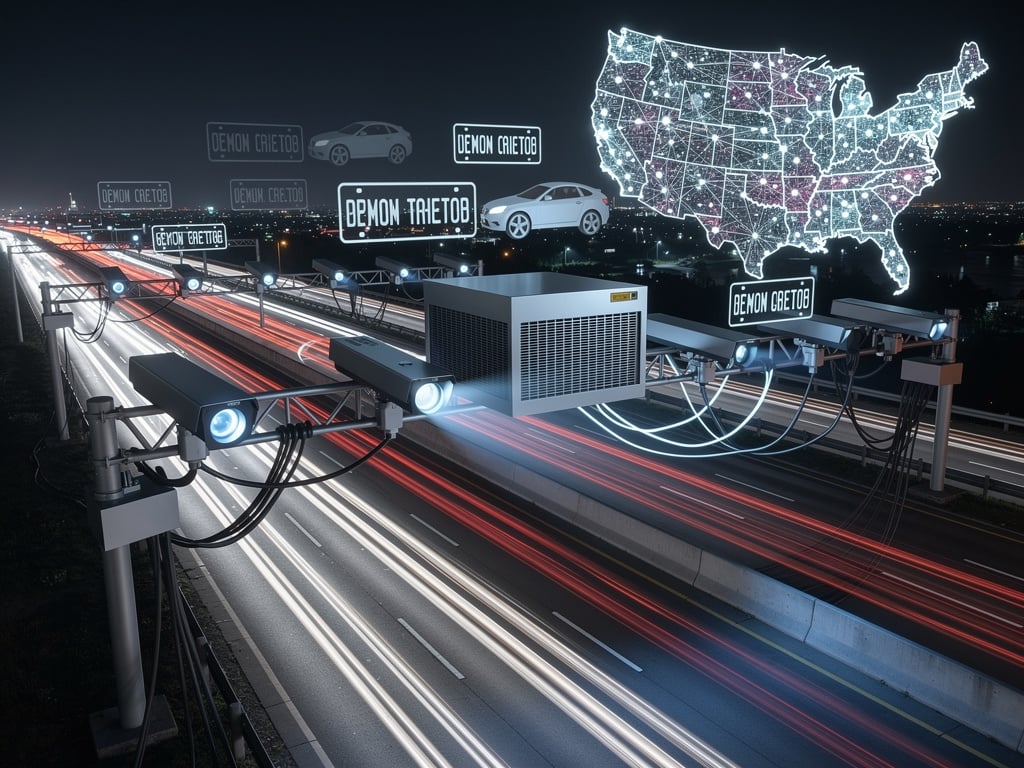
The FBI has issued a formal request for information seeking vendors that can supply direct access to a nationwide network of automated license plate readers. According to a detailed statement of work published by 404 Media, the agency wants the ability to query billions of historical records and receive near real-time alerts when specific vehicles appear in camera feeds across the United States. The document, available on DocumentCloud, outlines technical specifications that reveal the scale of surveillance the bureau envisions.
Automated license plate reader systems combine high-speed cameras with optical character recognition software to capture and store every license plate that passes within view. Private companies and local law enforcement agencies have deployed these cameras on roadsides, bridges, toll plazas, and parking facilities for years. The resulting databases contain location histories that stretch back for months or even years, creating digital trails of vehicle movements that privacy advocates have long criticized as warrantless mass surveillance.
The FBI’s request specifies that the chosen vendor must maintain a database with at least 30 billion records spanning a five-year period. Officials want to search this archive by license plate number, partial plate, state of registration, and date ranges. Beyond historical queries, the bureau demands the ability to set up automated notifications. When a target vehicle triggers any connected camera, the system should push an alert containing the plate number, timestamp, GPS coordinates, and a link to the captured image. The statement of work indicates that the FBI expects these alerts to arrive within 60 seconds in most cases, with 90 percent of notifications delivered no later than two minutes after capture.
Vendors must also guarantee coverage across all fifty states and the District of Columbia. The request lists specific performance metrics for urban, suburban, and rural environments, acknowledging that camera density varies dramatically between densely populated corridors and remote highways. To meet these standards, the contractor would likely need to aggregate data from thousands of individual law enforcement agencies, private security firms, and commercial data brokers that operate their own networks. This aggregation model raises immediate questions about data ownership, chain of custody, and the legal authority under which private entities share location information with federal investigators.
The document reveals that the FBI intends to integrate the license plate data into its existing investigative workflows. Agents would access the system through a secure web portal that supports both individual lookups and bulk queries. The bureau also wants the option to export results in standard formats for inclusion in case files or analytical software. Training requirements listed in the statement of work suggest that hundreds of personnel across multiple field offices will receive accounts, indicating the technology would become a routine tool rather than an exceptional resource reserved for major cases.
Privacy advocates expressed immediate concern after the request became public. Organizations that track government surveillance have argued for years that license plate readers generate sensitive movement data without individualized suspicion. A vehicle’s location history can reveal visits to medical clinics, places of worship, political meetings, or private residences. When aggregated at national scale and retained for five years, such records create comprehensive profiles of daily life that extend far beyond traffic enforcement or criminal investigation.
The FBI’s interest in commercial license plate networks is not entirely new. Court records and previous procurement documents show that federal agencies have purchased access to similar databases on a case-by-case basis for more than a decade. What distinguishes the current request is its ambition to create a standing, always-available connection rather than submitting sporadic requests to multiple vendors. By seeking a single nationwide feed, the bureau aims to reduce friction, accelerate response times, and normalize the practice of querying vast troves of location data.
Technical specifications in the statement of work also address data accuracy and error rates. The FBI requires that the system correctly read at least 85 percent of plates under normal conditions and maintain detailed logs of every query and alert. These audit trails would presumably allow supervisors to review usage patterns, although the document does not specify how often such reviews would occur or who outside the FBI would have oversight authority. The request further demands that the vendor maintain redundancy across multiple data centers so that service interruptions remain below one hour per year.
Commercial operators of license plate reader networks have marketed their products to law enforcement as powerful crime-fighting instruments. Proponents point to successes in recovering stolen vehicles, locating missing persons, and identifying suspects in hit-and-run collisions. They argue that cameras serve as digital witnesses that never sleep and can place a vehicle at a crime scene with objective precision. Yet these same systems have also documented patterns of police departments using them to monitor political protests, track abortion clinic visitors, and compile lists of vehicles at gun shows or religious gatherings.
Legal scholars continue to debate whether prolonged collection and retention of license plate data triggers Fourth Amendment protections. Some federal courts have ruled that individuals have no reasonable expectation of privacy in their license plates because vehicles operate on public roads where anyone can observe them. Other judges have expressed discomfort with the idea that constant recording creates a mosaic of movement data that reveals far more than any single observation. The Supreme Court has not yet issued a definitive ruling on automated license plate readers at national scale, leaving agencies to operate in a gray area while technology advances faster than case law.
The FBI request arrives at a moment when public scrutiny of law enforcement technology has intensified. Recent years have seen sustained debate over facial recognition, predictive policing algorithms, and cellphone location tracking. License plate readers occupy an unusual position in these discussions because the data they collect is simultaneously mundane and deeply revealing. A single plate scan might seem trivial, but thousands of scans over months can expose relationships, routines, and associations that individuals consider private.
If the FBI moves forward with a contract, the chosen vendor will occupy an unusual position of power. Private companies would control the infrastructure that feeds federal investigations, raising questions about accountability and potential mission creep. The statement of work does not address whether the vendor could sell access to the same data to other customers simultaneously, including corporations, insurance companies, or foreign governments. Nor does it specify whether the FBI would receive preferential treatment or exclusive features unavailable to local police departments that also pay for access.
Budget figures are not disclosed in the request for information, but the scale described suggests a multimillion-dollar annual commitment. Maintaining real-time connections to cameras across the continent, storing tens of billions of records, and delivering sub-two-minute alerts requires substantial computing resources and network bandwidth. The FBI would likely classify the exact cost as sensitive procurement information, shielding it from routine public disclosure.
Law enforcement agencies at every level already use license plate readers extensively. Municipal police departments deploy them on patrol cars and fixed poles to generate leads in property crimes and outstanding warrants. State highway patrols use them at weigh stations and rest areas to identify commercial vehicles with expired registrations or safety violations. The federal request envisions building upon this existing infrastructure rather than creating a parallel government-owned network, which would be prohibitively expensive and logistically complex.
Critics worry that easy access to nationwide data will encourage fishing expeditions rather than targeted investigations. With a few keystrokes, agents could map the movements of journalists, activists, or political opponents without demonstrating probable cause. Historical examples of government surveillance abuse, from COINTELPRO to more recent controversies involving bulk metadata collection, suggest that powerful tools tend to expand beyond their original stated purposes.
The statement of work also requires the vendor to handle high query volumes. The FBI anticipates that agents might submit thousands of searches per month, with peaks during major events or terrorism investigations. The system must return historical results within seconds and support simultaneous users without degradation in performance. These requirements indicate that the bureau sees license plate data as an always-on intelligence stream rather than an occasional research database.
As the procurement process advances, civil liberties groups are likely to press for transparency about how the data will be used and what safeguards will prevent misuse. They may also challenge the practice in court, arguing that the systematic collection of location information on millions of innocent drivers violates constitutional protections. Meanwhile, the companies that operate these networks will emphasize their cooperation with legitimate law enforcement needs while protecting the commercial value of their massive datasets.
The FBI’s move to secure direct nationwide access marks a significant expansion in the government’s ability to track vehicles without warrants. By formalizing and scaling up existing relationships with commercial data providers, the bureau aims to transform license plate readers from scattered local tools into a centralized national surveillance capability. The full implications of this shift will depend on how the technology is deployed, what policies govern its use, and whether courts ultimately decide that such comprehensive tracking requires judicial oversight. For now, the request stands as a clear statement of federal interest in harvesting location data at unprecedented scale and speed.


 WebProNews is an iEntry Publication